

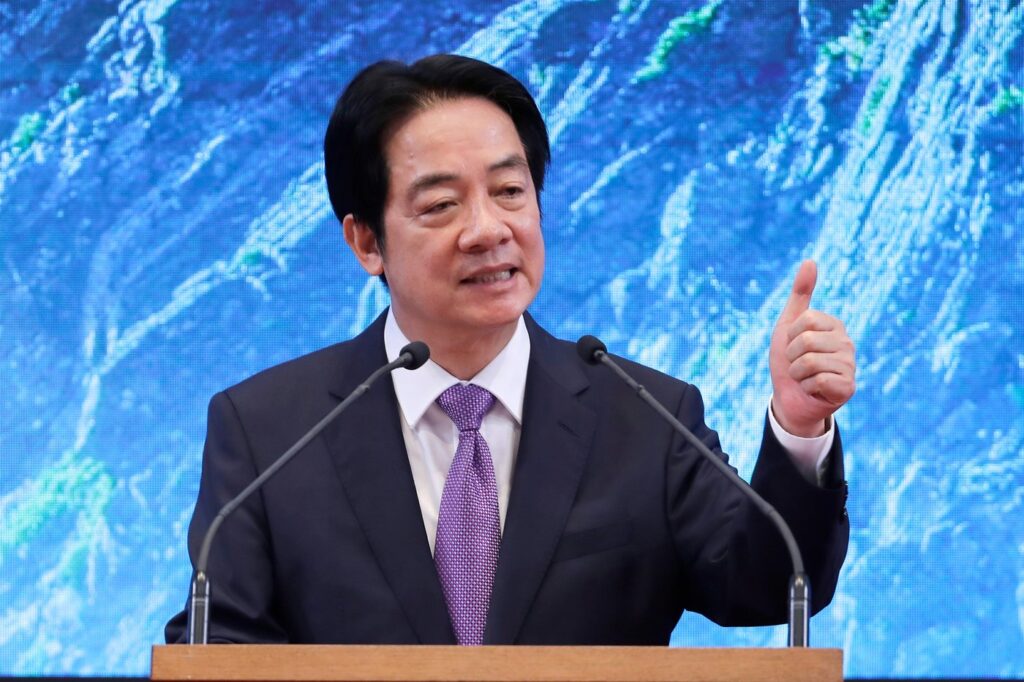
TAIPEI, Taiwan (AP) - Taiwan President Lai Ching-te, during a news briefing on Wednesday, expressed that if afforded the opportunity, he would convey to U.S. President Donald Trump the importance of continuing U.S. arms purchases for Taiwan, which he deemed essential for maintaining peace in the region. Lai asserted that the future of Taiwan should not be dictated by external influences, underscoring the importance of stability in the Taiwan Strait for global security. He characterized China as the "destroyer" of peace in the strait.
As Lai approaches the halfway mark of his presidential term, he faces increasing pressure from China, which views Taiwan as a breakaway province that must be reunified by force if necessary. Concerns have been raised regarding Trump's recent comments on Taiwan, which appear to challenge the traditional U.S. stance on support for the island despite the absence of formal diplomatic relations.
Lai emphasized that Taiwan's growing defense budget is a direct response to perceived threats, and he views arms acquisitions from the U.S. as a vital means to ensure the stability of the Taiwan Strait. He stated, "Only strength can bring peace," and firmly declared that no nation has the right to annex Taiwan. He insisted that democracy and freedom should not be misconstrued as provocations.
The president also touched on the value of collaborative efforts between Taiwan and the U.S., along with other democratic nations, to foster peace in the Taiwan Strait. This sentiment came following a strong warning from Chinese President Xi Jinping to the U.S. during a summit in Beijing, where he emphasized the significance of the "Taiwan question" in U.S.-China relations and noted potential clashes if the issue is mismanaged.
In December, Trump approved a record $11 billion arms package for Taiwan. In a recent interview on Fox News, he suggested that his approval of a new $14 billion arms package would depend on China's actions, referencing it as a "very good negotiating chip." He further remarked the need to communicate with the leader of Taiwan, refusing to specifically name Lai, whom Beijing considers a separatist figure.
During his address, Lai asserted that democracy is not something given freely and declared, "Taiwan's future cannot be decided by external forces, nor can it be hijacked by fear, division, or short-term interests." Although he refrained from explicitly naming these external forces, he communicated Taiwan's willingness to engage in constructive dialogue with China, based on principles of equality and dignity, while firmly rejecting any unification tactics masked as peace initiatives.
In a broader context beyond geopolitics, Taiwan plays a significant role as a leading manufacturer of artificial intelligence servers, computer chips, and precision instruments. The ongoing boom in AI technology has led to record-setting profits and revenues for Taiwan's top technology firms. However, experts express concerns regarding the risks associated with Taiwan's heavy dependence on the semiconductor industry, particularly if the current AI excitement leads to a market bubble.
Lai also announced plans for a $3.1 billion initiative aimed at accelerating the modernization and transformation of small and medium-sized enterprises and traditional industries, with a focus on integrating technology sectors into conventional industries.
Responding to Lai's comments, Zhu Fenglian, spokesperson for China's Taiwan Affairs Office, labeled the President's statements as filled with "lies and deception," arguing that Lai is inciting opposition and confrontation regarding Taiwanese independence. Zhu asserted that Lai is the true "destroyer of the status quo" concerning peace in the Taiwan Strait.








