

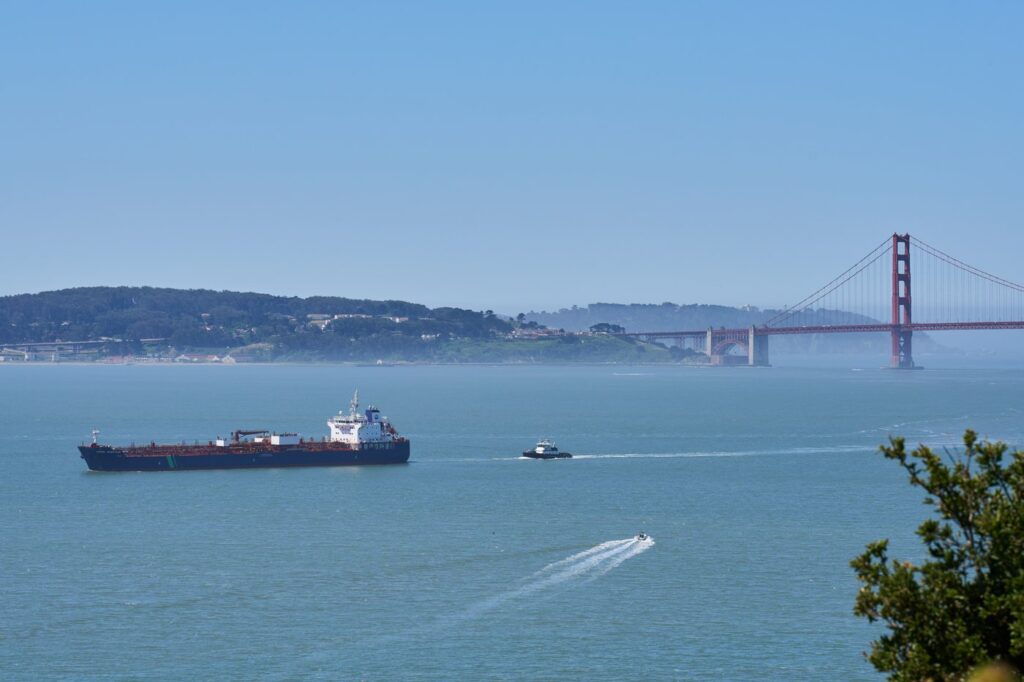
SAN FRANCISCO, Calif. (AP) - An artificial intelligence-powered detection network called WhaleSpotter has been launched to monitor whale activity in the San Francisco Bay, where increasing whale deaths, particularly among gray whales, have raised alarm. On Tuesday, ferries, cargo ships, and tankers navigated through choppy waters as a whale surfaced nearby, barely visible amidst the whitecaps. This new system alerts mariners to slow down or change their routes when whales are detected, most notably gray whales that are increasingly found within the bay.
Thomas Hall, the director of operations for San Francisco Bay Ferry, stated that the WhaleSpotter network enables adjustments to vessel routes well before they approach the whales, thus reducing the likelihood of collisions. The system not only alerts mariners but also collects valuable data over time to track where whales typically gather during their migration.
Recent years have witnessed an alarming rise in gray whale deaths, with 21 carcasses reported last year in the wider Bay Area, the highest in 25 years, and a significant portion of these attributed to ship strikes. Thus far in 2024, at least 10 gray whales have already been found dead in the Bay Area, and scientists believe these statistics likely underreport the actual numbers due to many carcasses sinking or being washed out to sea.
The gray whales typically migrate along the California coastline on a lengthy journey between breeding lagoons in Mexico and feeding grounds in the Arctic. However, many are now diverting into the congested San Francisco Bay and staying for extended periods, a phenomenon that scientists correlate with climate change. Changes in sea ice and warming temperatures are disrupting the food sources that gray whales depend on during the summer, leaving many of them malnourished during migration.
These whales are increasingly concentrated in high-traffic areas near Angel Island, Alcatraz, and Treasure Island, where ferry routes and shipping lanes intersect. Rachel Rhodes, a project scientist at the Benioff Ocean Science Laboratory, emphasized the severe risk of ship strikes in this corridor, noting that responders to whale strandings have struggled to find places to land deceased whales.
The eastern North Pacific gray whale population, once a conservation success story, has seen dwindling numbers, dropping by half in the past decade to approximately 13,000 individuals, according to the National Oceanic and Atmospheric Administration (NOAA). As conditions worsen, these whales face challenges, such as starting their exceedingly long migration while undernourished.
The WhaleSpotter system leverages thermal cameras and AI technology to offer real-time alerts to mariners. Potential whale sightings are automatically flagged, undergoing verification by trained marine mammal observers before alerts are disseminated via radio to ferry operators and vessel traffic controllers. This integration of land-based and vessel-mounted detection systems enables near-real-time relay of whale sightings to vessels navigating the bay.
Initial tests of the WhaleSpotter network produced a significant influx of detections, causing some concern among scientists. Douglas McCauley, director of the Benioff lab, expressed a mix of unease and determination: “We’re going to use that data and be smart about how we use that space and share it with the whales.” The constant monitoring offered by thermal cameras—unlike human observers—allows for wildlife detection during nighttime and foggy conditions, which are prevalent in the bay.
Currently, a thermal camera has been set up on Angel Island, with another planned for a ferry running between downtown San Francisco and Vallejo. Future expansions may include additional cameras on the Golden Gate Bridge and Alcatraz to enhance monitoring across the bay.
In addition to gray whales, humpback whales are also facing threats from warming ocean temperatures, which are reducing the typically cold, nutrient-rich waters essential for their prey, such as krill and anchovies. Consequently, humpbacks are increasingly moving closer to shore for food, where California's Dungeness crab fishery operates, leading to entanglement risks from the fishing gear used.
In light of these challenges, California has approved the commercial use of ropeless pop-up crab fishing gear, which minimizes the risk to whales while allowing continued harvests. This new technology stores gear on the seafloor, releasing it when fishermen trigger an acoustic mechanism, thus preventing entanglements.
As climate change continues to impact ocean conditions and whale migration, scientists anticipate ongoing overlap between whales, ship traffic, and fishing gear. Ongoing adaptive management strategies, driven by scientific data, will be essential to balance wildlife protection with the needs of fishermen.








