

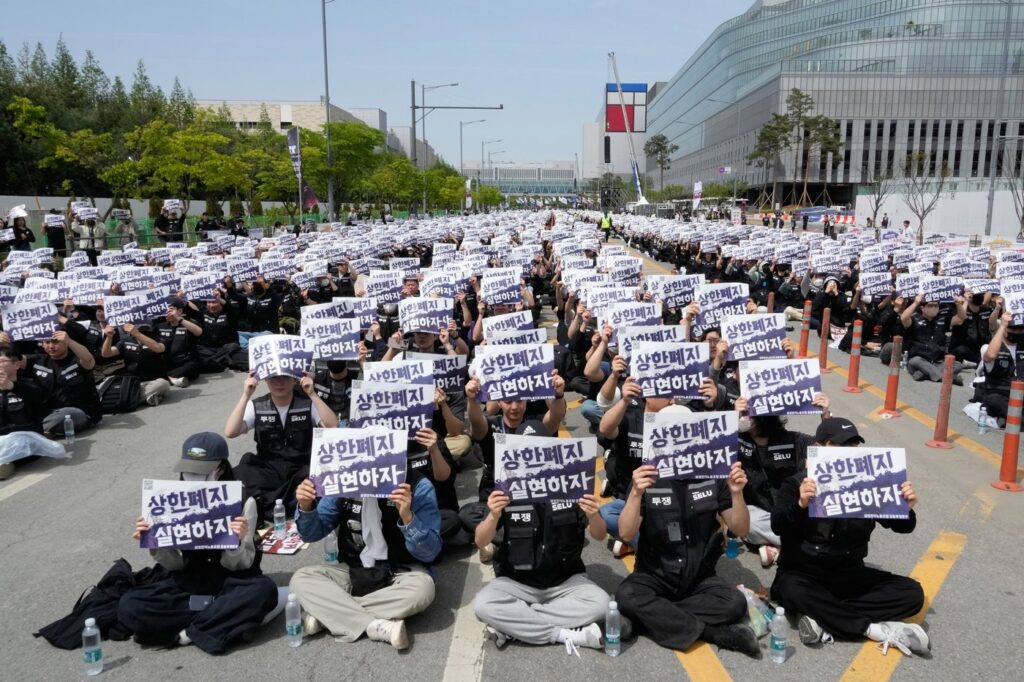
SEOUL, South Korea (AP) – Negotiations over wage increases between management and union leaders at Samsung Electronics concluded without an agreement on Wednesday, raising the likelihood of a strike that could considerably disrupt global semiconductor supplies and adversely affect South Korea's trade-dependent economy.
Government officials have issued warnings about potentially employing rarely invoked emergency powers to enforce a settlement at Samsung. The union, representing approximately 74,000 workers, claims that the company has not provided sufficient compensation despite its significant profits, driven by the ongoing global boom in artificial intelligence.
After the latest round of discussions ended in deadlock, union leader Choi Seung-ho informed reporters that workers would commence an 18-day strike starting Thursday. The tension between the two sides has escalated, with each accusing the other of contributing to the failure to finalize a deal. Choi specifically noted that management rejected a government-mediated proposal, the specifics of which he did not disclose. On the other hand, management asserted that the union’s demands for excessive compensation packages are unjustified, especially for units that are currently operating at a loss.
Although both parties have expressed a willingness to continue negotiations, it remains uncertain whether further talks will take place later on Wednesday. Samsung, known for its extensive manufacturing of smartphones, consumer electronics, and semiconductors, along with its rival SK Hynix, produces around two-thirds of the world’s memory chips. This sector is currently experiencing soaring demand due to advancements in AI technology. In a recent report, Samsung announced that its operating profit for the January-March quarter surged eightfold to a record 57.2 trillion won (approximately $38 billion).
The union has demanded a compensation model where Samsung commits to allocating 15% of its annual operating profit towards employee bonuses, alongside the elimination of existing bonus caps, which are limited to 50% of annual salaries. Management, however, argues that these requests are excessive, particularly due to the volatile nature of the semiconductor industry.
The potential strike raises concerns at the governmental level as well. Prime Minister Kim Min-seok, South Korea's No. 2 official after President Lee Jae Myung, cautioned in a televised statement that the strike could result in economic damages totaling up to 100 trillion won (around $66 billion). This would occur through disruptions to Samsung's complex semiconductor manufacturing processes.
In anticipation of the strike, a local court partially granted Samsung’s request for an injunction, stipulating that the union must maintain certain staffing levels to avert damage to facilities and materials while ensuring safe operations. The ruling from the Suwon District Court also prohibits union members from occupying key areas and offices within the company.








