

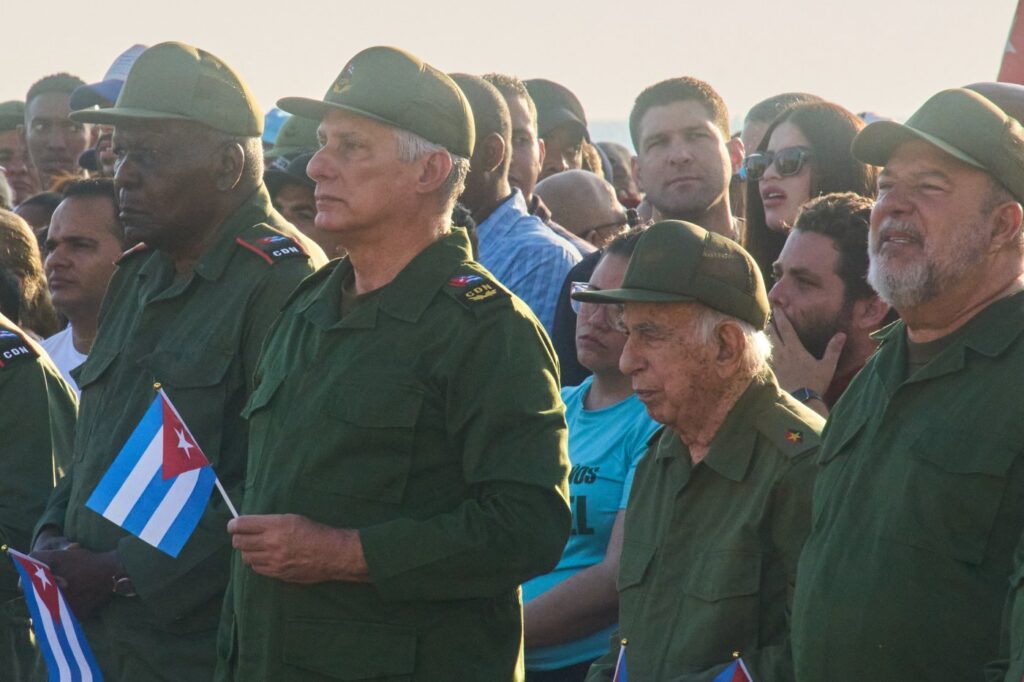
HAVANA (AP) – Raúl Castro, the former president of Cuba and a key figure in the country's revolutionary history, made his first public appearance since being indicted by the United States. The official video released on Saturday showcased Castro attending his 95th birthday celebration with top officials and military leaders at the Ministry of Interior in Havana on Friday night. This event served as an opportunity for Cuba's socialist government to unite and display resilience amid increasing pressure from the Trump administration.
During the celebration, state television aired footage of Castro, dressed in his olive-green military uniform, receiving a standing ovation as he entered a packed theater. Alongside him were his grandson, Raúl Guillermo Rodríguez, and Cuban President Miguel Diáz-Canel. Diáz-Canel offered heartfelt praise for Castro's "heroism and dignity," paying tribute to both Raúl and his late brother, Fidel Castro, who was the central figure of the Cuban revolution. He commended Raúl Castro for his bravery and loyalty, which have made him a target for enemy intelligence services from a young age.
Responding directly to threats from the Trump administration, Diáz-Canel issued a warning that there would be a "decisive and resolute battle" if the United States attempted to invade Cuba. The Cuban president emphasized national pride with the slogan, "Raúl is Raúl," which has circulated across Havana and social media since the May 20 indictment against Raúl Castro on murder charges. This rallying cry aims to foster national unity and counteract any concerns about governmental isolation. "Raúl is Cuba, and Cuba is untouchable," he declared during the ceremony.
The Friday night celebration, occurring just two days after Castro's actual birthday, highlighted his infrequent public appearances since his formal retirement from politics in April 2021. Despite his retirement, he remains a significant figure within the Cuban political landscape, believed to continue wielding considerable influence.
The indictment filed by the U.S. Department of Justice last month accuses Raúl Castro of orchestrating the 1996 shootdown of civilian aircraft operated by Miami-based exiles. This legal action stands as one of the sharpest escalations in tensions following the Trump administration's near-total cutoff of Cuba's oil supplies in January, adding to the island's ongoing challenges, which include power outages and a public health crisis.
The Trump administration has demanded several changes from Cuba's ruling socialist government: the release of political prisoners, implementation of significant economic reforms, and alterations to its governing practices to avoid designation as a national security threat. In response, Cuba maintains that it does not pose any threat to the United States.








