

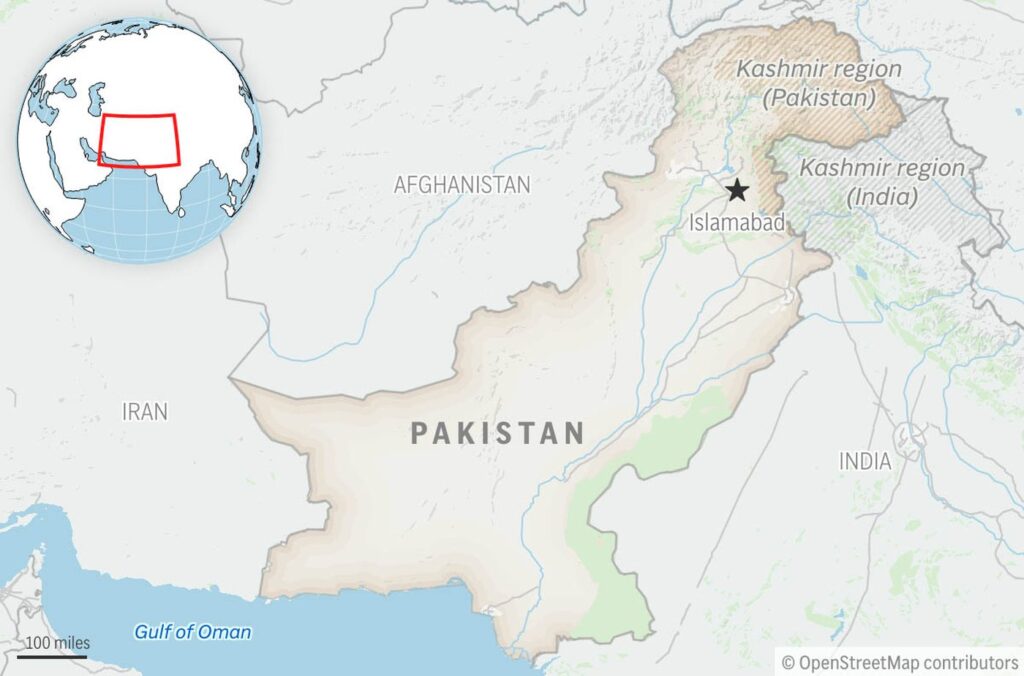
ISLAMABAD (AP) – On Saturday, police in Pakistan-administered Kashmir arrested dozens of supporters of the outlawed Joint Awami Action Committee (JAAC), a group that has recently led violent protests advocating for improved public services and enhanced rights. Witnesses reported significant police action following the regional government's crackdown on the group.
This operation came a day after the government in Muzaffarabad, the capital of Pakistan-administered Kashmir, officially banned JAAC. Authorities cited concerns over public order and security as the primary rationale for the ban. The decision followed weeks of escalating tensions between the regional government and the JAAC, which has been demanding a 38-point charter aimed at addressing various socio-economic issues, including subsidized wheat and electricity. Last year, negotiations resulted in the acceptance of 36 demands out of the 38 presented by JAAC representatives, federal officials, and local government authorities.
Faisal Mumtaz Rathore, the prime minister of Pakistan-administered Kashmir, has indicated his readiness to engage with JAAC representatives to resolve the remaining two demands. Despite this dialogue, JAAC has vowed to proceed with a planned protest march on Tuesday, reaffirming its resolve and insistence on the fulfillment of all demands. One of the two unresolved issues involves securing twelve legislative assembly seats reserved for Kashmiri refugees.
In anticipation of the protest, authorities have heightened security across the region. The Himalayan region of Kashmir is historically contentious, divided between Pakistan and India, both of which claim full sovereignty. The two nuclear-armed nations have over the decades engaged in three significant wars over the Kashmir territory since their independence from British colonial rule in 1947.
Attempts to address the grievances of Kashmiri citizens have proven difficult, often resulting in intense clashes. Just last year, protests led by the JAAC devolved into violence, leading to fatalities, including among police officers. During the recent events, JAAC alleged that police opened fire on its members, resulting in injuries to two individuals. However, Kashmir police have denied those claims, asserting that armed individuals opened fire on police officers after being signaled to halt their vehicle.
The ongoing unrest showcases the intricate and often volatile dynamics of governance and public dissent in Pakistan-administered Kashmir. The situation remains precarious as both the local government and JAAC navigate a complex landscape of political demands and public safety concerns.








