

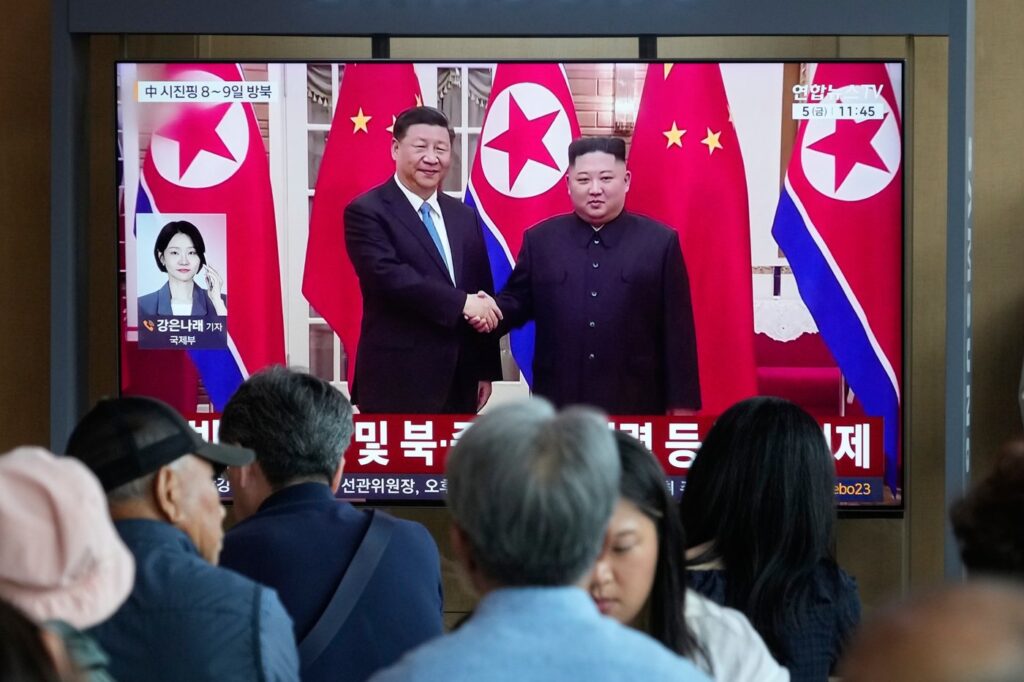
SEOUL, South Korea (AP) – In a significant diplomatic move, Chinese President Xi Jinping is set to travel to North Korea for the first time in nearly seven years. This visit aims to strengthen the ties between Xi and North Korean leader Kim Jong Un, offering North Korea a platform to assert its increasingly assertive foreign policy aligned with its traditional allies from the Cold War era.
China has long been considered North Korea's economic lifeline, and this visit will likely reaffirm its influence over a country that has been progressively turning towards Russia. The meeting marks the first interaction between Xi and Kim since Kim’s visit to Beijing in September 2025 for a World War II event.
As the two leaders prepare for this critical encounter, they each have distinct objectives. Kim Jong Un appears to be prioritizing a stronger alliance with China after increasing North Korea's military support for Russia during its invasion of Ukraine. Observers suggest that Kim is attempting to escape international isolation by promoting the idea of a "new Cold War," while positioning Pyongyang against Washington.
Historically, North Korea has maintained a policy of "equidistance" between China and Russia, leveraging its relationships with both nations to optimize its benefits. Despite the military aid received from Russia, Kim realizes that true improvements in living conditions for his citizens will necessitate economic support from China. Koh Yu-hwan, a former president of Seoul's Institute of National Unification, emphasized this necessity, stating, “It’s nearly impossible to raise living standards by mobilizing internal resources alone.”
During the upcoming meeting, discussions may revolve around the potential resumption of Chinese tourism to North Korea and the activation of an unused bridge over the Yalu River, among other joint economic development projects in border regions shared by North Korea, China, and Russia. Future dialogues with Washington are uncertain, especially after Kim’s talks with former U.S. President Donald Trump faltered in 2019 due to unresolved sanctions issues.
From Kim's perspective, fostering good relations with China may enhance security and confidence when approaching negotiations with the United States. Park Won Gon, a professor at Ewha University in Seoul, noted that having China's support could bolster North Korea’s bargaining position with Washington.
On the other hand, Xi Jinping's visit serves as an opportunity to realign North Korea back into China's strategic sphere. Xi may look to provide economic incentives and food aid similar to what China has historically extended to North Korea. Mike Chinoy, a former CNN journalist, pointed out that China appears uneasy with North Korea's closer relations with Russia, stating that part of Xi’s agenda is likely to recalibrate this balance.
This visit marks Xi’s first overseas trip in 2026, following a period of selective engagements after the pandemic. Hosting both Trump and Putin separately before this visit underscores its strategic significance. According to Seong-Hyon Lee, a senior fellow at the George H.W. Bush Foundation for U.S.-China Relations, this trip signifies that no one can alter the Korean Peninsula's security arrangements without China's approval.
Realistically, Beijing seems to be acknowledging Kim's nuclear ambitions. The absence of the term "denuclearization" from statements following Wang Yi's visit to Pyongyang in April suggests a potential shift in China’s stance, viewing North Korea as a nuclear state within its broader strategy against the United States.
In exchange for support, Xi may also seek greater access to the Tumen River's estuary and navigational rights in surrounding waters. While Kim is expected to extend a grand welcome for Xi, experts caution that China may not secure many concessions from an increasingly assertive North Korean leader.
According to Chinoy, “Kim is going to give Xi Jinping a welcome befitting a head of state, but he’s not going to adopt a submissive role.”








