

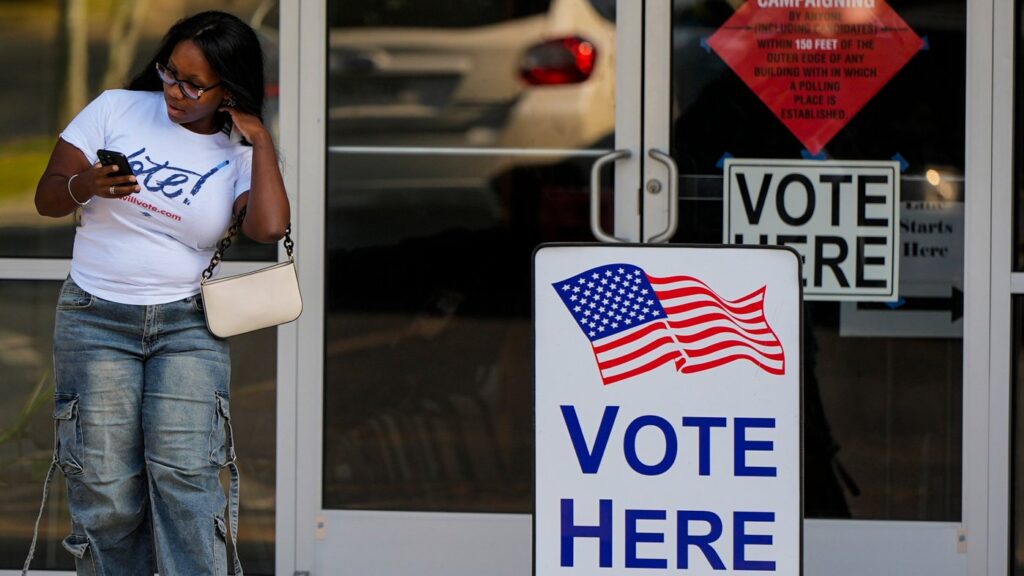
As the midterm elections approach, a significant wave of congressional redistricting is brewing, threatening to reshape representation across many critical issues, including tax policies, social safety nets, teacher wages, housing regulations, and local infrastructure repairs.
On June 17, Georgia's Republican-dominated Legislature will initiate a special session aimed at redrawing voting districts for the elections in 2028. This agenda involves not just congressional districts but also those for the state House and Senate, and potentially even for the state's utility regulatory commission.
This event marks the first attempt to redraw district lines since a recent U.S. Supreme Court ruling that weakened protections for minority voting rights. States like Mississippi and New York are also expected to undertake redistricting efforts ahead of their elections in 2027 and 2028, respectively. The question remains as to how many other legislatures will engage in mid-decade redistricting and whether this trend will extend to local jurisdictions such as county commissions, city councils, and school boards, given the potential widespread impact.
Joe Kennedy III, founder of Groundwork Project, emphasized that the stakes of these redistricting efforts are profoundly human rather than merely political.
Historically, voting district boundaries are redrawn every ten years following the U.S. census to reflect population changes. However, the urgency for redistricting surged last summer when former President Donald Trump encouraged Texas Republicans to redraw congressional maps to secure additional seats during the midterm elections. This prompted similar partisan gerrymandering across numerous states.
The Supreme Court's 6-3 ruling in late April spurred further redistricting efforts by declaring a majority-Black congressional district in Louisiana an illegal racial gerrymander. This decision provided a basis for Republicans in other states to consider reshaping districts with significant minority populations that have leaned Democratic.
In Georgia, the catalyst for redrawing districts stems from a federal judge's 2023 ruling which found certain congressional, state Senate, and state House districts to have been drawn in a racially discriminatory fashion. Following the ruling, the Legislature swiftly approved new maps to create majority-Black districts, although these changes minimally impacted Republican dominance in the upcoming 2024 elections.
Georgia Governor Brian Kemp has called the legislature into a special session to realign the districts again in response to the Supreme Court's recent decision regarding Louisiana. This session could allow Republicans to reverse the court-mandated changes implemented in 2023 and potentially alter other Democratic-leaning minority districts to their benefit.
Details of the GOP’s plans are yet to be disclosed. Nonetheless, Democratic state representative Tanya Miller, who is campaigning for attorney general, criticized the forthcoming redistricting efforts as a method of “rigging maps to maintain power.”
The stakes of this redistricting discussion are significant. A report from Fair Fight Action and Black Voters Matter indicated that Republicans in 10 Southern states could eliminate up to 191 Democratic-held legislative seats, including 140 districts possessing Black or Hispanic majorities, if the Supreme Court undermined Voting Rights Act protections for minorities. Cliff Albright, co-founder and executive director of Black Voters Matter, expressed concern, saying, “If anything, our report was an understatement. What’s at stake is the future of this democracy.”
While some analysts agree that the Supreme Court's decision will have repercussions, they do not uniformly anticipate such a drastic redistricting of seats. Kareem Crayton from the Brennan Center for Justice pointed out the potential for aggressive redistricting efforts across all levels of governance, particularly targeting maps that have previously provided better representation for communities of color.
A number of states have pending court cases regarding redistricting, with a recent Supreme Court decision impacting several ongoing cases. In Alabama, for instance, a federal appeals court has granted approval for the state to utilize a Senate map endorsed by Republican lawmakers rather than one dictated by a federal judge, which found that Black residents' voting power had been diluted. Furthermore, the Supreme Court is revisiting legislative redistricting cases involving Black voters in Mississippi and Native Americans in North Dakota, with a particular focus on aligning these cases with the Louisiana ruling.
Despite these developments, about half of the states possess constitutional provisions that restrict mid-decade redistricting of state legislative seats, as indicated by Justin Levitt, a law professor at Loyola Marymount University. In states that allow it, the incentive for lawmakers to redraw districts may not be strong, given that most state legislative chambers are predominantly controlled by a single party.
Simultaneously, local governments might also consider redistricting initiatives. The current Supreme Court decision has already influenced local jurisdictions; for instance, legal challenges to districting in Meriwether County, Georgia, have been dismissed while others in Mississippi are proceeding in light of the recent ruling. Despite the opportunity presented, local offices often operate under a nonpartisan basis, which may deter rapid redistricting as officials navigate the implications of such decisions.








