

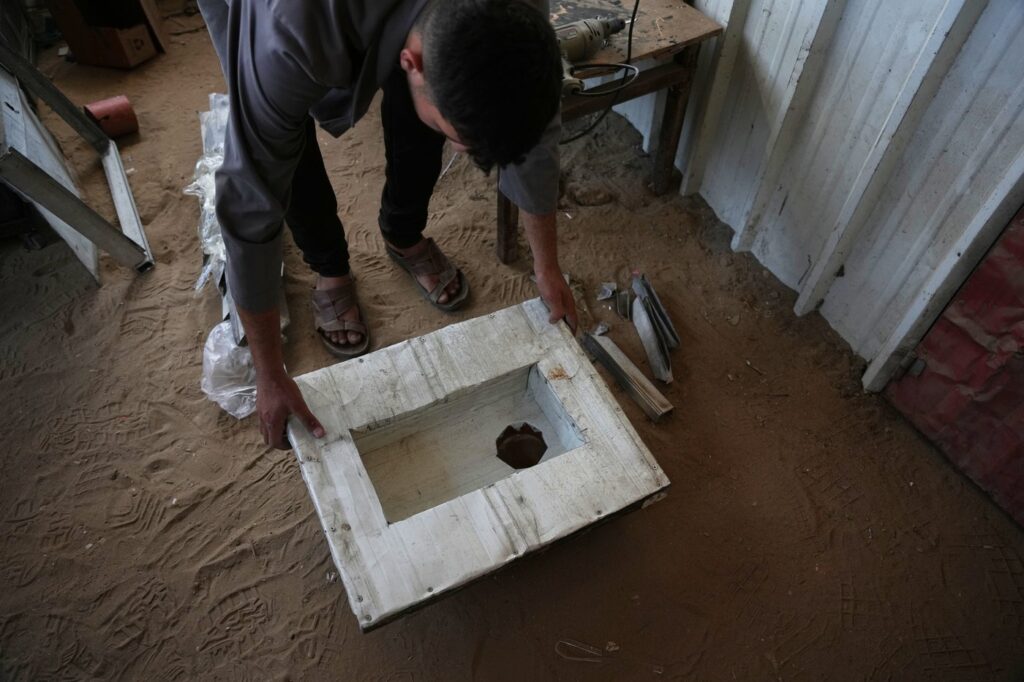
Khan Younis, Gaza Strip (AP) — In a makeshift tent in southern Gaza, Mostafa Shaaban has created a private toilet for his family, built behind a curtain in a corner. He dug a shallow pit in the sandy ground, poured a concrete slab around it, and placed a bottomless bucket over the hole before adding a battered plastic toilet seat. Despite the foul odor and the presence of flies and mosquitoes only a few feet away from where they sleep and prepare meals, Shaaban feels that having this private toilet is better than the communal latrines used by hundreds of others in the sprawling camp.
“I did not want the kids and my wife to use any public toilet. It is humiliating,” said the 38-year-old Shaaban, who was displaced from his home city of Rafah by Israeli forces two years ago and has settled in a tent camp in Khan Younis. He acknowledges that the situation is “revolting,” but he values the dignity of having a private toilet for his family.
The dire sanitation situation across the vast tent cities housing the majority of Gaza's 1.7 million displaced Palestinians continues to deteriorate. Displaced families have resorted to constructing their own latrines, many of which are shared among extended families. Long lines form at communal camp toilets, where men, women, and children must relieve themselves behind flimsy dividers, and women often feel unsafe using these facilities at night.
As a result, a major public health crisis looms over the camps as repugnant odors waft through the tightly packed tents and pools of sewage gather from leaking cesspits or improper disposal of waste. Reports indicate that more than 80% of Gaza’s sewage pumping stations have collapsed following ongoing bombardments over the past 2.5 years.
Although some aid organizations have attempted to improve sanitation by enhancing family toilets, these efforts have been modest and resources are severely limited. The timeline for reconstruction in Gaza remains uncertain, with ongoing tensions complicating recovery efforts.
The U.S.-backed official responsible for the ceasefire established since October claims that Hamas is obstructing development by refusing to agree on disarmament terms. The ceasefire agreement allows for significant construction and repair equipment to enter Gaza, yet deliveries to date have been scarce.
Iman Mansour, Shaaban’s wife, who is pregnant with their third child, expressed frustration about their toilet situation. “It’s the most basic right. Making a toilet is more important than food and water, because you see the insects everywhere, and the smell covers everyone. We want something clean,” she said.
Building a proper latrine can be costly, and Shaaban explained that setting up his toilet took time and money to procure the necessary materials like pipes and concrete, which often deteriorate and need replacement. The price for a porcelain toilet seat ranges from 1,700 to 2,000 shekels ($500 to $680), a luxury out of reach for most families. Consequently, people have devised makeshift solutions using chairs or buckets, or simply squatting over the holes.
In Khan Younis, vendors offer some relief by creating metal sheets designed to improve the cleanliness of latrines, priced at 100 shekels ($34). However, these options are limited. Khaled Kollab, another resident of one of the Khan Younis camps, shared his struggles to maintain hygiene near his tent. His simple latrine lacking a seat was constructed from whatever materials he could afford. His 3-year-old daughter, Sila, displayed skin lesions potentially linked to the unsanitary conditions they face.
Kollab articulated a universal sentiment among the displaced: “You go into this toilet and feel humiliation and shame.”








