

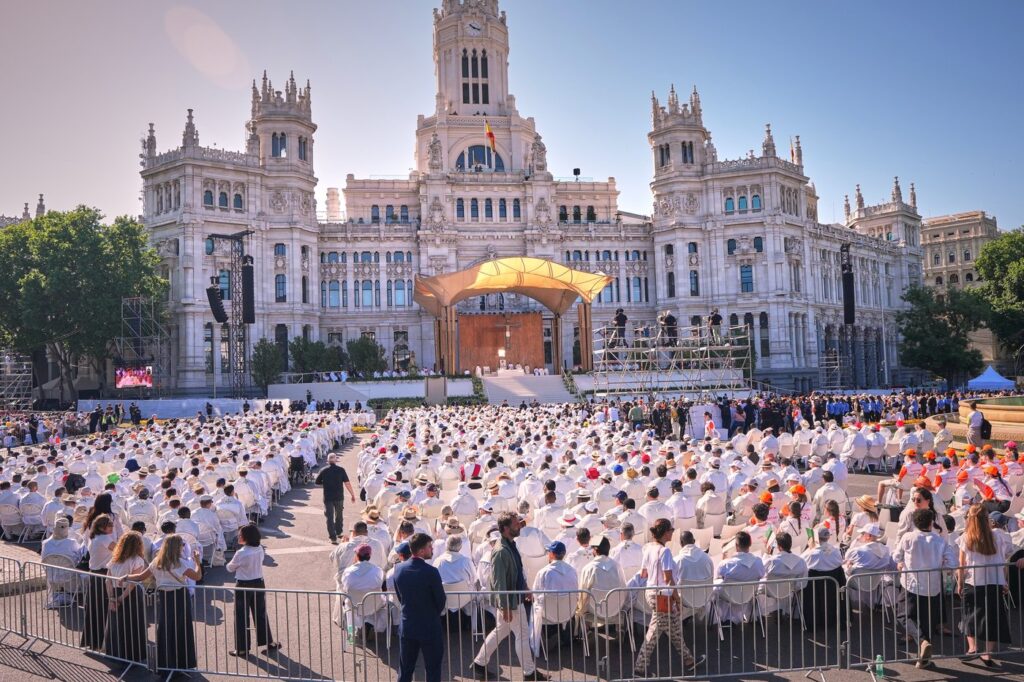
MADRID (AP) - Pope Leo XIV celebrated Spain’s rich tradition of religious devotion on Sunday, referring to it as a “school of faith” for contemporary society as he led a Mass attended by approximately one million people in Madrid. The occasion also featured a procession showcasing the vibrant cultural practice of flower carpets, a significant expression of Spanish popular piety.
The atmosphere was electric as the crowd cheered and chanted, “This is the youth of the pope!” upon Leo’s arrival at Plaza de Cibeles, marking the first papal visit to Spain in 15 years. In his popemobile, he navigated through the plaza and the adjacent streets, greeting the throngs of devotees eager to witness the historic event.
This particular Mass coincided with the Catholic feast day of Corpus Domini, which customarily includes processions led by priests carrying the Eucharist. In Spain, such processions are characterized by the magnificent floral carpets created along the route, a tradition that resonates deeply within predominantly Catholic communities.
Local organizers reported that 16 elaborate flower carpets, representing a half-kilometer (approximately one mile) route from Plaza Cibeles, were crafted by a florists association from Galicia. Over 30,000 flowers, primarily in the yellow and white colors of the Holy See flag, were utilized to create carpets adorned with symbols like the keys of the Holy See.
Pope Leo XIV, who arrived in Spain on Saturday for a weeklong visit, emphasized the importance of the long-standing tradition of Corpus Domini processions in his homily. He remarked that the floral carpets symbolize the “spiritual sentiments of this country” and reflect the altars raised in the streets. “This is not an exhibition or a mere display of beauty,” he declared. “It is a profession of faith in the presence of the risen Lord, who is alive and continues to walk among us.”
He further asserted that the ongoing participation in such devotional practices reveals what Spain can and ought to represent on the global stage. “Herein lies the task of Spain today and in the future: to ensure that the religiosity which has shaped and defined this country for centuries is not a museum of the past to be visited, but a school of faith from which to draw even today,” he stated.
A vigil service held the previous night drew an estimated 600,000 young Spaniards, many of whom knelt in silent prayer alongside the Pope, indicating a robust interest in spiritual matters despite the secular trends in contemporary Spanish society. Pope Leo encouraged attendees to consider vocations to the priesthood, religious life, or other church services.
Notably, a young couple, Irati Valda and Javier Hormazal, received the Pope’s blessing during the vigil as they announced their impending marriage. Valda expressed her amazement at the turnout, noting the significance of witnessing so many young people united in prayer during such a historic event.
Local coordinators reported that over 1.2 million people participated in the Mass and accompanying procession on Sunday, underscoring the enduring popularity of religious events in Spain. The tradition of creating flower carpets, which dates back over two centuries, is celebrated in many Latin American countries and is a recognized cultural heritage. In fact, Poland's tradition of Corpus Domini flower carpets has already received recognition from UNESCO, and efforts are underway in Galicia to achieve similar recognition.
Religious processions, pilgrimages, and feasts remain immensely popular throughout various Spanish regions. The most notable among them is the Holy Week processions, where brotherhoods and penitents parade ornate statues of Christ and the Virgin Mary, attracting both faithful followers and numerous tourists. Additionally, many towns honor their patron saints with lively festivals, showcasing a vibrant blend of piety and communal celebration.
During his visit, Pope Leo XIV also called on the Spanish people to move past polarization and work towards unity within society. In the subsequent days, he is set to privately meet with members of his Augustinian religious order and address cultural leaders as part of his significant weeklong engagement in Spain.








