

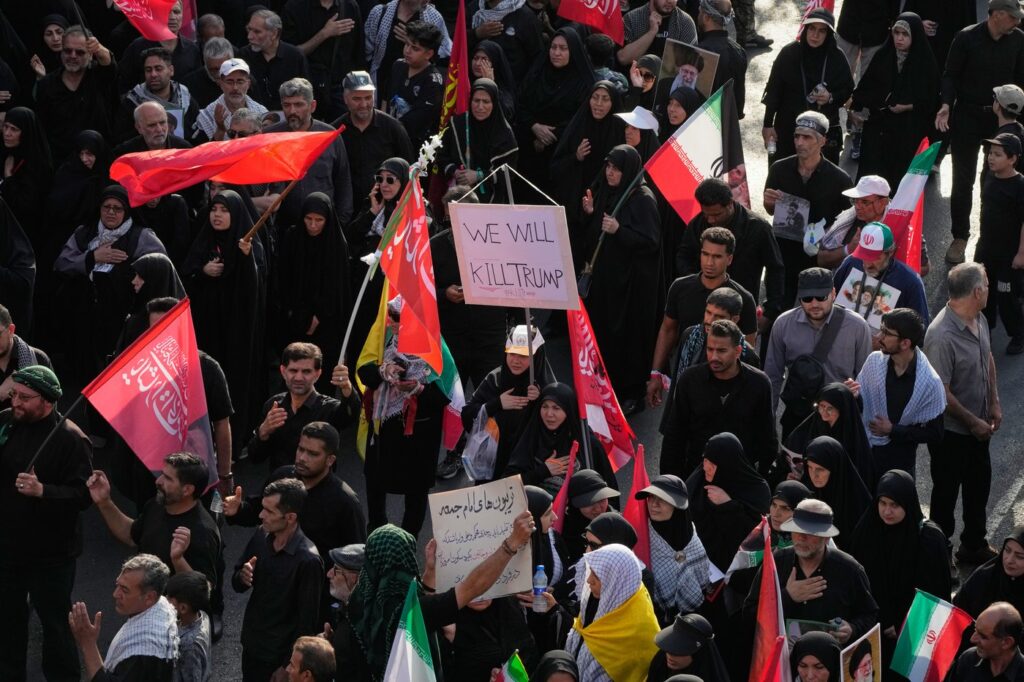
In a recent statement, President Donald Trump suggested that he has left standing orders for the U.S. military to respond to threats from Iran with unprecedented levels of force, particularly if they proceed with plans to assassinate him. Despite these assertions, the U.S. lacks a mechanism akin to a "dead man's switch" that would enable automatic military retaliation in the event of a president's death.
Under existing protocols, the transfer of power would default to Vice President JD Vance, who would assume command and hold authority over any military responses. Should such a tragic event occur, Vance would be within his rights to decide on a course of action, which may or may not align with Trump’s pre-existing orders.
Garrett M. Graff, an expert on U.S. continuity of government plans, indicated that the U.S. has never implemented an automatic retaliation system. There are extensive procedures in place for continuity in case of catastrophic events, but these protocols do not allow for immediate strikes solely based on the death of a president, regardless of prior directives.
Recently, Trump took to social media to declare that Iran had threatened to assassinate him, adding that "1,000 missiles are Locked and Loaded" aimed at Iran, with the potential for more to follow if they act on their threats. The escalating tensions were underscored by remarks from Iran's Supreme Leader Mojtaba Khamenei, who vowed that retaliation for his father's death—following U.S. and Israeli actions—would be enforced. Khamenei declared that vengeance was both a national desire and a certainty.
The White House has not publicly commented on the implications of Trump's military orders should he be killed. During recent funeral observances for Khamenei, many mourners expressed their sentiments about Trump in hostile terms, with calls for violence against him prominently displayed.
Concerns regarding credible threats to Trump have been prevalent, as it was reported that Israel informed U.S. officials about Iranian plots to target him. Trump's comments during a recent NATO summit suggested he acknowledges these threats, declaring, "They want to take out the U.S. leader—me." Sabrina Singh, a former Pentagon press secretary, emphasized that credible threats against senior U.S. leadership must be taken seriously.
Trump has endured threats on his life previously, including two domestic assassination attempts during the 2024 presidential campaign. Recently, he also faced a potential assassination incident at a public event. These complications raise significant security concerns, exemplified by his recent use of an older Air Force One jet that lacks advanced missile detection technology present in newer versions.
As the U.S. and Iran continue exchanging military strikes, the broader context remains tumultuous. Graff noted that while Trump might have given standing orders, they hold legal ambiguities, as the vice president would retain nuclear launch authority upon the president's death. The existing command structure necessitates that any action taken would need to come from Vance, who has the discretion to act differently than his predecessor.
The Biden administration has similarly warned Iran against any attacks on U.S. citizens, stressing severe consequences if such actions occurred. Historical precedents indicate that threats against Trump have prompted strong warnings from U.S. officials, underscoring the volatility of the relationship between the U.S. and Iran.








