

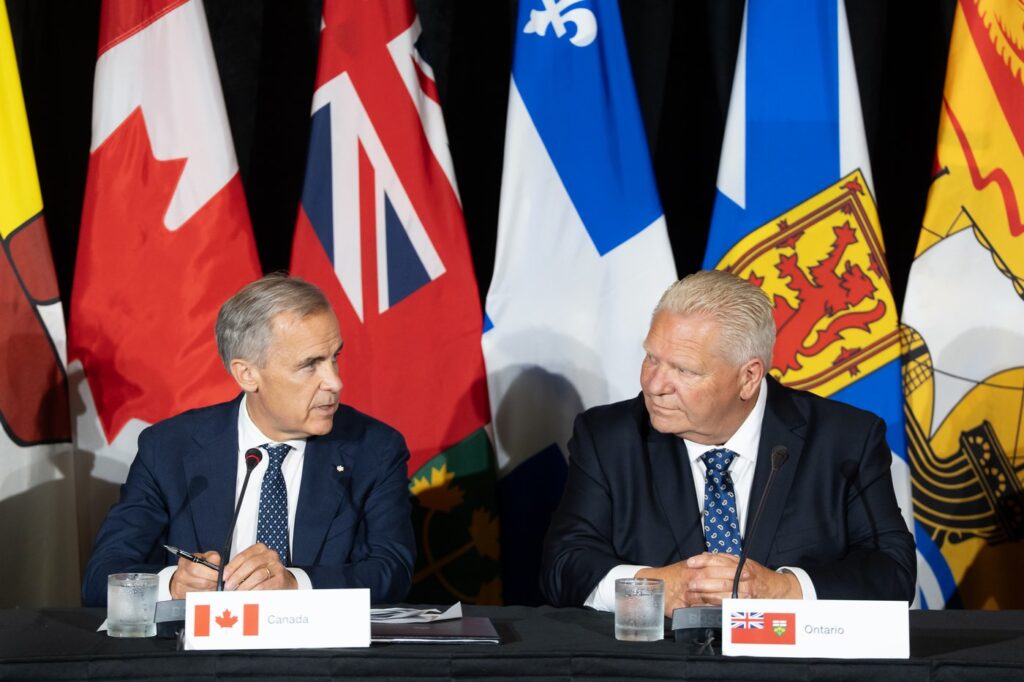
On Saturday, Canadian leaders faced the harsh reality of a trade war with the United States after Prime Minister Mark Carney's discussions with the U.S. government broke down. In response, U.S. President Donald Trump announced the imposition of new 50 percent tariffs on billions of dollars in Canadian exports, marking a significant escalation in trade tensions.
Reflecting on the situation, Prime Minister Carney expressed his determination to respond by implementing matching tariffs on U.S. goods starting next month. These retaliatory measures will predominantly affect vital sectors including steel, dairy, appliances, agricultural equipment, pulp and paper, and electronics. Carney characterized the U.S. proposals as a "bad deal," citing unacceptable terms that aimed to limit Canada's trade agreements with other nations and impose restrictions on the protection of the French language.
Ontario Premier Doug Ford, who had previously remained silent during the tense trade negotiations, commended Carney's decision to withdraw from the U.S. trade talks, asserting that President Trump is not a trustworthy negotiating partner. Ford likened Trump's behavior to that of a bully, stating, "President Trump is the type of person that would steal your lunch money the first day." He urged provincial premiers to unite as "Team Canada" to confront the challenges posed by the trade war.
During the unfolding crisis, Carney acknowledged the gravity of the situation, confirming that Canada is indeed in a trade war with the U.S. "You’re at war when you get attacked," he stated, emphasizing the need for strong national resolve in the face of adversity.
Alberta Premier Danielle Smith expressed concern over the potential impact of retaliatory tariffs, emphasizing that such measures would not benefit Canadian farmers who would face inflated prices on essential agricultural equipment. Meanwhile, Quebec Premier Christine Fréchette noted that the new tariffs would significantly impact her province, affecting $7.7 billion worth of goods, including aluminum, steel, lumber, and more, and announced plans to introduce support programs for affected businesses.
Premier Susan Holt of New Brunswick encouraged residents to prioritize supporting local businesses, highlighting the adverse effects the unjustified tariffs would have on the province's economy and workers. Other provincial leaders echoed similar sentiments on social media, extending their support to Carney's stance against the U.S. and calling for unity among the provinces.
Premier Tim Houston of Nova Scotia remarked on the shift in the relationship between Canada and the U.S., stating, "It’s clear that we cannot trust or rely on the United States as we once did." This sentiment was reflected by Newfoundland and Labrador's Premier Tony Wakeham, who assured full support for Carney's approach. British Columbia Premier David Eby reinforced the need for a continued fight against unjust tariffs, asserting that Canadian politeness should not be mistaken for weakness.
Amid this turmoil, Carney was scheduled to meet with provincial premiers on Saturday, following a virtual cabinet meeting. The newly imposed U.S. tariffs target an estimated $28 billion of Canadian goods, affecting a wide range of products from hockey sticks and honey to essential oils and dairy products, as U.S. Trade Representative Jamieson Greer laid the blame for the failed negotiations on Canada.
Furthermore, Carney announced that the retaliatory tariffs targeting U.S. goods would take effect on September 8, the day after Canada celebrates Labour Day. Details regarding the sectors affected by these countermeasures and the supports available for impacted industries are expected to be unveiled in the coming days.








