

BANGKOK (AP) – The International Monetary Fund (IMF) announced on Tuesday a slight upgrade to its economic forecasts for the global economy for 2023, noting increasing risks linked to rising debt levels and a financial surge surrounding artificial intelligence (AI). The IMF now anticipates that the global economy will expand by 3.1% this year, a slight increase from the previous estimate of 3.0% made in July. This growth expectation remains considerably lower than the anticipated 3.5% expansion for 2025, with a projected rebound to 3.4% growth by 2027, outlined in its latest Economic Outlook report.
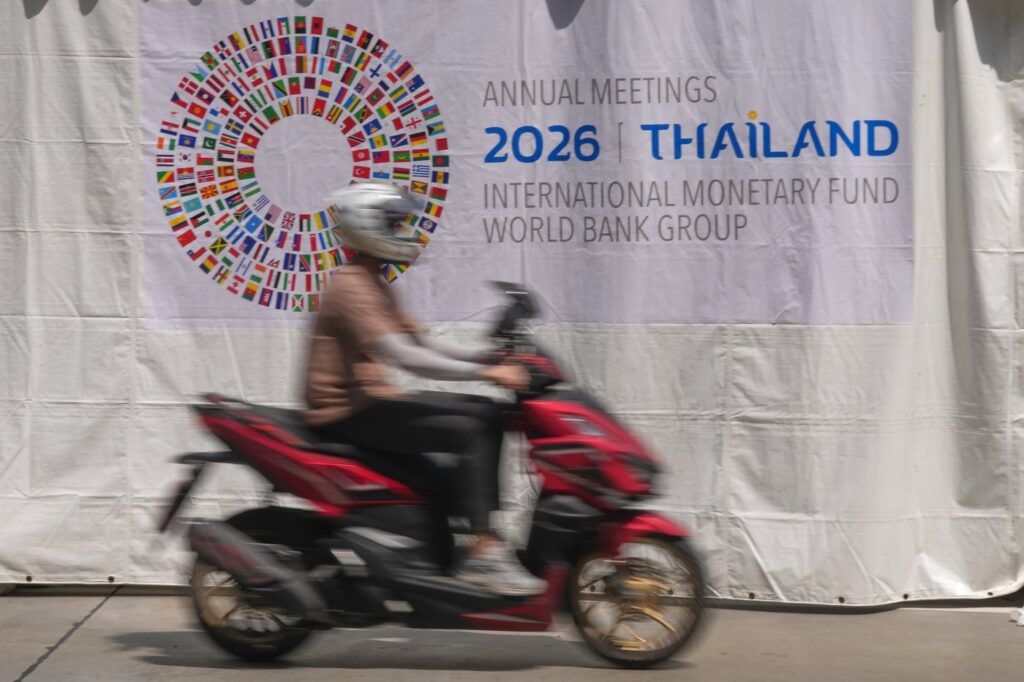
The updated forecasts were released during a gathering of world economic and financial leaders in Bangkok for the fall meetings of the IMF and the World Bank. The report anticipates that U.S. economic growth will hold steady at 2.3% for the years 2026 and 2027. Advanced economies collectively are predicted to grow by 2.1% this year, a modest increase from 2.0% for 2025. However, growth is expected to decelerate to 1.9% in the following year.
Key assumptions behind these forecasts include a nearly 41% increase in oil prices this year, averaging $96 per barrel, and expectations of global inflation peaking at 4.7% in 2026 before tapering to 4.1% in 2027. Additionally, the IMF assumes that vital oil and gas shipments through the Strait of Hormuz will recommence by March, while also predicting a moderation in the explosive demand for AI technologies.
While the surge in artificial intelligence is helping to offset some of the detrimental effects stemming from skyrocketing oil and gas prices, IMF economists caution that this growth is not evenly distributed. Significant benefits from AI, such as the demand for computer chips and related equipment, are concentrated primarily in the U.S. and China, which together account for over three-quarters of net demand. According to Silvana Tenreyro, the IMF’s director of research, “The outlook is highly uneven.”
The report highlights that global growth dynamics are increasingly concentrated, with just 32 countries now accounting for 95% of global economic growth, compared to 54 countries previously noted in April. This indicates a shift in growth allocation, influenced by countries' varying exposure to disruptions caused by the Iran conflict and the strength of AI-induced demand.
Athanasios Vamvakidis, deputy director at the IMF's Monetary and Capital Markets Department, underlined various emerging risks, including potential stock market corrections related to AI developments and rising bond yields. He pointed out that cyber threats pose additional risks that could destabilize financial systems. Recently, AI-related stock sell-offs were observed in Asia, with South Korea’s Kospi index plummeting as much as 7% before concluding the day down 5.5%.
The impact of AI on employment is another pressing concern. Kristalina Georgieva, the IMF Managing Director, characterized the employment effects as a “slow-moving tsunami,” estimating that about 40% of jobs may be affected—either augmented, downgraded, or eliminated entirely. Evidence of job impact is already becoming apparent.
The IMF emphasized the importance of countries enhancing their national finances and managing debt levels, especially given current high borrowing costs. Countries that are somewhat insulated from the energy shocks tied to geopolitical tensions and are benefiting from rapid AI adoption are managing to maintain growth. However, developing economies and emerging markets that are more vulnerable to rising oil and gas costs are anticipated to see growth slow to 3.7% this year, down from 4.5% in 2025, with a forecast of regaining momentum to 4.4% growth next year.
The economic outlook is particularly bleak for regions such as the Middle East and Central Asia, where economies are projected to contract this year before experiencing a recovery with a 6.3% growth rate by 2027. In contrast, the 21 European countries utilizing the euro are expected to achieve minimal growth of just 1.1% this year, rising slightly to 1.2% by 2027.
China, ranked as the world’s second-largest economy, is set to grow by 4.5% this year, a decrease from the government’s official target of 5% in 2025. Meanwhile, India is projected to retain its status as the fastest-growing major economy, advancing at a pace of 7%, albeit down from a robust 7.7% last year.
The IMF, a 191-nation lending organization, focuses on fostering economic growth, ensuring financial stability, and alleviating global poverty. During the meetings in Bangkok, finance ministers and central bank governors will evaluate the current state of the world economy and deliberate on strategies aimed at promoting financial stability and sustained economic growth.








