

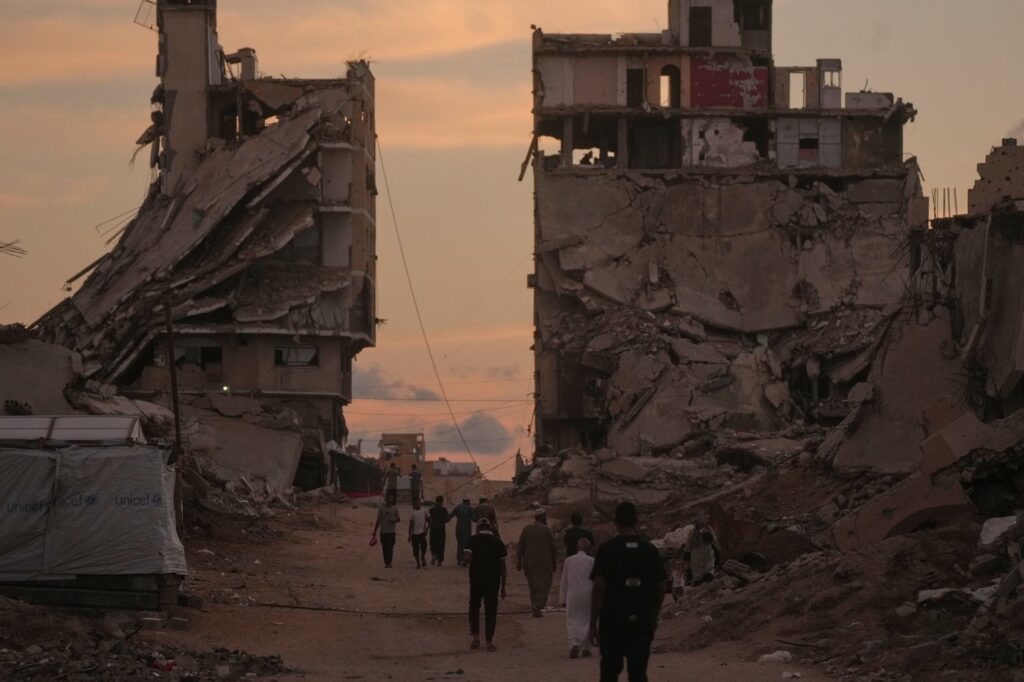
OTTAWA An Edmonton mother, Salomy Abusalim, struggles to provide reasonable answers to her 10-year-old son, Rashid, about why his father remains trapped in Gaza. Abusalim describes the emotional turmoil of being a mother in this situation, stating, “This is killing me as a mom. I can’t keep going on, lying to him.” Her husband, Saed, has been unable to escape Gaza due to bureaucratic hurdles and dire conditions, including a lack of food. “For three months he didn’t have food at all. Imagine I’m staying here, eating at my table, my son eating my food and my other half — he can’t find a piece of bread just to eat,” she expressed, emphasizing the devastating reality of their separation.
The family’s plight reflects the broader humanitarian crisis in Gaza that has escalated over three years, following a violent attack by Hamas on Israel. In retaliation, Israel has conducted military operations that have resulted in over 75,000 casualties in Gaza, while also escalating tensions in southern Lebanon and the West Bank. Many Canadians with connections to the region report ongoing horror stories from relatives caught in the turmoil, raising concerns over the staggering loss of civilian life.
Abusalim mentioned the anxiety that accompanies a loss of communication with her husband, particularly when the internet goes down. The uncertainty leaves her haunted, pondering whether he has been shot, leading to continuous nightmares. “It’s a lot of scenarios in your mind, and it’s not stopping. It’s happening every day,” she lamented.
Salomy Abusalim, who moved to Canada in 2018, has encountered significant delays in her husband's immigration process. Although she and Rashid have obtained Canadian citizenship, Saed's application for permanent residency was postponed, initially due to the COVID-19 pandemic. He had been scheduled to complete necessary biometrics on October 10, 2023, just days before the latest outbreak of violence. Currently, despite a nominal ceasefire, civilians in Gaza continue to suffer, with dozens still being killed each month.
Abusalim revealed that her husband was listed among Canadians approved to leave Gaza through Egypt in January 2024, but Egyptian officials have denied him entry and requested bribes. While Saed's visa application remains active, Ottawa has refused to process it without completion of biometrics that cannot be conducted in Gaza. This situation reflects a larger systemic issue affecting hundreds who seek to leave the territory for Canada.
In a desperate bid to express their frustration, Rashid has threatened to go on a hunger strike, which led his mother to undertake a water-only fast herself. “It’s been eight years since my son held his dad, or smelled him and hugged him. As a mom, I don’t think any mom wants to go through any of this with her son or daughter,” she said, voicing a universal sentiment against the ongoing violence.
In Quebec, Sylvie Labrecque mourns her son, Jacob Flickinger, an aid worker killed in an Israeli airstrike in April 2024. She shared, “Every day he’s there in my heart, in my mind, and I do pray and meditate, thinking of him.” Flickinger had been participating in humanitarian efforts when he and several others were killed due to Israeli strikes aimed at restricting aid to the territory. Labrecque criticized Israel’s military actions, noting the lack of accountability, as a military prosecutor deemed an investigation unnecessary regarding the attack that killed her son and six other aid workers.
Labrecque urged the Canadian government to take a stronger stance against such injustices, expressing skepticism over whether Israel would change its conduct. “They’ve been killing already tens of thousands of people. So, to kill a few more is kind of nothing to them,” she remarked, emphasizing the tragic normalization of violence in the region.
Amidst the broader conflict, Hassan Haidar, a Windsor resident, was reportedly killed at a family farm in southern Lebanon by what his family claims was an unprovoked Israeli drone strike. In light of these civilian casualties, Haidar’s brother Mohamed criticized the world’s indifference to such violence, stating, “I don’t want his blood to run cold for no reason.” This sentiment highlights a growing concern over accountability and the need for international response in the face of escalating violence against civilians.








