

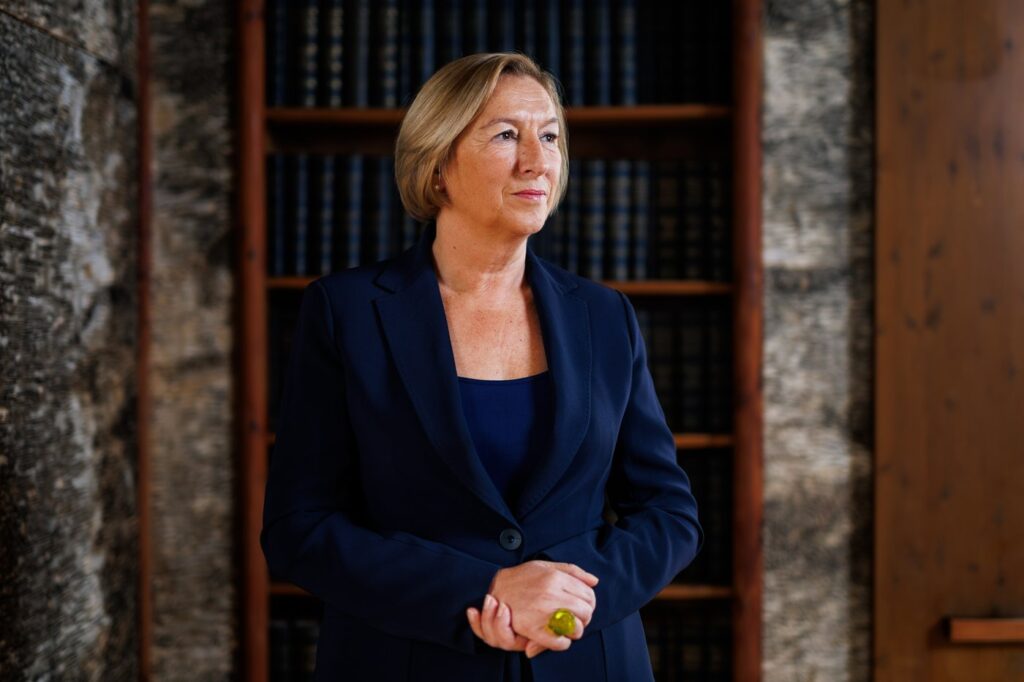
OTTAWA – France's newly appointed ambassador to Canada, Hélène Farnaud-Defromont, has expressed her country's willingness to cooperate more closely with Canada on defense procurement. This comes amidst France's ongoing initiative for Europe to cultivate a fully autonomous arms industry.
In a recent interview conducted in French, Farnaud-Defromont emphasized the importance of advocating for a European preference in procurement within the defense sector and other strategic areas. “The ideal for us would be to achieve 100 per cent European content, but we are being realistic. We know we are all going to need a bit of time to reach that goal,” she stated.
Farnaud-Defromont highlighted France's unique position within the European Union, noting that it is currently the only member state to have preserved a comprehensive defense industrial and technological base. She mentioned that France has valuable ideas to share that could bolster Canada’s defense capabilities through collaboration and knowledge exchange.
In February 2026, Canada made history by becoming the first non-European partner in the EU’s joint defense projects loan program called Security Action for Europe (SAFE). So far, however, only one contract has been established under this program for Canada. SAFE allows EU member states to obtain low-interest loans for the acquisition of military equipment and weapons, as part of a broader initiative known as ReArm Europe, which aims to decrease the continent's reliance on American military supplies.
Farnaud-Defromont remarked on the significance of Canada's participation in SAFE, asserting, “I think that’s a very good thing. We now need to see things come to fruition. We need this partnership to actually take shape.” She did not provide insights regarding how Canada's deep connections with American defense companies might influence its role in the SAFE program.
She observed that 65 percent of the components used in France’s defense acquisitions are sourced from Europe— a standard the EU seeks to implement for projects under the SAFE initiative. This highlights France's commitment to European defense integration rather than reliance on external markets.
Farnaud-Defromont also shared her perspective on public sentiment in France regarding the ongoing war in Ukraine, noting that many French people are "extremely concerned and worried" about the war's implications for freedom across Europe. She expressed appreciation for Canada’s strong support for Ukraine, acknowledging the significance of such solidarity across the continent amidst what she described as “an all-out war on European soil” following Russia’s invasion of Ukraine. “The front line is just a few hundred kilometers from Paris. It is not that far away,” she stated.
The ambassador discussed France’s ongoing efforts to seek peace through multilateralism, despite the numerous armed conflicts that extend beyond localized borders, including significant situations in the Middle East. “The international order has been profoundly disrupted,” Farnaud-Defromont remarked, reflecting on her 32 years as a diplomat and emphasizing how the current geopolitical climate has drastically transformed from what it once was.
Despite France being a founding member of NATO, it has historically maintained a level of autonomy, notably withdrawing from NATO’s command structure during much of the Cold War. Farnaud-Defromont noted that France has long advocated for a European security framework, aligning with the EU's strategic independence while sometimes conflicting with American dominance. This approach intensified following U.S. President Donald Trump’s controversial remarks regarding Greenland, which raised concerns in Europe.
Farnaud-Defromont stated, “We have long been committed to developing, within the European Union and NATO, a European pillar… We are by no means pleased with the situation within NATO, which is, to say the least, very confused.”
Kerry Buck, a former Canadian ambassador to NATO, has cautioned that if NATO were to shift its focus towards European defense, it could diminish Canada’s security. She highlighted Canada’s historical reluctance to establish an EU defense pillar due to fears of being marginalized and concerns over the EU competing with NATO in strategic decision-making.
This report encapsulates the significant dialogue and evolving defense relationships between Canada and France in the face of emerging global challenges.








