

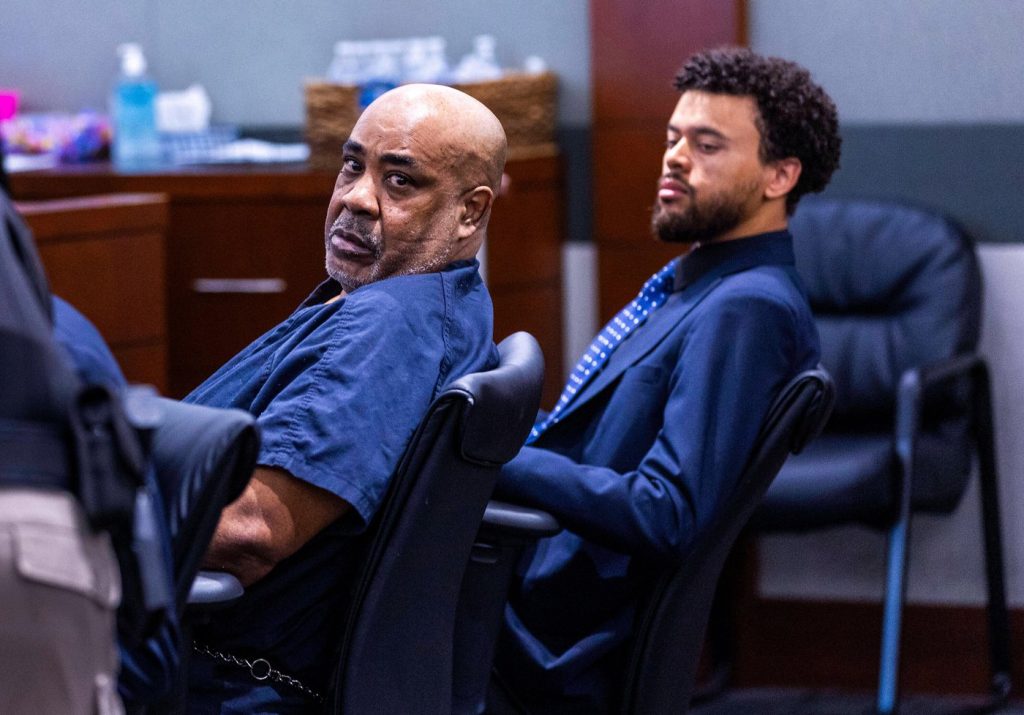
LAS VEGAS (AP) – The legal representatives of Duane “Keffe D” Davis, who is accused of murdering iconic rapper Tupac Shakur in 1996, are contesting the legality of evidence obtained through what they describe as an “unlawful nighttime search.” The defense attorneys, Robert Draskovich and William Brown, filed a motion this week arguing that a judge's decision to issue a nighttime search warrant was based on a “misleading portrait” portraying Davis as a dangerous drug dealer. Such warrants, they assert, should only be executed under exceptional circumstances where there is a risk of evidence disappearing if police were to wait until daylight.
The defense claims that Davis, a former gang leader from Southern California, had distanced himself from a life of crime in 2008 and was engaged in inspection work for oil refineries at the time of the search. They describe him as a 60-year-old retired cancer survivor, who lived with his wife in Henderson, a city located outside of Las Vegas, for nine years prior to the warrant execution. According to the motion, the court was not informed of these relevant details, which led to a flawed factual conclusion that justified the nighttime search.
The Las Vegas Metropolitan Police Department, which conducted the search and subsequently collected Davis's electronic devices, “purported marijuana,” and an array of photographs, opted not to comment on the matter, citing ongoing litigation. At the time of the search, police rationale for executing the warrant under the cover of darkness included the tactical advantage of surrounding and securing the residence. They stated that if Davis had attempted to barricade himself inside, the darkness would help facilitate evacuating neighboring homes with minimal exposure to the residents.
Davis was apprehended in September 2023 and has pleaded not guilty to first-degree murder, seeking release shortly after his arrest. His defense attorneys claim that Davis’s potential arrest stemmed from inaccurate public claims in which he suggested he was in the white Cadillac from which Shakur was shot. They argue that while he claimed to be present at the scene, he has never provided concrete details to substantiate this assertion. Instead, they contend he has used these claims for personal gain, including avoiding drug charges through a proffer agreement and profiting from his story in documentaries and a 2019 book.
The legal battle has also reached the Nevada Supreme Court, where Davis sought to have the murder charges dismissed; however, his petition was denied in November. His attorneys argue that the sensational nature of Shakur's murder, often likened to the entertainment world's version of the JFK assassination, creates a context where individuals like Davis might fabricate narratives to place themselves at the center of such high-profile events for personal advantage.
This ongoing legal situation emphasizes the complexities surrounding the case and the interactions of law enforcement, the judicial system, and personal narratives in criminal proceedings. As the defense continues to challenge the legitimacy of the evidence gathered against Davis, the case remains in the public eye, highlighting the enduring mystery and intrigue surrounding the unsolved murder of Tupac Shakur.








