

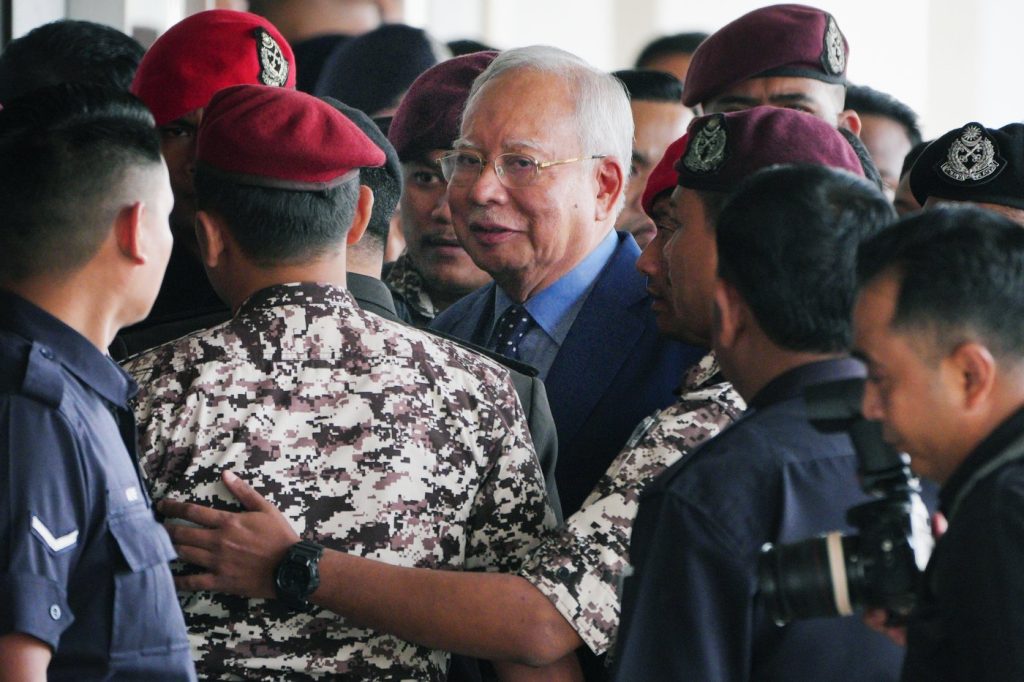
PUTRAJAYA, Malaysia (AP) – On Friday, former Malaysian Prime Minister Najib Razak was convicted by the nation’s High Court in a significant corruption trial related to the embezzlement of billions from the 1MDB state investment fund. Najib, 72, was found guilty on four counts of abuse of power and 21 counts of money laundering involving over $700 million that was channeled into his personal bank accounts from the 1MDB fund.
Najib's defense team was anticipated to present mitigation arguments before sentencing on the same day. Throughout the trial, Najib denied any wrongdoing, claiming the funds were a political donation from Saudi Arabia and asserted that he was misled by rogue financiers led by Low Taek Jho, who remains at large and is regarded as the mastermind behind the scandal.
Justice Collin Lawrence Sequerah dismissed Najib's assertion of a Saudi donation, labeling it “incapable of belief.” The judge cited evidence indicating that four letters supposedly from the Saudi donor were forged and clarified that the funds were traced back to 1MDB. Sequerah also rejected defense arguments claiming Najib was simply a victim, emphasizing the deep connection between Najib and Low, who acted as a “proxy, conduit, intermediary, and facilitator” for Najib concerning the 1MDB scandal.
The judge pointed out that Najib did not verify the origins of the substantial funds nor did he take action against Low. Rather, he utilized the money despite its dubious origins and sought to safeguard his position by dismissing key figures investigating the case, including the then-attorney general and the head of the anti-corruption agency. “The accused was no country bumpkin,” Sequerah stated, firmly rejecting any portrayal of Najib as unaware of the malfeasance happening around him.
This ruling marks a pivotal moment in one of the largest financial scandals in history, which has had repercussions in global markets and instigated investigations in the United States and other countries. Dressed in a blue suit, Najib appeared composed during the proceedings and was seen jotting notes periodically.
Najib served as Malaysia's prime minister from 2009 until 2018 and is currently incarcerated following his conviction in a previous case connected to the 1MDB scandal, which contributed to the downfall of his government in 2018. In 2020, he was sentenced to 12 years in prison for abuse of power, criminal breach of trust, and money laundering involving approximately 42 million ringgit (about $10.3 million) that was funneled into his accounts from SRC International, a former 1MDB subsidiary. His sentencing began in August 2022 after he lost a final appeal, making him Malaysia's first former leader to be imprisoned. A subsequent ruling by the Pardons Board in 2024 reduced his sentence and fine significantly.
The 1MDB fund, which Najib established shortly after taking office, was officially managed as a state development fund. During the period between 2009 and 2014, it was reported that more than $4.5 billion was misappropriated from the fund by top executives and associates of Najib, laundering the money through various countries, including the U.S., Singapore, and Switzerland. The U.S. Justice Department indicated that the stolen funds were used to finance lavish purchases, including Hollywood films, luxury yachts, hotels, artworks, and jewelry. The then-U.S. Attorney General Jeff Sessions described the scandal as “kleptocracy at its worst.”
The reverberations of the scandal have also affected major financial institutions, with Goldman Sachs facing substantial penalties for its involvement in raising funds for 1MDB. Najib, stemming from a prominent political lineage, had long seemed beyond reach of prosecution until public outrage regarding the 1MDB scandal culminated in the electoral defeat of his party in 2018, ending its longstanding rule since Malaysia's independence in 1957.
Earlier in the week, Najib's attempt to serve his corruption sentence under house arrest was thwarted when Malaysia's High Court ruled that a royal order for home confinement from the former king was invalid, as it did not adhere to constitutional requirements. Najib’s legal team indicated their intention to appeal this decision. Following a reduction in his sentence, Najib, initially expected to be released in August 2028, now faces a lengthened prison term.
Najib's wife, Rosmah Mansor, was also sentenced in 2022 to a decade in prison along with a hefty fine for her involvement in a separate graft case, although she has been released on bail pending her appeal.








