

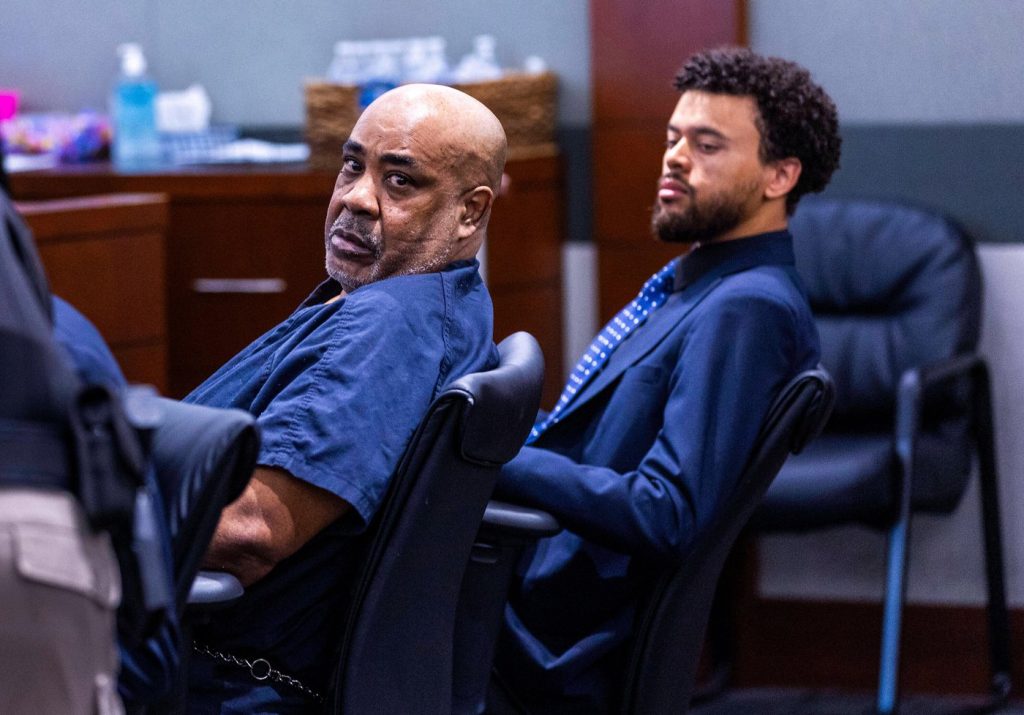
LAS VEGAS (AP) – The legal team representing Duane “Keffe D” Davis, the man charged with the 1996 murder of rap icon Tupac Shakur, has filed a motion to suppress evidence obtained during what they describe as an “unlawful nighttime search.” This motion was submitted by Davis’ attorneys, Robert Draskovich and William Brown, asserting that the search warrant execution, carried out during the night, did not meet the necessary legal standards.
The attorneys argue that the judge authorized the nighttime search based on a “misleading portrait” of Davis, portraying him as a dangerous drug dealer. They maintain that nighttime searches are only justifiable under exceptional circumstances, such as when there is a threat of evidence being destroyed if officers delay until morning. They assert that the judge was not informed of Davis’s true circumstances, which include his retirement from the narcotics trade in 2008 and his subsequent career in inspection work within oil refineries.
Davis, now a 60-year-old retired cancer survivor, had been living a stable life with his wife in Henderson, a city located just outside of Las Vegas, for nine years at the time the warrant was executed. His attorneys highlight that Davis has adult children and grandchildren, and they argue that the judge’s decision to authorize a nighttime search was based on distorted and erroneous information. This led to a factual determination that did not accurately reflect Davis’s current life situation.
The Las Vegas Metropolitan Police Department conducted the search, during which they collected electronic devices, what they referred to as “purported marijuana,” and tubs of photographs from Davis’s residence. The police have declined to provide comments regarding the case, citing the ongoing litigation. However, their justification for executing the warrant during nighttime was to secure the residence and manage the potential risk posed by Davis barricading himself, allowing for safer evacuation of nearby homes.
Davis was arrested in September 2023 and has pleaded not guilty to first-degree murder. His attorneys claim that his arrest is rooted in his public statements in which he asserted being present in the white Cadillac from which Shakur was shot. They argue that he has failed to provide reliable evidence to substantiat his claims and that he may have exploited these claims for personal gain, such as avoiding drug charges and profiting from his story in documentaries and his published book in 2019.
Furthermore, Davis previously sought to have his murder charges dismissed by the Nevada Supreme Court; however, his petition was denied in November. His attorneys elaborated that “Shakur’s murder was essentially the entertainment world’s JFK assassination—endlessly dissected, mythologized, monetized,” suggesting that this media attention may have led individuals like Davis to position themselves at the center of the narrative for financial motives.
The unfolding legal arguments surrounding the evidence obtained during the search, combined with the broader implications of Davis’s claims regarding Tupac Shakur’s murder, continue to capture public interest as the case progresses through the courts.








