

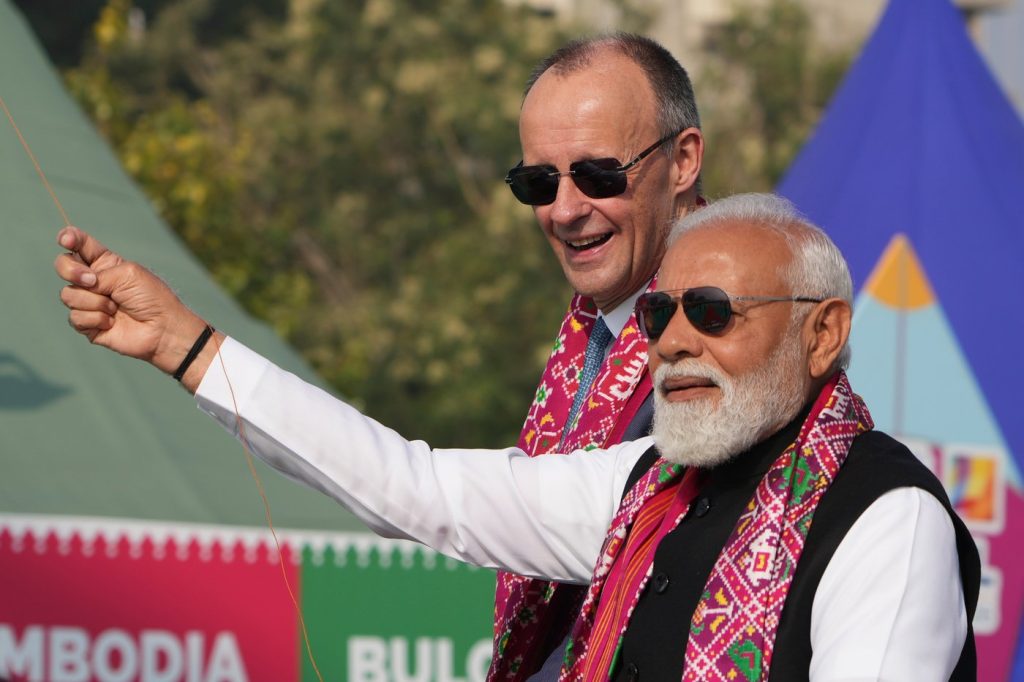
NEW DELHI (AP) — On Monday, Indian Prime Minister Narendra Modi and German Chancellor Friedrich Merz convened in Gandhinagar, located in the western state of Gujarat, to foster closer economic and security relationships between India and Germany, Europe’s largest economy. The leaders held discussions aimed at enhancing collaboration in several sectors amid a broader strategy to reduce reliance on China.
During their talks, Modi emphasized Germany's significant role as India’s primary trading partner within the European Union. Both leaders expressed their commitment to expanding bilateral ties, particularly in areas such as climate action, energy, and the mining of rare earth elements. They also finalized a strategic roadmap designed to strengthen cooperation between their defense industries, focusing on joint development and production initiatives.
Modi stated, “We want to elevate the relations between India and Germany to an even higher level.” This sentiment reflects the intent to bolster defense ties, an area where Germany has traditionally had less engagement with India. Notably, Thyssenkrupp, a German industrial giant, is expected to collaborate with Indian firms to construct six advanced conventional submarines in India, part of New Delhi’s ongoing efforts to enhance its naval capabilities.
Chancellor Merz stated that there exists a "tremendous economic potential" between India and Germany. He underscored the importance of strengthening ties in the domain of security policy and defense cooperation, asserting that “India is a desired partner, a partner of choice for Germany.” Furthermore, he advocated for concluding negotiations on a free trade agreement between India and the EU to fully unlock the potential economic collaboration between the two nations.
As a part of their discussions, the two sides also inked an agreement facilitating Indian professionals’ entry into Germany's healthcare sector, thereby enhancing workforce exchange between the nations.
Chancellor Merz, making his first visit to an Asian country since assuming office last year, arrived in India ahead of a scheduled India-EU summit later this month, where leaders aim to advance discussions on a long-delayed free trade agreement. This move is part of India's broader strategy to deepen economic linkages with Europe, particularly in light of substantial U.S. tariff rates which can reach up to 50%.
During his visit, Merz also took time to tour the Sabarmati Ashram, the former residence of independence leader Mahatma Gandhi, and attended the International Kite Festival at the Sabarmati riverfront, where he and Modi engaged in flying kites, showcasing cultural ties between the nations.
Merz is accompanied by a significant business delegation and is scheduled to proceed to Bengaluru, where he will meet with business and technology leaders from both India and Germany. This visit symbolizes the evolving landscape of international relations, emphasizing collaboration and partnership aimed at mutual growth.








