

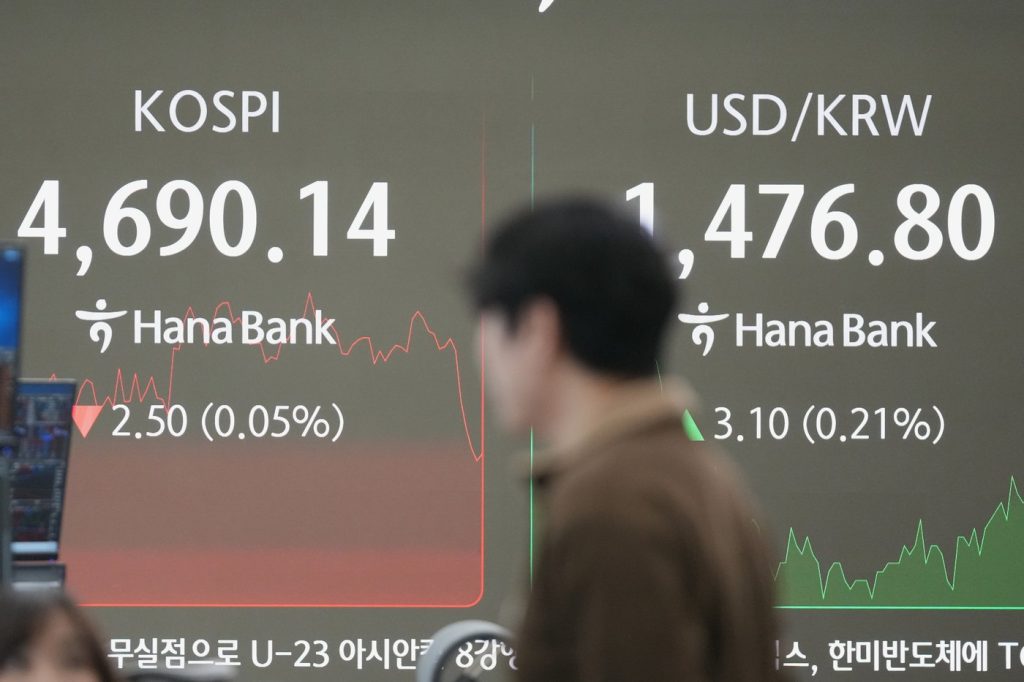
Asian shares showed a mixed performance on Wednesday, following a pullback in Wall Street from its recent record highs and amid growing political uncertainty in various regions, including Iran. In early trading, Australia's S&P/ASX 200 slipped by 0.1% to 8,798.80, while Japan's benchmark Nikkei 225 surged by 1.6% to 54,413.92, fueled by speculation that Prime Minister Sanae Takaichi might soon call for general elections.
On Tuesday, Takaichi met with South Korean President Lee Jae Myung, where both leaders committed to collaborate on pressing economic and security issues. However, South Korea's Kospi index fell by 0.1% to 4,687.32 during the same trading session. In contrast, the Hang Seng index in Hong Kong added nearly 0.8% to reach 27,055.14, while the Shanghai Composite experienced a 1.2% increase, climbing to 4,187.14.
In a significant political move, President Donald Trump announced a 25% tax on imports into the United States from countries that engage in business with Iran. The situation in Iran has been dire, with the death toll from recent protests reportedly exceeding 2,500, according to activists.
On Wall Street, the S&P 500 experienced a decline of 0.2% from its all-time high set the previous day, primarily following mixed earnings reports from several U.S. companies. The Dow Jones Industrial Average dropped by 398 points (0.8%) from its record, while the Nasdaq composite registered a slight decline of 0.1%.
Investors are closely watching U.S. companies as pressure mounts to deliver strong profit growth to validate the recent escalations in stock prices. Analysts project that corporations within the S&P 500 will report earnings per share in the last quarter of 2025 that are 8.3% higher compared to the previous year, according to FactSet.
JPMorgan Chase began the earnings reporting season with disappointing profit and revenue figures that fell short of analysts' expectations. As a result, its stock price fell by 4.2%, making it one of the biggest drags on the market. This shortfall may have arisen because some analysts failed to adjust their forecasts to account for the earnings impact tied to the bank's acquisition of the Apple Card credit card portfolio. Despite the results, CEO Jamie Dimon expressed optimism about the U.S. economy, asserting that "consumers continue to spend, and businesses generally remain healthy."
In another notable development, Delta Air Lines shares fell by 2.4% even though it delivered a stronger profit than expected; however, the company's revenue fell short of Wall Street's projections, and its profit forecast for 2026 did not meet expectations.
On a more positive note for Wall Street, several healthcare firms increased their financial forecasts during an industry conference, driving up their stock prices. Moderna, for example, posted a significant gain of 17.1% after announcing that it anticipates reporting revenue for 2025 above the midpoint of its previous November forecast. The company also provided updates on various products, including a seasonal flu vaccine that could see potential approvals later this year.
As a result, the S&P 500 closed down by 13.53 points at 6,963.74, while the Dow Jones Industrial Average fell by 398.21 points, closing at 49,191.99. The Nasdaq composite experienced a decline of 24.03 points, ending at 23,709.87.
In the bond market, Treasury yields eased after a much-anticipated update on inflation closely aligned with economists' predictions. This data reinforced expectations that the Federal Reserve will likely reduce its main interest rate at least twice in 2026 to support job market stability. Lower interest rates could make borrowing cheaper for U.S. households, enhancing investment prices, yet they could also exacerbate inflation risks. The recent report indicated that U.S. consumers faced a 2.7% increase in prices for gasoline, food, and other living costs compared to one year prior, slightly above economists' expectations and exceeding the Fed's target inflation rate of 2%.
The data led to the 10-year Treasury yield easing to 4.17% from 4.19% late Monday, while the two-year Treasury yield, which more closely tracks Fed expectations, fell to 3.52% from 3.54%.
A day prior, Treasury yields had fluctuated amid concerns over the Federal Reserve’s ongoing tensions with Trump, raising worries that the President's criticisms could make the central bank more compliant to the White House, a scenario that experts say could lead to long-term higher inflation.
In energy trading, benchmark U.S. crude oil prices dipped by 18 cents to $60.97 per barrel, while Brent crude, the international standard, lost 15 cents, ending at $65.32 per barrel.
In currency trading, the U.S. dollar inched up to 159.16 yen from 159.13 yen. Meanwhile, the euro remained relatively stable, priced at $1.1645, slightly down from $1.1647.








