

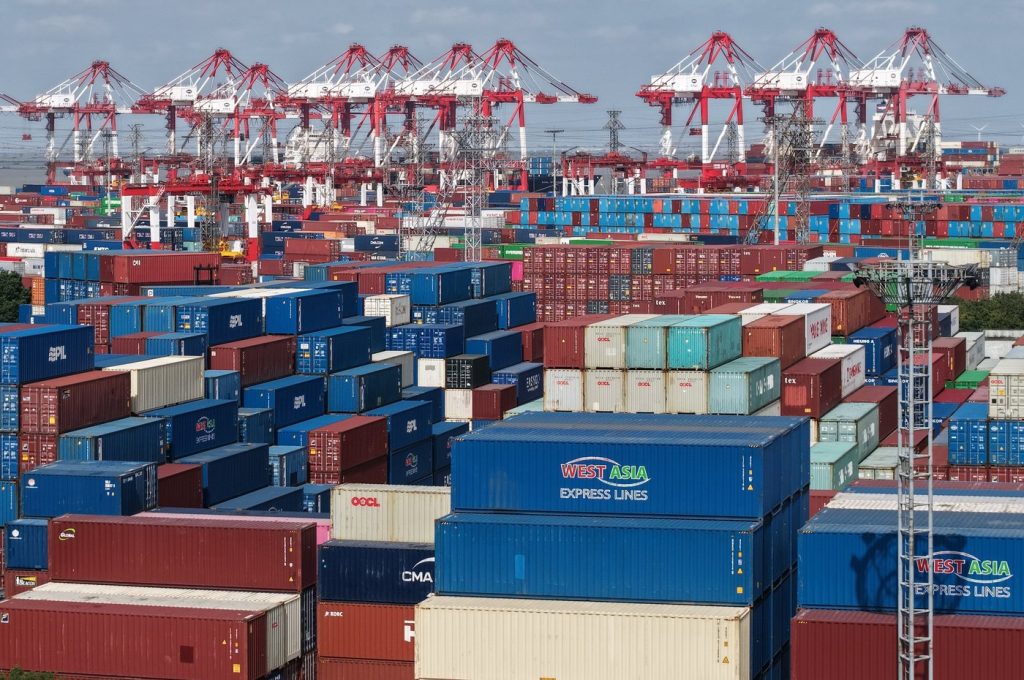
HONG KONG (AP) — In a notable economic development, China has reported a record trade surplus of nearly $1.2 trillion for the year 2025. This significant increase is largely attributed to an uptick in exports to various countries, which has compensated for a marked decline in shipments to the United States.
According to customs data, China's total exports rose by 5.5% over the entire year, reaching $3.77 trillion, while imports remained stagnant at $2.58 trillion. This trade performance contrasts sharply with the previous year's surplus, which stood at $992 billion for 2024. The growth in exports highlights the resilience of China's economy, especially amidst global trade tensions.
In December 2025 alone, exports climbed 6.6% compared to the same month the previous year, surpassing economists' forecasts and exceeding a 5.9% increase witnessed in November. The data also indicated that imports grew by 5.7% year-on-year in December, a significant improvement from the 1.9% growth noted in November.
Looking ahead, economists are optimistic that exports will continue to play a vital role in supporting China's economy. Jacqueline Rong, the chief China economist at BNP Paribas, expressed confidence, stating, "We continue to expect exports to act as a big growth driver in 2026."
However, the trade landscape for China has shifted, particularly with decreased exports to the U.S. This trend has been attributed to the escalated trade war initiated by President Donald Trump upon his return to office. Despite these challenges, China has successfully offset the decline in U.S. shipments by increasing exports to other markets, including regions in South America, Southeast Asia, Africa, and Europe.
The robust export performance has been a crucial factor in maintaining China's economy, which is growing at an annual rate close to the official target of approximately 5%. Yet, this rising trade surplus has raised concerns in other countries that fear an influx of inexpensive Chinese imports could adversely affect local industries.
In response to these economic dynamics, the International Monetary Fund's head recently called for China to address its economic imbalances and accelerate the transition away from a reliance on exports. There is an urgent need for China to enhance domestic demand and investment to foster sustainable growth moving forward.
Moreover, the ongoing downturn in the property market has been a significant weight on consumer confidence and domestic demand. The government's crackdown on excessive borrowing has led to defaults by various developers, which has further complicated the consumer landscape.
Looking to the future, Gary Ng, a senior economist at French investment bank Natixis, projects that China's exports will grow by approximately 3% in 2026. This anticipated growth is slightly lower than the 5% increase recorded in 2025. Despite the potential slowdown, he expects the trade surplus to remain above the $1 trillion mark in the coming year.
As global economic conditions continue to evolve, the trajectory of China's exports and overall economic performance will be crucial not only for itself but also for the wider international community navigating through these complex trade dynamics.








