

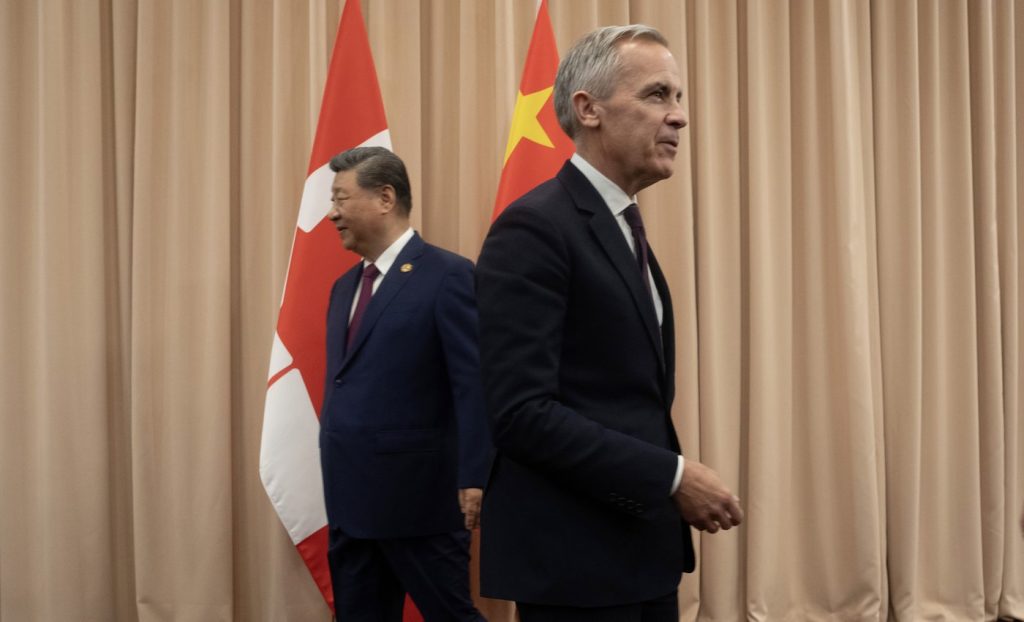
OTTAWA – Prime Minister Mark Carney is en route to Beijing for a pivotal visit aimed at improving Canada-China relations, which have been strained in recent years. This diplomatic engagement is part of Canada’s broader strategy to increase non-U.S. trade with China by 2035. Vina Nadjibulla, vice-president of the Asia Pacific Foundation, noted that while there may not be a singular descriptor for the relationship, it is essential that public messaging acknowledges the complexities involved.
Carney's itinerary includes meetings with senior Communist Party leaders on Thursday, culminating in a meeting with President Xi Jinping and a business banquet on Friday. This marks the first visit by a Canadian prime minister to Beijing in eight years and is significant as it follows the detainment of two Canadians for nearly three years in 2019, a response to the arrest of a Chinese tech executive in Canada on a U.S. extradition warrant.
The visit also comes against a backdrop of serious issues, including allegations of Chinese electoral interference, growing human rights concerns regarding the Uyghur minority, restrictions on free speech in Hong Kong, and military actions by China to expand its territorial claims. In 2022, the Canadian government characterized China as a “disruptive global power” that does not align with Canadian values. However, Carney's administration has since redefined China as a strategic partner, advising Liberal MPs to depart a Taiwan visit early to avoid confusion over Canada’s stance on the self-governing island.
Dylan Loh, a professor at Nanyang Technological University in Singapore specializing in China’s foreign policy, emphasized that Beijing is interested in fostering better diplomatic relations globally, especially in light of the challenges posed by Washington's aggressive foreign policy. He noted that China is also contending with considerable domestic issues, including high youth unemployment and a troubled property market. Loh anticipates that Carney and Xi will likely sign “low-hanging-fruit agreements” and hint at resetting bilateral relations, albeit at a potential cost to Canada’s stance on pertinent issues.
According to Loh, China is eager for Canada to acknowledge the rift in diplomatic ties and is looking for signs of reconciliation in private discussions without compromising public stances. He emphasized that the normalization of economic relations would require Canada to adopt a less confrontational stance toward Beijing's interests.
Carney plans to promote trade and environmental cooperation with China while excluding Beijing from sectors that may threaten Canadian national security or involve the Arctic region. While China's typical approach does not favor compartmentalizing relationships, it has shown readiness to engage in limited interactions with Canada's allies, such as the European Union.
There is potential for movement in the energy sector, with discussions surrounding increased exports of Canadian oil and gas to China, possibly extending to clean energy collaborations. Nadjibulla cautioned, however, that Canada must be vigilant against any attempts by China to use this visit as propaganda for its narrative of responsible global leadership, particularly in contrast to the United States.
Furthermore, Nadjibulla pointed out that any actions taken by Canada will be closely scrutinized by Washington, especially considering ongoing negotiations regarding the North American trade agreement. The implications of Carney’s visit extend beyond Canada-China relations and will influence Canada’s standing with other nations in the Indo-Pacific region, many of which are currently navigating pressures from both Washington and Beijing.
Graham Shantz, president of the Canada China Business Council, suggested that Carney could adopt an Australian-style approach, continuing to publicly criticize China for human rights issues while simultaneously pursuing mutually beneficial trade agreements. He noted that Canada is "underinvested" in China and stated the importance of addressing issues like exchange rate policies to protect Canadian interests.
A significant topic during this week’s discussions will be the heavy tariffs imposed by China on Canadian pork, canola, and seafood, which were enacted following similar tariffs applied by Canada on Chinese electric vehicles, steel, and aluminum. Provincial leaders from Western Canada are advocating for the removal of these tariffs. However, Ontario Premier Doug Ford expressed concern about the potential removal of tariff policies that are critical for protecting the auto sector.
Experts have pointed to these automotive tariffs as necessary responses to concerns about China's subsidized production potentially undermining local industries. The tensions around tariffs have been compounded by China perceiving Canada as complicit in U.S. efforts to contain its economic rise. An editorial in the China Daily suggested that Canada must demonstrate that its new approach to China is sincere, rather than merely a reaction to U.S. pressures.
As Carney prepares for this significant visit, the complexities and challenges in improving Canada-China relations remain evident. Loh highlighted the importance of tempering expectations for substantive change, recognizing that deep-seated disagreements will not be resolved through a single diplomatic visit.








