

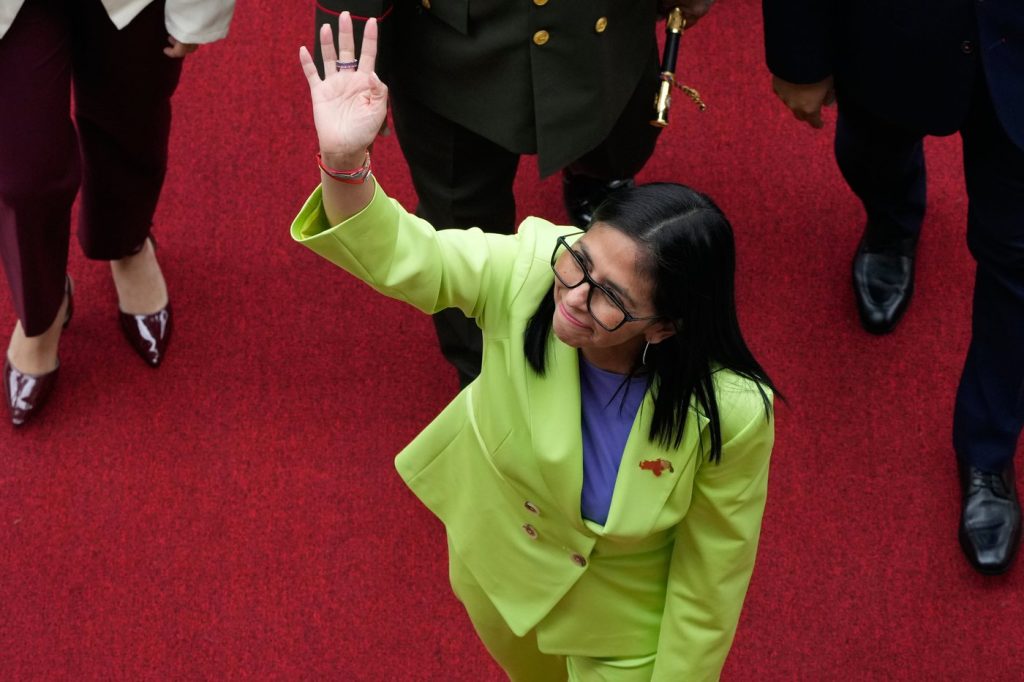
In a recent development, President Donald Trump announced the capture of Nicolás Maduro, the Venezuelan strongman, on drug trafficking charges in the United States. He portrayed Delcy Rodríguez, Maduro's vice president and longtime aide, as a potential leader for stabilizing Venezuela amidst rampant issues of drugs, corruption, and economic turmoil.
However, concerns about Rodríguez's reputation precede her ascent to acting president earlier this month. She has been on the U.S. Drug Enforcement Administration's radar for years, and by 2022, was designated a "priority target"—a label reserved for individuals believed to significantly impact the drug trade, according to records acquired by The Associated Press and several current and former U.S. law enforcement officials.
The DEA has maintained a comprehensive intelligence file on Rodríguez since at least 2018. The records detail her connections and possible involvement in various allegations, including drug trafficking and gold smuggling. A confidential informant reported in early 2021 that Rodríguez was allegedly using hotels on Isla Margarita as a front for money laundering activities. Most recently, she was linked to Alex Saab, Maduro’s alleged financial intermediary, who was arrested on money laundering charges in 2020.
Despite her documented presence in nearly a dozen DEA investigations, the U.S. government has not publicly accused Rodríguez of any criminal activity. Notably, she remains uncharged among more than a dozen Venezuelan officials implicated in drug trafficking alongside Maduro.
Three DEA agents who reviewed the records for AP stressed that the agency's interest in Rodríguez has persisted throughout her tenure as vice president since 2018. Although the specifics of each investigation are not disclosed, the records suggest a sustained close watch on her actions.
The rationale behind Rodríguez's designation as a priority target remains unclear, as this status necessitates substantial evidence for increased investigation resources. Furthermore, while this status can lead to significant scrutiny, it does not automatically result in criminal charges.
Rodríguez’s rise within the Venezuelan government has generated skepticism. Critics argue that the current government operates as a "criminal-hybrid regime," where power is often consolidated through criminal activities. This perspective was echoed by opposition leader Maria Corina Machado, who highlighted the U.S. justice system's awareness of Rodríguez's potential involvement in criminal operations.
Throughout her ascent, Rodríguez has maintained her loyalty to Maduro, shaped by a personal history that includes her socialist father's death in police custody when she was just seven. Despite her animosity towards the United States, she previously attempted to attract American investment, notably hiring lobbyists affiliated with the Trump administration.
However, Rodríguez's efforts were undermined when Trump, influenced by Marco Rubio, pressured Maduro to conduct free elections. In September 2018, the White House sanctioned Rodríguez, emphasizing her critical role in enabling Maduro’s authoritarian rule. The sanctions imposed by both the U.S. and the European Union focused on her threat to democracy rather than corruption allegations.
The ongoing DEA investigations highlight the troubled nature of governance in Venezuela, which ranks as the third most corrupt country globally according to Transparency International. For Rodríguez, the investigations pose a looming threat, underscoring Trump's earlier comments threatening severe consequences for her failure to cooperate following Maduro's capture. Trump's remarks hinted at the potential for U.S. access to Venezuela's wealth in oil and natural resources, emphasizing the stakes for Rodríguez.
Finally, the DEA's scrutiny of Rodríguez aligns with broader investigative efforts into corruption within the Venezuelan regime. The agency's findings point to an intricate web of political power and criminal activity that has thrived in Venezuela, leaving Rodríguez in a precarious position as both a key figure in the government and a target of U.S. investigations.








