

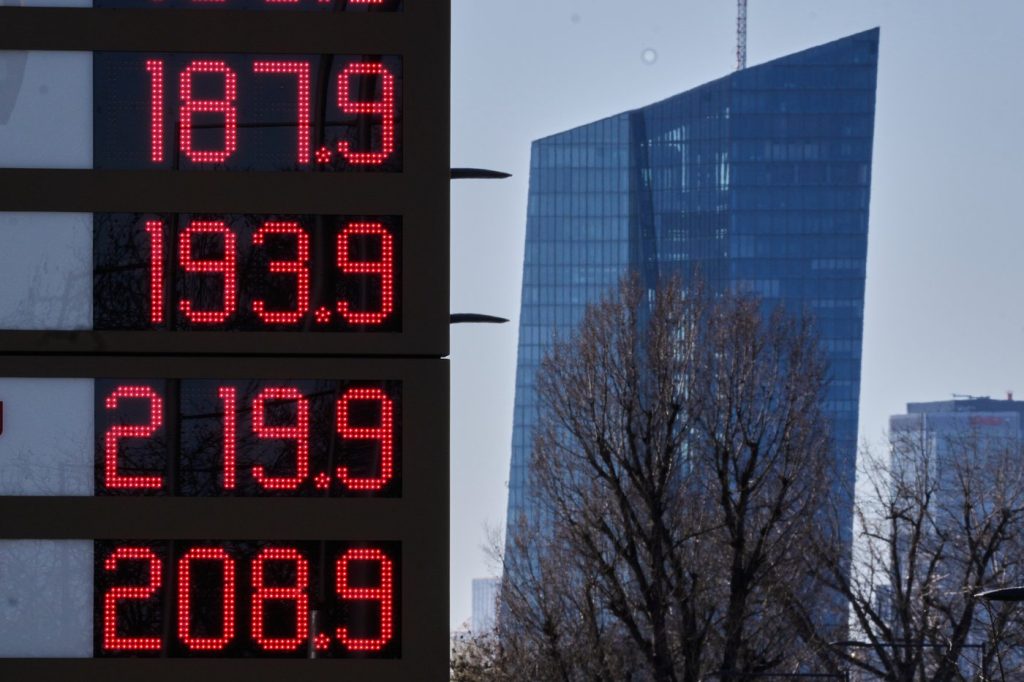
TOKYO (AP) – Asian shares predominantly saw declines, while oil prices spiked on Tuesday as investors expressed concerns over potential threats to the region’s energy supply in light of the ongoing Iran war.
Following a holiday on Monday, South Korean markets reopened to a significant drop, with shares plummeting by 4.8% to settle at 5,946.06. Japan’s benchmark index, the Nikkei 225, also suffered, falling 2.1% to 56,853.48. The impact on Japan is pronounced, given that it is a resource-scarce nation; a substantial portion of its oil and natural gas imports transit through the strategic Strait of Hormuz. However, analysts have noted that Japan has maintained a significant stockpile that can last over 200 days, mitigating immediate supply threats.
The effects of the turmoil were notably felt in Japanese energy stocks, with Eneos Corp. and Idemitsu Kosan seeing declines of nearly 6% and 4%, respectively. Companies involved in defense sectors, buoyed by expectations of increased military spending under Prime Minister Sanae Takaichi, retreated as traders opted to secure profits from previous gains. Mitsubishi Heavy dropped by 5%, while IHI fell by 4%.
In the wider region, Australia’s S&P/ASX 200 index dropped 1.2% to close at 9,089.50. Hong Kong's Hang Seng index marginally changed, losing 0.1% to 26,038.29, and the Shanghai Composite index declined by 0.3%, ending at 4,170.63. The airline sector faced some of the harshest repercussions; major U.S. airlines like American Airlines, United, and Delta suffered losses due to rising fuel prices amidst ongoing fighting in the Middle East, which has also disrupted airport operations and left many travelers stranded.
A significant decline was observed in Asian airline stocks, with All Nippon Airways (ANA) falling by 2.4%, Japan Airlines dropping 5.2%, and Korean Air declining by 8.9%. Qantas Airways also faced a 2.9% dip in its stock prices. Analysts have suggested that while the market reaction to the Iran war has been tepid, historical trends indicate that such military conflicts in the region seldom result in long-term downturns in U.S. markets. For a persistent and significant reduction in U.S. stocks, oil prices may need to exceed $100 per barrel, as noted by strategists at Morgan Stanley, led by Michael Wilson.
Stephen Innes, managing partner at SPI Asset Management, pointed out that since 2000 there have been 22 instances of one-day oil price spikes of over 10%, indicating that energy shocks do not inherently destabilize equities unless they are severe and prolonged. On a different note, the U.S. stock market exhibited resilience; on Monday, the S&P 500 recovered from an early loss of 1.2% to close almost flat with a marginal gain of less than 0.1% at 6,881.62. The Dow Jones Industrial Average saw a slight decline of 0.1% to 48,904.78, whereas the Nasdaq composite managed a 0.4% increase, closing at 22,748.86.
Amidst these market fluctuations, gold prices increased by 1.2% as investors sought safer investment avenues, while U.S. officials worked to assure the global community that the conflict would not be an enduring crisis. The rising oil prices benefitted U.S. oil companies; Exxon Mobil saw a 1.1% uptick, and Marathon Petroleum recorded a 5.9% rise. Defense contractors fared well too, with Northrop Grumman increasing by 5.9%, RTX gaining 4.7%, and Palantir Technologies climbing 5.8%, bolstered by its defense-oriented software solutions. Big Tech also saw gains; Nvidia, in particular, rose by 2.9%, playing a significant role in lifting the S&P 500 higher.
In the bond market, the yield on the 10-year Treasury bond climbed to 4.04% from 3.97% the previous Friday, driven by a manufacturing report indicating better-than-expected growth. Currency markets showcased slight fluctuations, with the U.S. dollar dipping to 157.32 Japanese yen from 157.47 yen, while the euro inched up to $1.1693 from $1.1690.








