

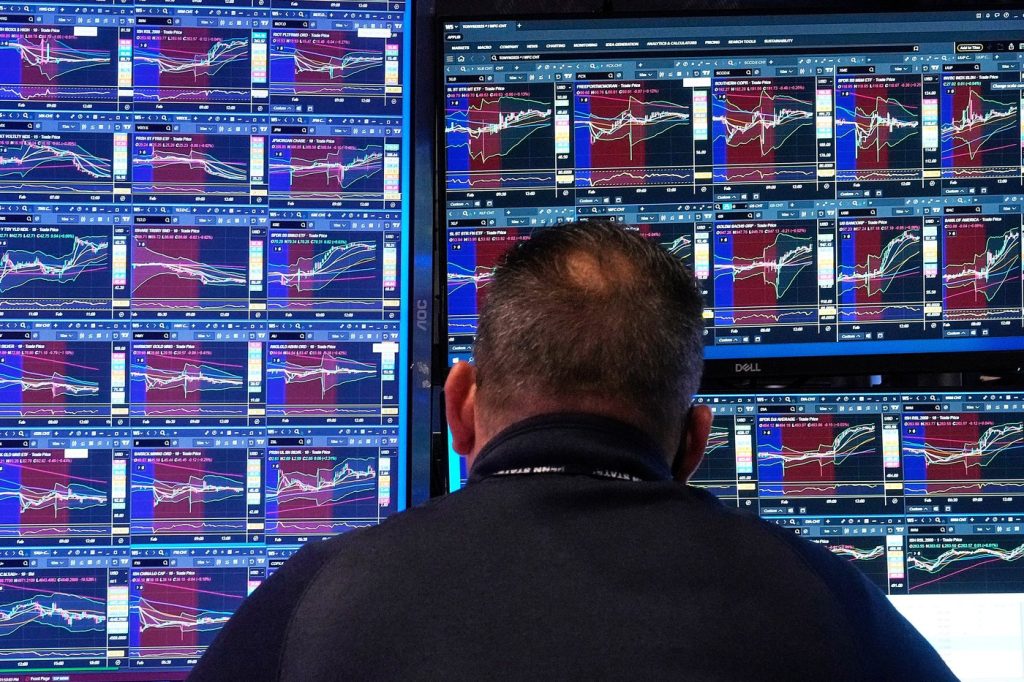
Asian shares faced a downturn on Thursday, influenced by a continued drop in technology stocks on Wall Street. U.S. futures showed slight positive movement while oil prices decreased by more than $1 per barrel.
The Nikkei 225 index in Tokyo fell by 0.7%, closing at 53,935.77. Meanwhile, South Korea's Kospi tumbled by 3.2%, reaching 5,199.47. Hong Kong's Hang Seng posted a 1.2% decline, finishing at 26,516.38, and the Shanghai Composite index also experienced a setback, dropping 0.8% to 4,069.27. In Australia, the S&P/ASX 200 went down by 0.3% to settle at 8,902.20, while Taiwan's Taiex decreased by 1.1%.
Back in the U.S., the S&P 500 decreased by 0.5%, marking its fifth loss in the last six days, closing at 6,882.72. Conversely, the Dow Jones Industrial Average rose by 0.5%, finishing at 49,501.30, while the Nasdaq Composite experienced a significant drop of 1.5%, closing at 22,904.58. Despite the overall downturn, more than double the number of stocks rose in the S&P 500 compared to those that fell, indicating a mixed market situation.
Technology stocks faced significant pressure despite some companies reporting stronger-than-expected profits. Advanced Micro Devices (AMD) suffered a staggering 17.3% loss, despite surpassing quarterly profit expectations and providing a positive revenue forecast for early 2026. Investors seemed dissatisfied, likely due to the stock having doubled in value over the previous year. The broader tech sector is grappling with uncertainties as companies, particularly software makers, face competition risks from emerging artificial intelligence technologies.
Uber Technologies also negatively affected the market, dropping by 5.1% after reporting disappointing quarterly results and providing a profit forecast that fell short of analyst expectations, in addition to announcing a new chief financial officer. On a more positive note, Super Micro Computer surged 13.8% after delivering stronger-than-anticipated quarterly profits, bolstered by its AI server sales.
Eli Lilly saw a rally of 10.3% after exceeding profit expectations due to robust growth driven by its Mounjaro and Zepbound products. Additionally, Match Group experienced a 5.9% increase following better-than-forecasted results and a dividend hike. Walmart also gained slightly, increasing by 0.2% after its market value exceeded $1 trillion for the first time, joining the ranks of major tech firms like Nvidia and Apple.
Gold and silver prices saw modest increases after volatile trading. Gold settled at $4,950.80 per ounce, increasing by 0.3% after briefly surpassing the $5,000 threshold. The precious metal has undergone significant price fluctuations in the past year, recently nearing $5,600 before dropping below $4,500 earlier this week. Silver prices rose by 1.3% as investors sought safe-haven assets amidst various global economic uncertainties, including tariffs and a weakening U.S. dollar, although critics cautioned that precious metal pricing might have risen too rapidly.
Treasury yields remained stable following a couple of mixed economic reports from the U.S. An ADP Research report indicated that U.S. employers outside of government hired fewer workers than anticipated last month. Simultaneously, a report from the Institute for Supply Management highlighted that growth in U.S. services sectors like healthcare and construction persisted, aligning with economists' forecasts. However, it also noted that prices paid by service-sector businesses rose faster than expected, which may signal inflationary concerns.
In addition to these developments, U.S. benchmark crude oil prices decreased by $1.19 to $63.95 per barrel, while Brent crude, the international standard, dipped by $1.24 to $68.22 per barrel. Currency exchanges showed the dollar rising to 156.83 Japanese yen from 156.80 yen, while the euro slipped to $1.1795 from $1.1804.








