

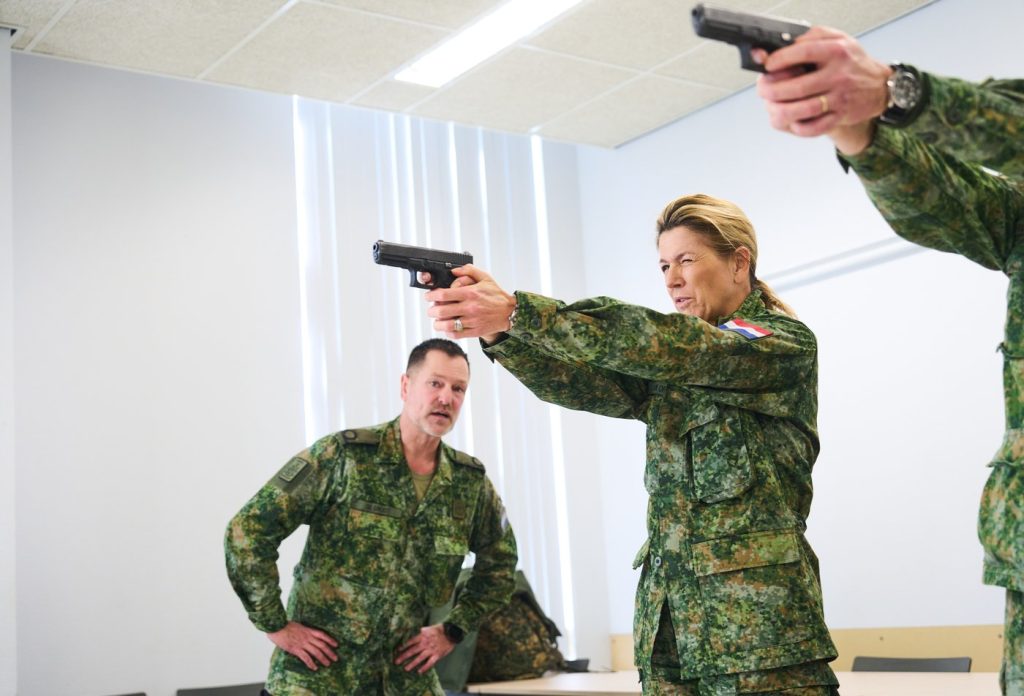
THE HAGUE, Netherlands (AP) — In a notable development aimed at addressing rising concerns over peace and security in Europe, Queen Máxima of the Netherlands has volunteered to become a reserve member of the Dutch army. This initiative comes as the military seeks to bolster recruitment efforts amid ongoing geopolitical tensions, particularly due to Russia's war in Ukraine.
After commencing her training on Wednesday, Queen Máxima, the 54-year-old Argentine-born spouse of King Willem-Alexander, expressed her commitment to contributing to the security of her adopted country. The Dutch Ministry of Defense stated, "Because the security of the Netherlands can no longer be taken for granted, Máxima has decided to become a reservist." The Royal House further noted her desire to make a meaningful contribution to national security.
Interestingly, Queen Máxima is not the only royal in her family to pursue military training; her daughter, Crown Princess Amalia, completed basic military training last month as a volunteer reservist. This trend is not unique to the Dutch monarchy; royal family members across Europe have a history of military service. For instance, five years ago, Princess Elisabeth, heir to the Belgian throne, enrolled in a military school in Brussels to prepare for her future royal duties.
The incoming Dutch coalition government, which is poised to be sworn in later this month, has outlined plans to expand the military workforce to 122,000 personnel. Currently, the Dutch military comprises approximately 80,000 individuals, including military personnel, civilians, and reservists such as Queen Máxima. Klaas Meijer, a spokesperson for the Ministry of Defense, expressed pride in Máxima's decision to enlist, hoping it would inspire others to consider joining the military.
As part of her training regimen, several photographs were released by the House of Orange, depicting Máxima engaged in various military exercises at a military academy in Breda. The images showcase her practicing marksmanship, rock climbing, and other physical activities. The training program will cover essential military skills, including self-defense, map reading, and military law. Upon completion, Queen Máxima will be granted the rank of lieutenant-colonel and could be deployed wherever her services are required.
The Netherlands is not alone in this recruitment drive. Other European nations are also seeking to enhance their military capabilities against the backdrop of heightened concerns stemming from the conflict in Ukraine. The Dutch government plans to implement a "freedom contribution" to help finance the increasing military budget. Similarly, Germany has approved initiatives to attract military recruits to strengthen its armed forces amidst rising security threats from Russia.
France has introduced a program aimed at training thousands of young volunteers, aiming to gradually ramp up participation to 10,000 volunteers per year by 2030, with a long-term goal of reaching 50,000 by 2035. At a recent naval conference in Paris, Dutch navy chief Vice Admiral Harold Liebregs, along with leaders from the U.K. and U.S., reported positive outcomes in recruitment and personnel retention as a result of growing security concerns in Europe.
A noteworthy shift in recruitment efforts has been observed, with increased willingness among volunteers to join the armed forces. This change can be partly attributed to programs allowing young people to enlist for short periods, providing them first-hand experience and training opportunities. Notably, Denmark has also extended compulsory military enlistment to women for the first time in an effort to increase the number of individuals serving in the military.
Neighboring Belgium has recently reactivated two military brigades as part of a broader strategy to enhance its defense capabilities. These ongoing recruitment initiatives across Europe are likely to exert pressure on defense budgets, pushing governments toward increased military spending agreed upon at a recent NATO summit.
In summary, the Dutch royal family's involvement in military training highlights a growing acknowledgment across Europe that maintaining peace and security is of paramount importance. The initiatives taken by various countries underline the need for a renewed commitment to military readiness in the face of emerging geopolitical challenges.








