

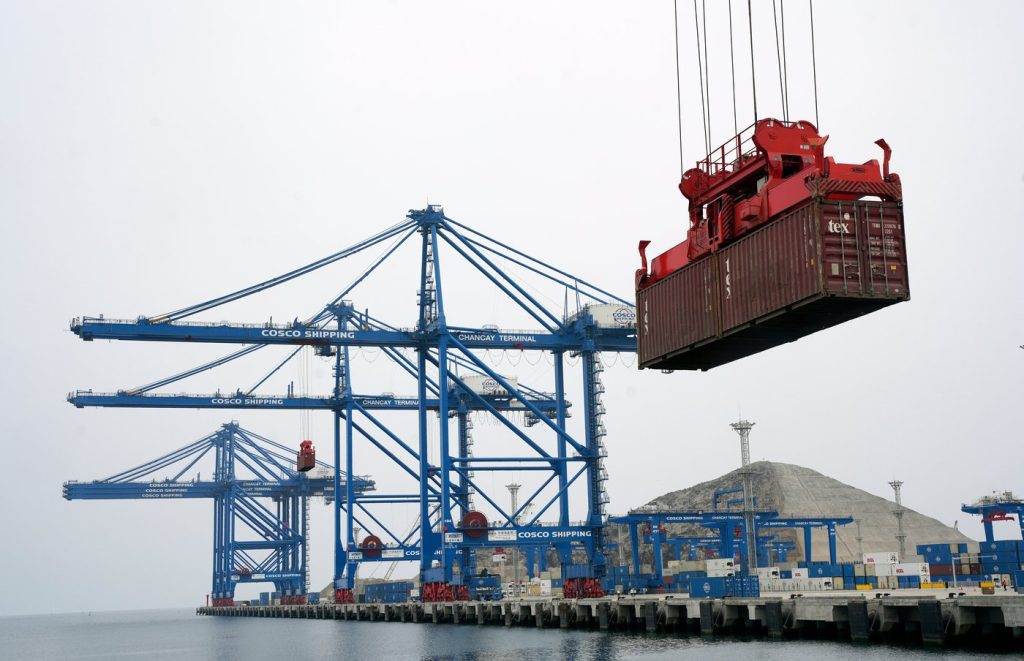
LIMA, Peru (AP) – The Trump administration raised alarms on Wednesday regarding China's influence in Peru, asserting that the country risks losing its sovereignty due to Chinese control over its critical infrastructure. This warning follows a recent ruling by a Peruvian court that limits the oversight of a local regulator over the Chancay mega port, which was built by Chinese interests.
The $1.3 billion deepwater port in Chancay, located north of Lima, has emerged as a focal point of China's growing foothold in Latin America, triggering tensions with Washington. The U.S. State Department's Bureau of Western Hemisphere Affairs expressed concerns on social media, stating their apprehension regarding the latest reports indicating that Peru might lack the authority to manage Chancay, one of its largest ports, which is governed by financially aggressive Chinese stakeholders.
The Bureau explicitly declared, "We support Peru’s sovereign right to oversee critical infrastructure in its own territory. Let this be a cautionary tale for the region and the world: cheap Chinese money costs sovereignty." This statement signals a broader U.S. strategy to reclaim influence in the Western Hemisphere, where China's presence has been bolstered by substantial loans and trade partnerships.
Chancay is integral to China's Belt and Road Initiative, an expansive infrastructure program that has facilitated significant investment in seaports, highways, and airports across various continents through Chinese state-owned banks. As the deepest port in Latin America, Chancay is equipped to accommodate some of the largest cargo vessels operational between Asia and South America. China has held the title of Peru's largest trading partner for over a decade.
In response to U.S. apprehensions, Cosco, China's state-owned shipping and logistics firm and a majority stakeholder in Chancay, refuted the claims. In statements to the Associated Press, Cosco asserted that the court's ruling does not pertain to sovereignty and emphasized that "the port remains under the jurisdiction, sovereignty, and control of Peruvian authorities, subject to all Peruvian regulations." Furthermore, Cosco highlighted the presence of multiple Peruvian agencies monitoring the port, including police, environmental regulators, and customs officials.
The disputed ruling, made on January 29 by a lower court judge, directs Peruvian entities to refrain from exercising regulatory and oversight powers regarding the Chancay port. The regulatory body, known as Ositran, which supervises other major ports in Peru, has announced plans to appeal this decision. The organization argues that there is no valid justification for exempting Cosco from its oversight responsibilities.
Verónica Zambrano, the president of Ositran, criticized the ruling, stating during a local radio interview, "(Cosco Shipping) would be the only company providing services to the public that could not be supervised." She clarified that although Chancay is privately owned, it spans 180 hectares (approximately 445 acres) of Peruvian land, therefore necessitating government monitoring and compliance with local standards designed to protect users.
Peru's Foreign Ministry has chosen not to comment on the issue, and a request for input from China's Embassy in Peru has gone unanswered. The ongoing situation at Chancay port illustrates the complexities of foreign influence in regional infrastructure and the geopolitical tension stemming from significant foreign investments, particularly from China.








