

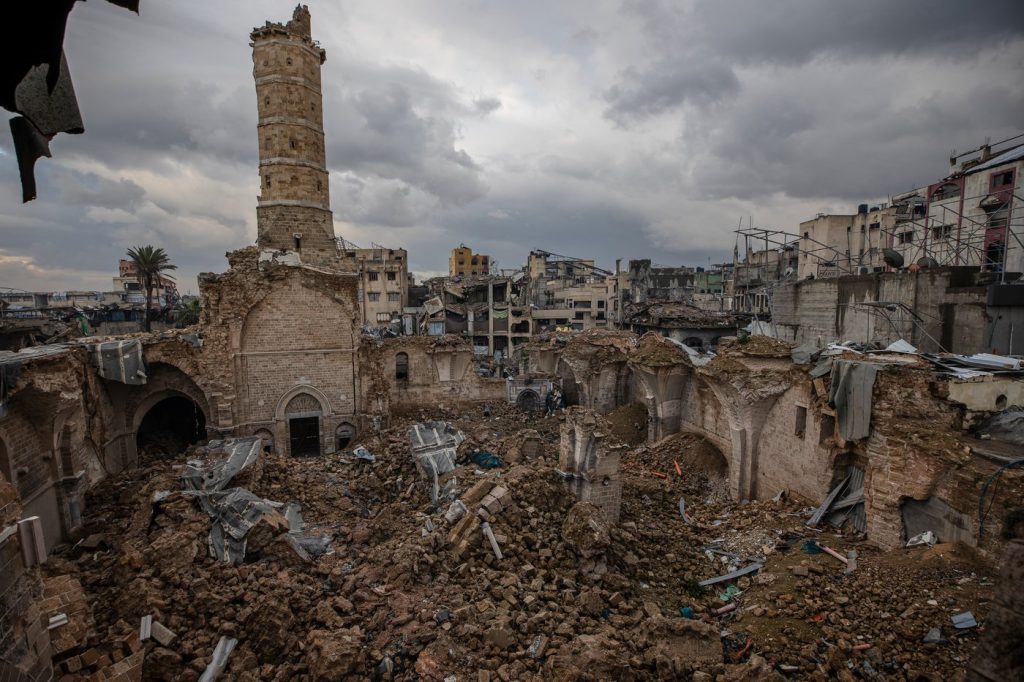
Gaza City, Gaza Strip – Muneer Elbaz fondly recalls the days he spent visiting the Great Omari Mosque with his family, engaging in prayers at a historical site that has been a place of worship for centuries. “These were the best days,” he reflects, recalling the vibrant atmosphere of the surrounding markets before the outbreak of the Israel-Hamas war. Today, however, much of the mosque lies in ruins, having been damaged by Israeli strikes during a two-year conflict that has wreaked havoc throughout Gaza.
The toll of the military offensive has been catastrophic, with Gaza’s Health Ministry reporting over 72,000 Palestinian casualties. The destruction has not only claimed lives but has also eroded the cultural and historical heritage of the region, particularly sites like the Great Omari Mosque, which was built on the remnants of a Byzantine church and has witnessed the ebb and flow of different empires and religions.
As the military actions have subsided, Palestinians are slowly uncovering the extent of the damage. Various organizations are now striving to salvage what remains of their historical sites, even though full restoration and reconstruction face significant hurdles. The offensive was initiated following a deadly attack by Hamas militants on October 7, 2023, which resulted in approximately 1,200 deaths, largely among civilians. The Israeli military justified its strikes, alleging that Hamas was concealing military resources near cultural heritage sites.
The U.N. cultural agency has been monitoring the situation and has confirmed damage to at least 150 sites amid the war, including religious sites, monuments, and archaeological locations. This destruction raises significant concerns among Palestinians about the erasure of their cultural identity, with experts like Issam Juha emphasizing that these sites are crucial for maintaining the Palestinian connection to their land.
Efforts are underway to protect and recover valuable artifacts from damaged sites. One of the most urgent projects involves the Pasha Palace, which has housed numerous ancient artifacts. Reports indicate that some items, including an Ottoman-era Quranic manuscript and medieval jewelry, may have been looted. Meanwhile, the Israeli military has claimed that its attacks targeted Hamas military operations, but evidence for such claims remains unverified.
The impact of the conflict extends to various religious structures. The Saint Porphyrius Orthodox Church, which was providing shelter for displaced individuals, was also caught in the crossfire and sustained damage. In contrast, some heritage sites like the Saint Hilarion Monastery have reportedly avoided destruction entirely.
International law emphasizes the protection of cultural properties during conflicts; however, the ongoing situation has complicated these principles. The Israeli military asserts that it takes precautions to avoid damaging cultural and religious sites. Despite this, various international bodies, including an independent U.N. commission, have questioned the validity of the military's claims regarding identifying legitimate targets at these historical sites.
The Great Omari Mosque, originally constructed in the seventh century, has historically served as a symbol of Gaza's rich past. Throughout its existence, it has transitioned between being a mosque and a cathedral, particularly during the Crusader era. Local archaeologist Stephennie Mulder highlights that the mosque encapsulates Gaza's legacy as a nexus of trade, culture, and religious traditions.
The destruction of the mosque is particularly poignant for many residents, such as Mohammad Shareef, who recalls attending prayers there with his father. The emotional weight of the loss is profound, especially as the Muslim holy month of Ramadan approaches, traditionally a time of increased congregational prayer at the mosque. Currently, workers are focused on recovery efforts to prevent further damage to the already devastated structure.
The ongoing U.S.-brokered ceasefire has allowed a momentary respite from fighting; however, it does not specify a timeline for Gaza's reconstruction—a task that may remain unfeasible under the current Israeli blockade, imposed since Hamas's rise to power in 2007. Prolonged neglect and previous conflicts have already strained historic sites, complicating potential reconstruction efforts.
As the war's aftermath unfolds, Elbaz poignantly expresses the collective grief felt in Gaza: “We have memories everywhere — in this tree, this flower, this garden and this mosque. Yes, we cry over every part of Gaza.”








