

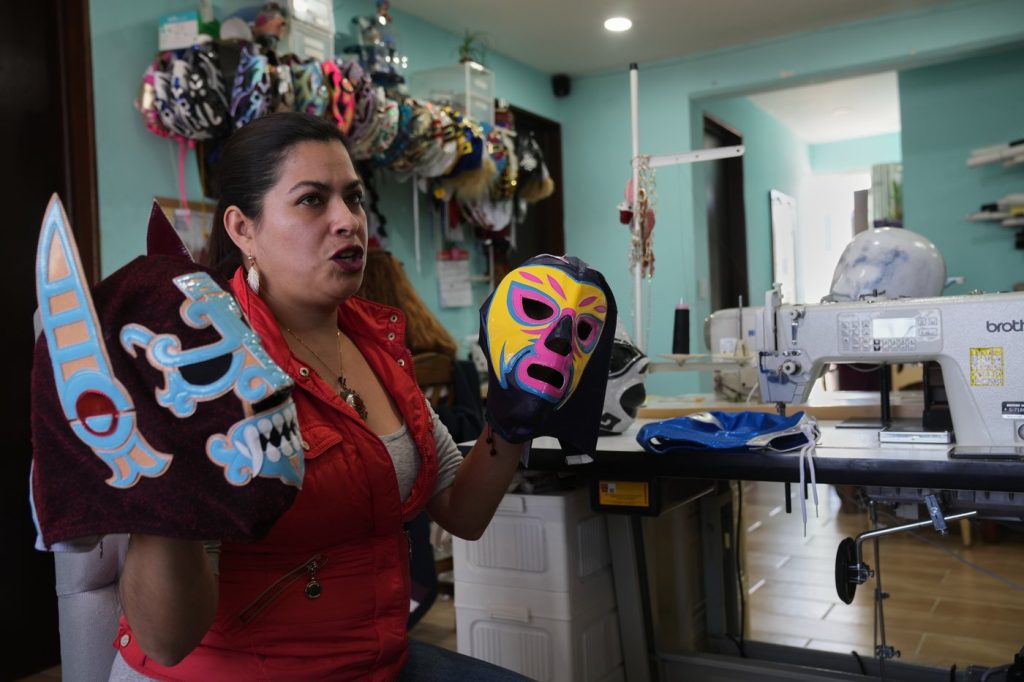
MEXICO CITY (AP) - Alma Guadalupe Zuñiga, a prominent figure in the world of wrestling masks, has been involved with this unique craftsmanship for as long as she can remember, thanks to her father, the late wrestler Angel Azteca. Now, at 42 years old, she runs a successful factory in Iztapalapa, a popular neighborhood on the outskirts of Mexico City, where her team produces an average of 300 handmade wrestling masks every week.
With the 2026 FIFA World Cup approaching, Zuñiga anticipates a significant surge in sales. She noted, "We expect a very large increase in sales with so many foreigners because wrestling and masks are a Mexican symbol." The masks, which can take up to two days to customize, appeal to both collectors and tourists who visit local shops seeking authentic souvenirs.
Aside from her artisanal work, Zuñiga collaborates closely with well-known wrestlers like Tinieblas, Blue Panther, Ultimo Guerrero, and Mascara Sagrada. The demand for masks has grown substantially over the years; she mentioned, "There are more collectors now. Fifteen years ago, not many people would say, 'I have 30 masks at my place.' Now you have fans with 50 or 100 masks in their homes."
Near the Arena Mexico wrestling venue and other tourist attractions, vendors like Clementina López also anticipate increased foot traffic during the World Cup, stating, "We always have many foreign customers, but we expect many more during the World Cup. We’ll try to give them a nice souvenir to take back to their countries." Mexico is set to host 13 World Cup matches, with five taking place in the capital, alongside four games in Guadalajara and Monterrey. Authorities expect around five million tourists to visit during the tournament.
The history behind wrestling masks in Mexico is rich and intriguing. Renowned Mexican writer Carlos Monsivais described wrestlers' affinity for masks as a means to create an intimidating persona. Wrestler Star Black added, "The mask has magic. It’s like having two identities." The tradition of wearing masks in wrestling is thought to have begun in 1933 with American wrestler Corbin James Massey, who later adopted the alias "Maravilla Enmascarada." This practice was followed by Mexican figures like Santo and Blue Demon, becoming a cultural hallmark of Lucha Libre, or freestyle wrestling.
The connection between wrestling masks and other sports is also noteworthy. While it's unclear exactly when fans began wearing masks to soccer matches, both wrestling and soccer are immensely popular among Mexicans. In a notable crossover, Adidas created a jersey for the Mexican national team inspired by Rey Mysterio, a celebrated Mexican-American wrestler, for the 2014 World Cup. Furthermore, prominent figures in motorsports, like Mexican driver Sergio Pérez and Max Verstappen, have embraced wrestling culture by wearing masks and decorating their gear with wrestling motifs.
Pérez, who wore a helmet featuring a wrestling mask design during a recent Formula 1 Grand Prix, expressed his love for Mexican culture and Lucha Libre, stating, "It’s a great gesture that lucha libre is crossing borders." Another athlete, Seattle Mariners outfielder Randy Arozarena, has donned Ignacio Uribe Mistico’s mask as a lucky charm during games, attributing a sense of "mystical magic" to its power.
Zuñiga's factory has notably supplied masks for Pérez, Verstappen, and Russell, indicating the increasing demand as the World Cup approaches. She is already receiving special requests for unique designs, saying, "We’ve ordered certain fabrics to make special products, special models for the World Cup." With the event just around the corner, excitement and anticipation continue to mount for both wrestling fans and the broader Mexican culture.








