

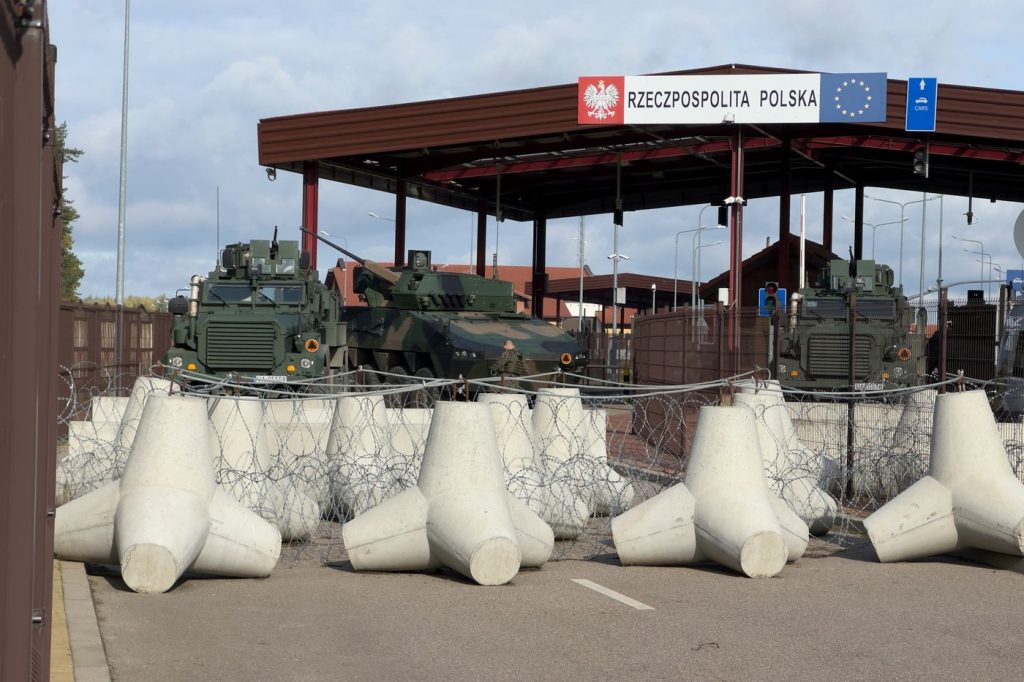
WARSAW, Poland (AP) — Poland's deputy defense minister announced that the country will utilize both antipersonnel and anti-tank land mines to fortify its eastern border in response to the escalating threat posed by Russia. This announcement comes as Poland officially withdraws from the 1997 Anti-Personnel Mine Ban Treaty, commonly known as the Ottawa Convention.
The Ottawa Convention prohibits its signatories from deploying or retaining antipersonnel mines, which are notorious for causing extensive suffering among civilians in war-torn regions like Cambodia, Angola, and Bosnia-Herzegovina. Poland had ratified this treaty in 2012 and had completely dismantled its domestic stockpile of antipersonnel mines by 2016. However, the country made the decision to withdraw from the treaty on Friday and announced plans to restart the manufacturing of these controversial weapons.
Pawel Zalewski, Poland’s deputy defense minister, emphasized the need for such mines as a crucial component of the defense strategy being developed along NATO's eastern flank, including borders with Russia to the north and Belarus to the east. He pointed out that Poland must prepare for defense against Russia, a nation he characterized as having “very aggressive intentions vis a vis its neighbors” and noted that Russia has never committed to the international land mine ban treaty.
Since the onset of Russia's full-scale invasion of Ukraine, several neighboring countries have reevaluated their positions regarding the Ottawa Convention. Last year, Poland aligned with Finland and the three Baltic states—Estonia, Latvia, and Lithuania—alongside Ukraine to announce their collective departure from the treaty.
Russia remains one of nearly thirty countries that have never acceded to the Ottawa Convention, a list that includes the United States. In a further escalation of its military capabilities, Poland plans to initiate domestic production of both antipersonnel and anti-tank land mines, with an aim toward achieving self-sufficiency in its defense industry.
Land mines are explosive devices placed on or just beneath the ground, designed to detonate upon the pressure of a person or vehicle. While antipersonnel mines are restricted by the Ottawa Convention, anti-tank mines, which are specifically designed to avoid tripping from human weight, remain permissible.
Polish Prime Minister Donald Tusk, speaking after a demonstration of the Bluszcz unmanned vehicle designed for deploying anti-tank mines manufactured by the Polish company Belma S.A. and a military research institute, noted that Poland would soon possess the capability to lay mines along its eastern borders within a mere 48 hours of perceiving a threat. With the length of Poland's eastern borders, Zalewski indicated that a substantial quantity of land mines would be necessary for this defensive strategy.
Poland intends to stockpile these mines as part of the “Eastern Shield,” a series of enhanced fortifications being constructed on its borders with Belarus and Russia since 2024. However, Zalewski emphasized that the deployment of mines will only occur “when there is a realistic threat of Russian aggression.” He reassured that Poland values its territory and aims to keep it accessible for its citizens, stating, “We very much respect our territory and we don’t want to exclude it from day-to-day use for the Polish citizens.”
Despite the government's stance, human rights organizations have decried Poland's decision to exit the Ottawa Convention, arguing that antipersonnel mines pose an unacceptable risk to civilian lives. In response, Zalewski maintained that Poland is seeking a balance by reserving the use of mines and only deploying them in the event of an attack, asserting, “We are not an aggressive country, but we have to use all means to deter Russia.”








