

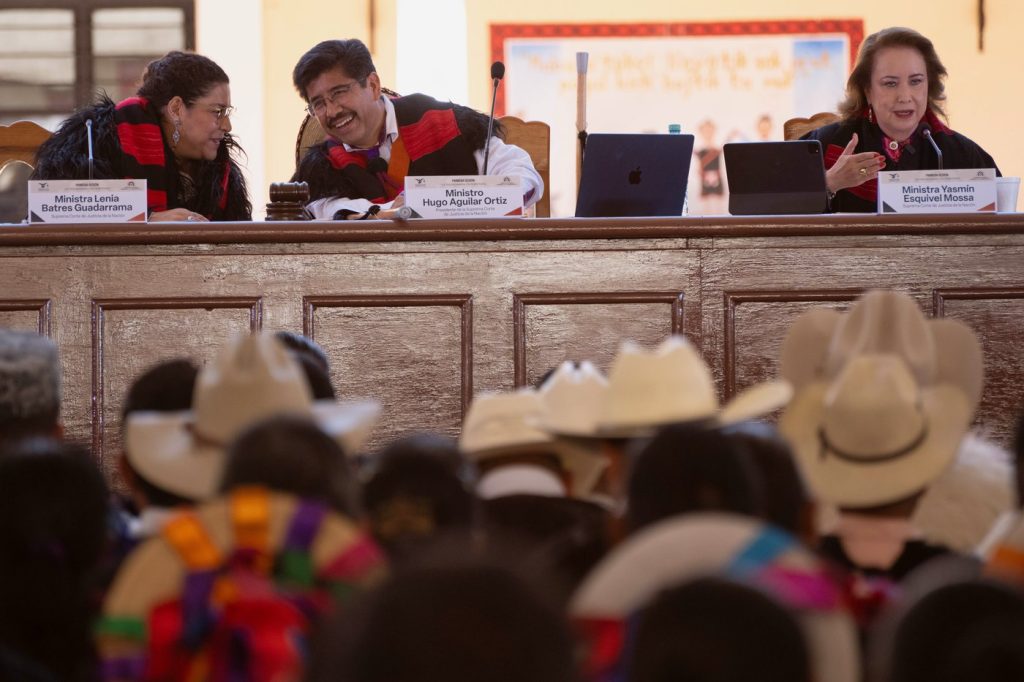
TENEJAPA, Mexico (AP) – In a significant event for the Mexican judicial system, the Supreme Court of Mexico conducted its first session outside its traditional location in Mexico City, taking place in the mountainous town of Tenejapa, Chiapas. This marks the commencement of a new initiative aimed at bringing the country's highest court closer to its diverse populations across the nation.
Held under a tent in the central square of Tenejapa, the session attracted approximately 2,000 attendees, showcasing the local community's engagement with the judicial process. The court's justices deliberated publicly, allowing citizens to witness firsthand the workings of judicial decision-making.
As part of a constitutional reform, the Supreme Court justices were popularly elected for the first time last year, with Hugo Aguilar, an Indigenous lawyer from Oaxaca, serving as the chief justice. Aguilar emphasized the importance of the court's presence in local communities, stating, "Often in our communities, we only feel the effects of a decision taken far away." He highlighted the goal of promoting transparency in the court's deliberative processes.
Among the audience were Indigenous leaders and community members, some holding signs advocating for the "right to self-determination." The event witnessed various stakeholders, including María de la Cruz Velasco, president of a foundation assisting victims of femicide, expressing hopes that the new court leadership would focus on community justice. Velasco noted the significance of the Supreme Court's involvement in a specific case regarding self-governance in La Candelaria, a community that has sought autonomy for years.
While court sessions can be complex and challenging for those outside the legal realm to follow, the Supreme Court has historically supported Indigenous rights and human rights issues. This progressive approach has made the court a vital ally for those affected by violence, despite challenges in enforcing its own rulings. Velasco recalled her personal tragedy, stating that the Supreme Court eventually classified her daughter's murder as a femicide, leading to the conviction of her daughter's killer with a 55-year sentence.
This court assembly, as the first elected by the populace, has been criticized for introducing potential political biases into the judiciary. The election, which saw voter turnout drop significantly, resulted in candidates aligned with the ruling party securing a majority of the positions. However, the focus in Tenejapa remained on the importance of the court's engagement with the community rather than these controversial election aspects.
The cooperative spirit in Tenejapa illustrated a broader desire for the court to connect with ordinary citizens and address local legal concerns directly, fostering a sense of empowerment in marginalized communities across Mexico. The Supreme Court's visit reflects an evolving judicial philosophy aimed at bridging the gap between justice and community engagement.








