

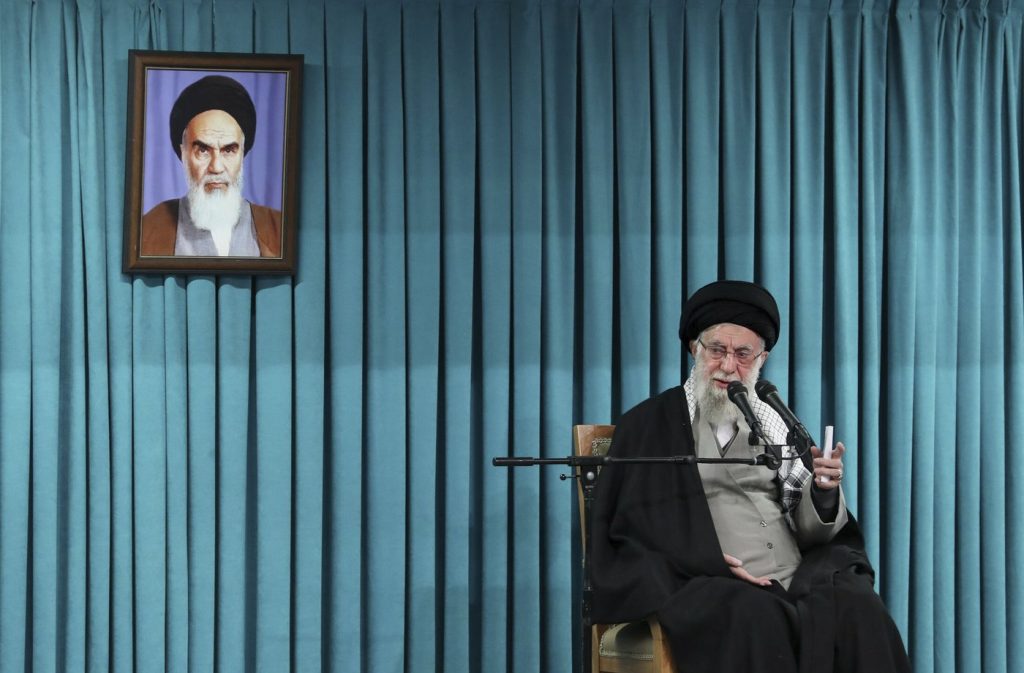
DUBAI, United Arab Emirates (AP) — Supreme Leader Ayatollah Ali Khamenei, who has been a distinct figure in Iranian politics since he succeeded Ayatollah Ruhollah Khomeini after Khomeini's death in 1989, has passed away at the age of 86. Under Khamenei's leadership, Iran expanded its military capabilities and pursued a confrontational stance against Israel and the United States, particularly regarding its nuclear program.
Iranian state media confirmed Khamenei’s death early Sunday, shortly after a significant attack by Israel and the United States. Former U.S. President Donald Trump stated that Khamenei had been killed in this operation. Throughout Khamenei's tenure, he transformed the Islamic Republic into a formidable state, significantly extending the reach of the Shiite clerical class and bolstering the Revolutionary Guard, which became crucial to maintaining his grip on power.
The socio-economic strains in Iran intensified during Khamenei’s rule, leading to numerous protests fueled by political repression and economic hardship. Significant outrage arose after the 2022 death of Mahsa Amini, resulting in nationwide demonstrations where many chanted, “Death to Khamenei.” His administration met these movements with severe crackdowns, leading to thousands of deaths and arrests.
Challenges persisted, especially with the 2023 Mideast wars triggered by Hamas’ attacks on Israel. The conflicts created a rift in the so-called “Axis of Resistance” Khamenei established, culminating in direct confrontations between Iran and Israel in 2024 and beyond. Khamenei's death also raises critical questions about the future stability of the Islamic Republic.
The Assembly of Experts, made up of mostly hard-line clerics, is scheduled to select Khamenei’s successor, but a clear successor was not immediately evident. Khamenei's legacy included not only the consolidation of power but also a growing bureaucracy of Shiite clerics that blurred governance lines, leaving him as the ultimate decision-maker. His reign saw the Revolutionary Guard flourish, extending its influence over the economy and employing overwhelming force to quell dissent.
Economically, the regime faced severe challenges, leading to unrest that included protests in 2017, 2019, and most dramatically in late 2025, where the populace directly challenged the core of the Islamic Republic. Some protestors even called for a return of the former monarchy. Khamenei's establishment also engaged in regional proxy warfare, supporting groups such as Hezbollah and the Houthi rebels in Yemen, further extending Iran’s influence in the Middle East.
Throughout his leadership, Khamenei maintained a staunch anti-U.S. stance, referring to America as the “Great Satan.” His regime continued to advance Iran’s nuclear program despite international sanctions and criticism. Under the 2015 nuclear deal with world powers, Iran agreed to limits on its nuclear activities, but these were largely ignored after the U.S. withdrawal from the agreement in 2018, escalating tensions and military operations between Iran, Israel, and the United States.
Khamenei's legacy is complex, characterized by both resilience against external pressures and mounting internal unrest. As his tenure concludes with his death, Iran stands at a pivotal juncture, with significant implications for domestic politics, regional dynamics, and international relations.








