

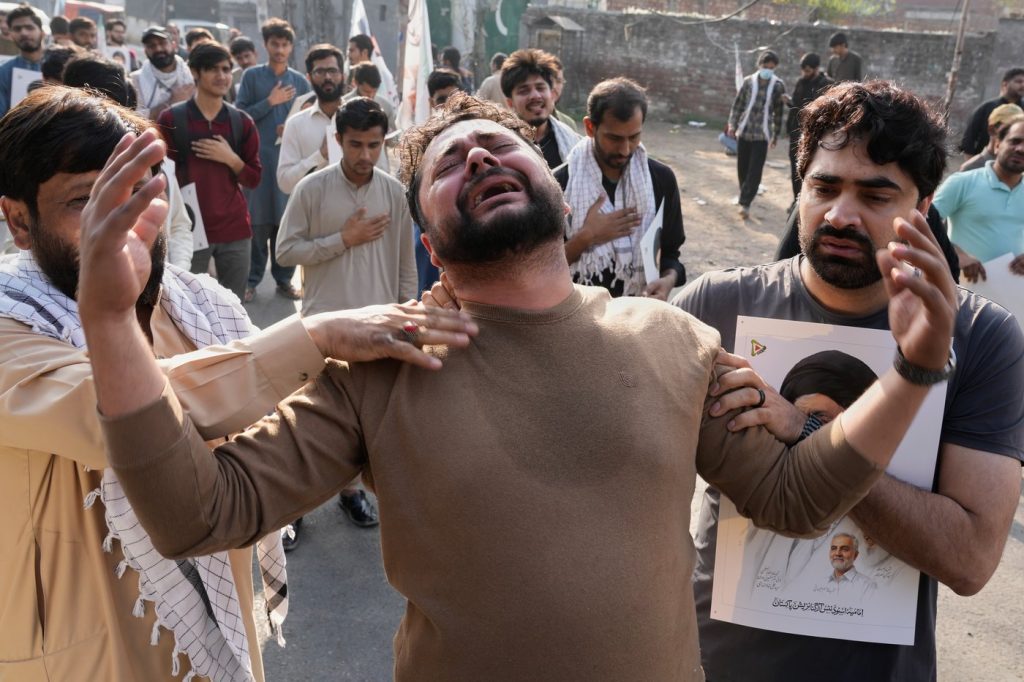
KARACHI, Pakistan (AP) - On Sunday, violent clashes erupted in Karachi, resulting in the deaths of at least nine individuals and injuring around two dozen more. The unrest ensued after hundreds of demonstrators stormed the U.S. Consulate in this major port city. According to police and hospital officials, among the wounded, several were reported to be in critical condition.
The violence followed closely on the heels of a military strike by the United States and Israel, which resulted in the assassination of Iran's Supreme Leader, Ayatollah Ali Khamenei. Initial reports indicated that six bodies and numerous injured individuals were transported to the city’s main government hospital, but the death toll later rose to nine when three critically injured patients succumbed to their wounds, as confirmed by Summaiya Syed Tariq, a police surgeon.
Karachi serves as the capital of Sindh province and is Pakistan’s largest city. Senior police official Irfan Baloch reported that demonstrators briefly attacked the perimeter of the U.S. Consulate but were ultimately dispersed by security forces. Baloch refuted claims that any part of the consulate building had been set ablaze but noted that protesters did ignite a nearby police post and shattered windows of the consulate building prior to security intervention.
Witnesses reported that several Shiite protesters congregated approximately one kilometer from the consulate, calling for more individuals to join their ranks. One protester attempted to set a window of the consulate on fire just before security personnel arrived to disperse the crowd. In response to the unrest, the provincial government of Sindh issued a statement advising citizens to express their views peacefully while warning against violent actions.
In contrast to the violence in Karachi, Shiite groups organized a peaceful rally in Multan, located in Punjab province, where they chanted slogans condemning the United States and Israel. Mamoona Sherazi, an attendee, voiced her discontent regarding the killing of Khamenei, whom she referred to as a fatherly figure and a strong advocate for Shiite Muslims. Sherazi emphasized, "God willing, we will never bow before America and Israel."
Another demonstration took place near the U.S. Consulate in Lahore, the capital of Punjab province. According to senior police official Faisal Kamran, protesters attempted to approach the consulate, but police intervened and dispersed the crowd to maintain order. A rally was also anticipated in Islamabad and other locations nationwide, prompting authorities to bolster security measures around the U.S. Embassy in the capital and consulates across the country to mitigate the risk of further violence.
Shiites constitute approximately 15% of Pakistan's population of around 250 million, representing one of the largest Shiite communities globally. While anti-Israel and anti-U.S. demonstrations have been a recurring feature in Pakistan, the clashes witnessed during this incident are notably rare.
Reportedly, this incident has raised significant tension within Pakistan, illustrating the volatile nature of the region following the assassination of a key Iranian leader. The situation remains under close observation by local authorities as they seek to manage public sentiment amidst international conflict.








