

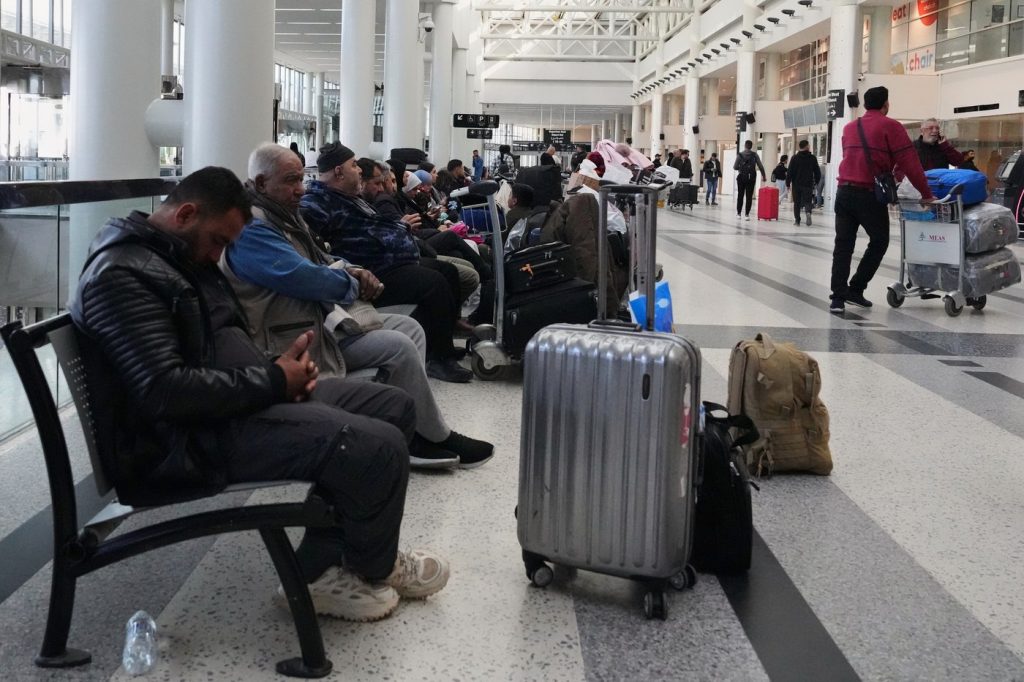
LONDON (AP) — The United States and Israel's recent military attack on Iran has significantly disrupted air travel across the Middle East, prompting multiple countries to close their airspace. This has impacted flights not only in the region but also affected international connections between Europe, Africa, and Asia. As the conflict continues into its second day, many airports remain shut, and thousands of travelers find themselves stranded.
Emirates Airlines announced the suspension of all flights to and from Dubai until at least the afternoon of Sunday, with Qatar's airport closed until at least Monday morning. Israeli airspace also remained closed, compounding the travel chaos as countries including Iran, Iraq, Syria, Kuwait, and Bahrain have closed their airspace as well. Flight tracking website FlightRadar24 indicated no flight activity over the United Arab Emirates due to a "temporary and partial" airspace closure.
The comprehensive airspace closures have left tens of thousands of travelers stranded. According to aviation analytics firm Cirium, Emirates, Qatar Airways, and Etihad typically manage around 90,000 passengers per day through these hubs. Reports indicated that over 1,800 flights were canceled due to the turmoil. In particular, Dubai International Airport, one of the busiest in the world, reported injuries among passengers, while Zayed International Airport in Abu Dhabi confirmed a fatality due to a drone strike.
While Iran has not publicly claimed responsibility for attacks, Gulf nations attributed a range of retaliatory strikes to Iranian forces. Aviation industry analyst Henry Harteveldt noted the implications for travelers, emphasizing the likelihood of continued delays or cancellations as the situation unfolds. Airlines are rerouting flights around the conflict, leading to longer travel times and increased fuel costs, which may eventually lead to higher ticket prices.
Air traffic controllers in Saudi Arabia are expected to face increased pressure due to the rerouted flights. Retired FAA air traffic official Mike McCormick theorized that some airspace might be reopened in the coming days, depending on the cooperation between American and Israeli officials and airlines concerning military flight operations.
The longevity of these disruptions remains uncertain. For reference, a previous conflict in June 2025 between the U.S. and Iran lasted 12 days. Airlines are advising travelers to stay updated on flight statuses before heading to the airport, with some offering waivers for affected passengers to change their travel plans without incurring extra fees.
Travelers from various locations, such as Newcastle, England, have experienced cancellations and have had to return home without clear information on when they might be able to resume their journey. Airports like Athens, Istanbul, and Rome have become diversionary destinations for numerous flights that were forced to turn back due to the escalating situation. Some airlines, including Air India and Turkish Airlines, have canceled flights to many Middle Eastern countries as a precautionary measure.
Major U.S. carriers like Delta and United have also suspended flights to Tel Aviv at least through the weekend, while European airlines like KLM have halted all operations to and from Tel Aviv. As disruptions continue to ripple through the aviation industry, airlines have been advised to prepare for potential further cancellations and adjustments in flight schedules.
Industry experts like Harteveldt express concern that if travelers have not yet departed, they will likely face significant delays in their plans, emphasizing the need for creative alternative routes for those attempting to return home amidst the ongoing turmoil.








