

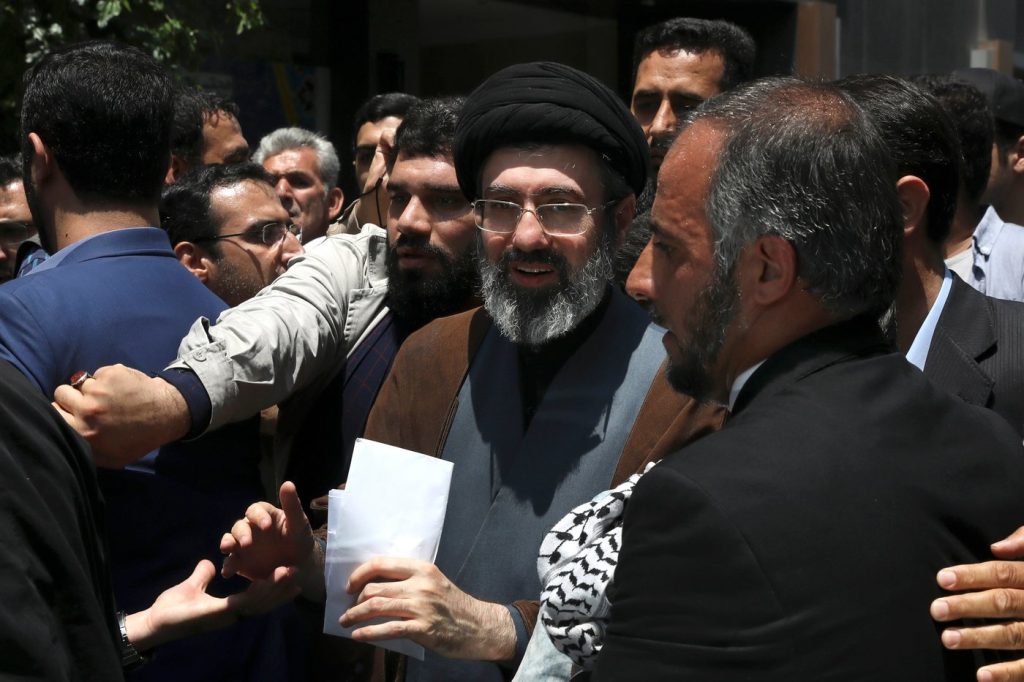
DUBAI, United Arab Emirates (AP) – Mojtaba Khamenei, the son of Iran's late Supreme Leader Ayatollah Ali Khamenei, has emerged as a potential candidate for the nation's next paramount ruler. This speculation arises despite the fact that Mojtaba has never held an elected or appointed government position. His profile as a key figure within the Islamic Republic has intensified following the Israeli strike that resulted in his father's death at the onset of a new war.
Since the Israeli airstrike that targeted the supreme leader's offices and killed his father, Mojtaba Khamenei has remained out of the public eye. Alongside his father, the airstrike also claimed the life of his wife, Zahra Haddad Adel, who hailed from a family closely tied to Iran's theocracy. Although Iranian state media have not reported on his current status, it is believed that Mojtaba is alive and may be in hiding as American and Israeli airstrikes continue to target Iran.
In the wake of these events, Mojtaba Khamenei's name has regained traction as a prospective successor to his father. His potential rise to leadership has raised concerns about the establishment of a theocratic dynasty, resembling Iran's former hereditary monarchy. However, in light of his father and wife's status as martyrs in the ongoing conflict against the US and Israel, Mojtaba's prospects appear to have improved among the clerics of the 88-seat Assembly of Experts, responsible for selecting the new supreme leader.
The next leader will inherit control over Iran's military, which is currently engaged in wartime operations, along with a significant stockpile of highly enriched uranium. Mojtaba's role has been similar to that of Ahmad Khomeini, son of Iran's first Supreme Leader, combining responsibilities such as aide-de-camp, confidant, and power broker.
Mojtaba Khamenei was born in 1969 in Mashhad, Iran, growing up in a family steeped in dissent against the Shah, Mohammad Reza Pahlavi. His early life was marked by political turmoil, with his father becoming a prominent figure in the opposition against the Shah. Following the 1979 Islamic Revolution, Khamenei's family relocated to Tehran, where he participated in the Iran-Iraq War with the Revolutionary Guard’s Habib ibn Mazahir Battalion, establishing connections that would later prove beneficial.
As his father's political influence grew, Mojtaba leveraged the family's access to substantial wealth generated through various bonyads, or foundations, that benefitted from state industries. Over the years, he consolidated power within his father’s office in Tehran, described in leaked U.S. diplomatic cables as "the power behind the robes." Allegations include claims of him tapping his father's phone and building his influence within the regime.
Khamenei is perceived as a capable leader, albeit one lacking theological credentials, but is nonetheless considered a plausible candidate for national leadership. He has collaborated closely with Iran's paramilitary Revolutionary Guard and has been sanctioned by the U.S. due to his role in forwarding Iran's regional ambitions and suppressing domestic dissent. His involvement has included support for hard-line President Mahmoud Ahmadinejad and interference in electoral processes, drawing criticism from fellow political figures.
The potential transition of power is particularly significant as it marks only the second time in the history of Iran’s supreme leadership since the 1979 Islamic Revolution. The new leader will take charge in a time of intense conflict, as the U.S.-Israeli war aims to neutralize Iran's nuclear capabilities and military strength, while also instigating hopes of an uprising against the Iranian regime. The supreme leader wields paramount authority over all state matters, serving as the commander-in-chief of the military and directing the powerful Revolutionary Guard, which has extensive financial assets and control over Iran’s ballistic missile capabilities.








