

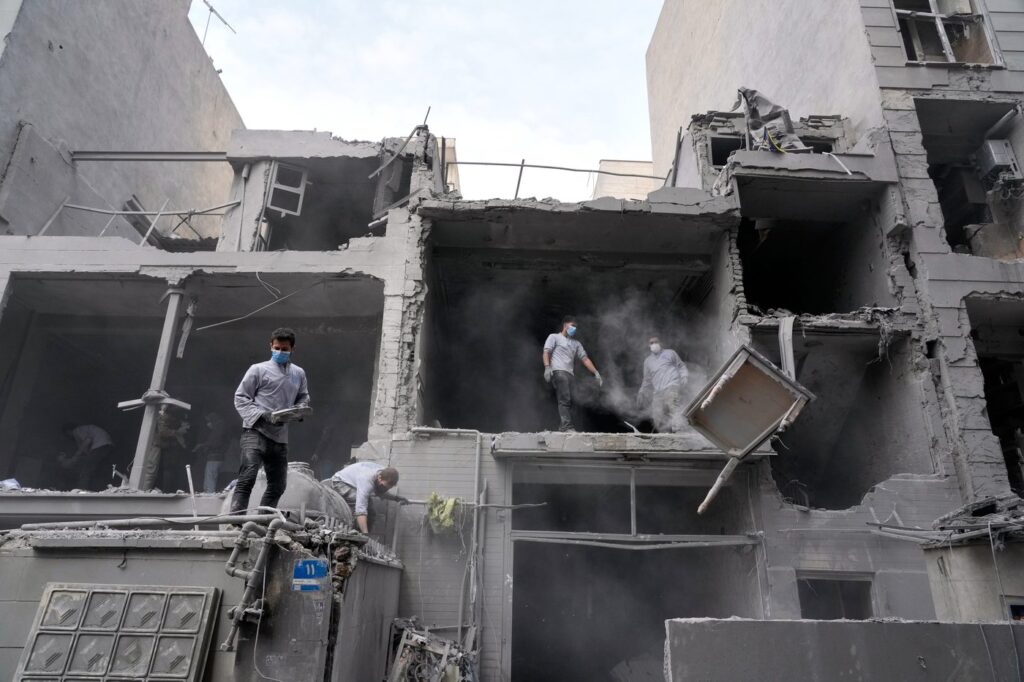
On Tuesday, Israeli Defense Minister Israel Katz announced that the Israeli military had conducted an overnight strike that resulted in the death of prominent Iranian security official Ali Larijani. This attack also reportedly claimed the life of General Gholam Reza Soleimani, the head of the Basij force, which is part of Iran's Revolutionary Guard.
The details of the strike are significant, particularly in light of the ongoing tensions between Israel and Iran. Katz's statement highlighted the strategic military operations aimed at disrupting Iranian leadership, following a notable earlier strike on February 28 that killed 86-year-old Supreme Leader Ayatollah Ali Khamenei. Katz stated, "Larijani and the Basij commander were eliminated last night and have joined Khamenei, the head of the annihilation program, along with all those eliminated from the axis of evil in the depths of hell." This reflects a broader Israeli commitment to targeting influential figures within Iranian governance.
Ali Larijani, who was born on June 3, 1958, comes from one of Iran's most prominent political families. He has held various significant positions, including that of parliamentary speaker and senior policy adviser. His most recent role involved advising the late Khamenei on strategies regarding nuclear negotiations with the United States under the Trump administration. Larijani also served as the secretary of Iran's Supreme National Security Council, which oversees the country's security policies.
Earlier in the year, in January, Larijani was sanctioned by the U.S. Treasury for his role in coordinating a violent crackdown on protests across Iran, which resulted in numerous fatalities and detentions. The U.S. Treasury's characterization of him pointed to his support for violence against peaceful demands from the Iranian populace, branding him as a significant player in the regime’s repressive measures.
Larijani had traditionally been regarded as a conservative within Iran's theocratic framework, serving as parliament speaker from 2008 to 2020. However, as Iran faced mounting external and internal pressures, Larijani shifted towards more aggressive rhetoric, issuing hard-line threats in response to the growing dissent among the Iranian people.
Interestingly, his family ties elevate his profile within Iran; his brother, Sadeq Larijani, has served as the head of Iran's judiciary, further embedding the Larijani family within key power structures of the Iranian state. Despite his prestige, Larijani faced significant political hurdles. The late Khamenei prohibited him from running for president in 2021, especially after he positioned himself as a pragmatic candidate in favor of adhering to the 2015 nuclear agreement with world powers. Following this exclusion from the presidential race, Larijani expressed gratitude to those who supported him, encouraging participation in future elections to promote an "Islamic Iran."
As of now, Iranian state media has not confirmed the reports of Larijani's death or that of Soleimani. However, they indicated that an official statement from Larijani's office would be released soon, potentially responding to the allegations surrounding these high-profile casualties. The potential implications of this strike could further escalate tensions in the already volatile Middle East region, as Israel continues its policy of preemptive strikes against what it perceives as threats from Iranian leadership.








