

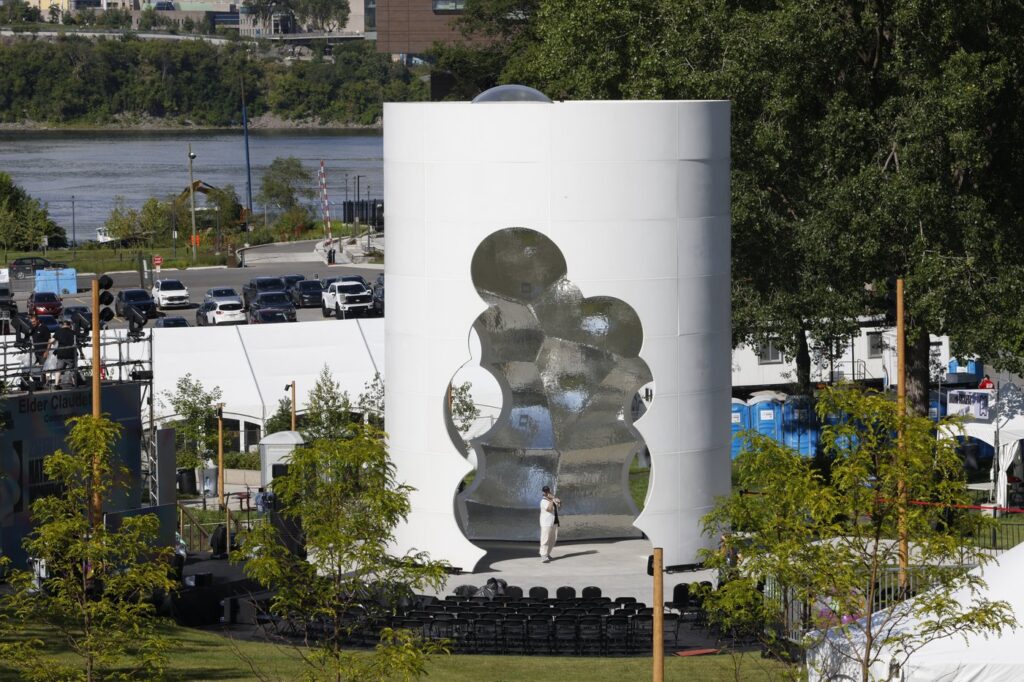
Victims of state persecution are hopeful that Canada’s newly inaugurated national monument dedicated to LGBTQ+ individuals will serve as a space for education, mourning, and celebration. The monument officially opens today in Ottawa, just west of Parliament Hill.
Michelle Douglas, the head of the LGBT Purge Fund, emphasized the importance of sharing stories from the past, stating, “We’re telling the stories of what happened to so many of us, and making sure that Canadians know this is a time we should never return to.” Douglas represents those in the military and public service who were unjustly forced out of their positions due to their sexual orientation or gender identity, a practice that was prevalent among the federal government during the Cold War era.
The Heritage Department describes the Purge as “a prolonged and widespread campaign led by the Government of Canada to identify and expel thousands of lesbian, gay, bisexual, and transgender members of the Canadian Armed Forces, the Royal Canadian Mounted Police and the federal public service.” This campaign initiated in the 1950s and persisted until the 1990s.
The monument's funding comes as part of a $145 million settlement from a class-action lawsuit filed by 719 individuals who claimed they were purged due to their sexual orientation or gender identity. Of this settlement, $15 million was allocated specifically for the creation of the monument and associated memorialization exhibits.
Douglas pointed out that many Canadians remain unaware of the historical injustices that LGBTQ+ individuals faced, asserting, “Not enough people know that this was a historical injustice of great magnitude.” Research estimates indicate that around 9,000 individuals were affected across the federal workforce, facing harassment and discrimination, including Douglas herself. In the late 1980s, Douglas was discharged from the Canadian Armed Forces, marked in her release documents as “not advantageously employable due to homosexuality.” This led to her 1992 lawsuit, which ultimately prompted the military to reform its anti-discrimination policies.
The monument, named Thunderhead, is inspired by a cumulonimbus cloud that signifies potential power and renewal amidst storms, often accompanied by heavy rains and lightning. According to Anishinaabe teachings, thunderheads are sacred, hosting the thunderers, entities “whose storms renew the land and make things right,” as noted by the LGBT Purge Fund.
The design features a sculpture with a cloud imprint crafted from mirrored tiles, incorporating hundreds of thousands of glass squares that resemble disco balls. It also includes Indigenous elements that reflect identities that predate the European gender binary's imposition.
Located along a cycling path by the Ottawa River, the monument is visible from significant landmarks, including the Supreme Court and Parliament. Within the monument's space, visitors can learn about history and reflect in quiet areas, enjoy picnic benches for social gatherings, and host solemn events. This evening, the Public Service Pride Network will hold a dance party at the monument.
Douglas encourages visitors to make the monument meaningful for them, stating, “We can express our joy and our love here... we hope any visitor will make it what they need it to be.” The opening ceremony will feature Douglas, Gov. Gen. Louise Arbour, and various dignitaries and prominent LGBTQ+ Canadians, including individuals who identify as two-spirit.
This ceremony occurs against a backdrop of a global decline in LGBTQ+ rights. Issues have arisen in several countries, such as Senegal and Ghana, where laws have been strengthened to impose harsher penalties for same-sex relations and LGBTQ+ advocacy. In the U.S., former President Donald Trump sought to exclude transgender individuals from federal institutions and reversed protections that had previously been established for minority groups.
“Discrimination must be fought, wherever it exists,” Douglas stated, adding that the experiences of those affected by the LGBT purge serve as a cautionary tale against judging people based on their identities. She voiced concerns about movements aimed at erasing the existence of trans and non-binary individuals, asserting, “We should not have to fight so hard for our mere existence.”
Similar monuments addressing LGBTQ+ history and rights exist globally, including the Homomonument in central Amsterdam, which utilizes granite pink triangles reminiscent of the badges used by Nazis in concentration camps to identify LGBTQ+ individuals.








