

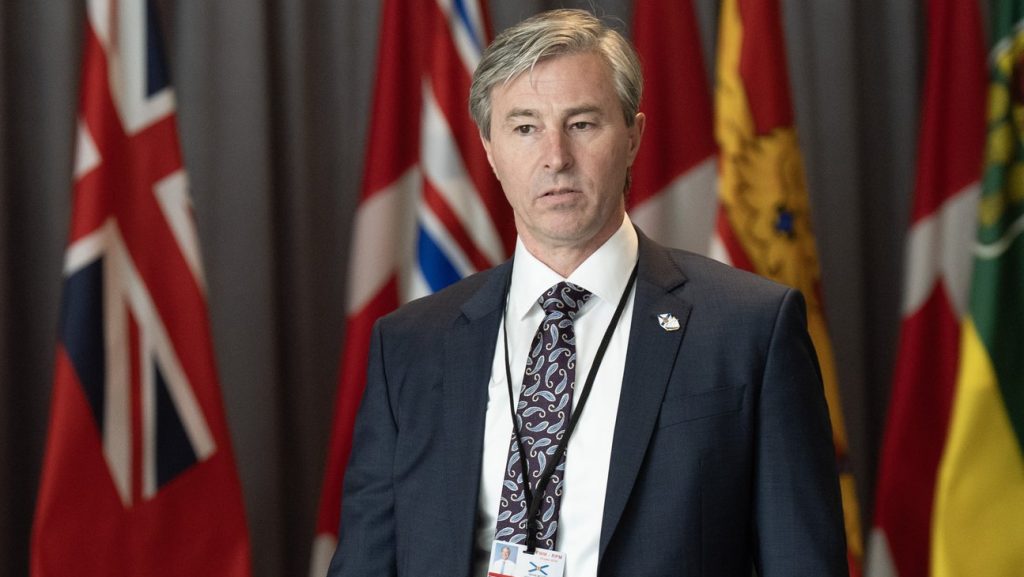
HALIFAX — The popularity of Nova Scotia Premier Tim Houston has significantly declined following controversial budget cuts that sparked public outcry and protests. An Angus Reid poll released recently reveals that Houston’s approval rating has plummeted to 39 percent, marking his lowest rating since he assumed office in 2021. The online survey, conducted between March 11 and 17, indicates that Houston experienced an 11-point drop, the largest decline among any premier in the country.
In response to the budget cuts, several vocal protests have taken place outside the legislature, and Houston has faced boos at various public events. Alex Marland, a political scientist at Acadia University, noted that it was sensible for the premier to amend some cuts and apologize in light of the widespread backlash. He stated, "Sometimes that (change of course) can actually work in your favour... could give you a lot of authenticity and credibility. In a democracy, having a leader listen to the public is a great thing," adding that Houston may have acted too late.
Houston currently ranks sixth out of nine provincial premiers surveyed by Angus Reid, with Quebec Premier François Legault noted as the least popular, holding a 26 percent approval rating. In contrast, Manitoba's Wab Kinew and New Brunswick's Susan Holt received the highest and second-highest approval ratings, respectively. According to the Canadian Research Insights Council, the nature of online surveys means they can't be assigned a margin of error due to the lack of randomness in sampling.
The budget, presented by Houston’s finance minister on February 23, included cuts totaling $304.9 million, which encompassed reductions in public service staff and a rollback of $130.4 million in funding for arts and culture, Mi'kmaq and African Nova Scotian programming, and services for individuals with disabilities. Initially, on March 4, Houston indicated he could not foresee any changes to the budget. However, just six days later, he issued an apology for cutting crucial programs and announced the reinstatement of $53.6 million in funding.
Despite the apology, Marland pointed out that public sentiment shifted from viewing it as a display of empathy to perceiving it as Houston being "backed into a corner." He remarked on Houston's failure to communicate effectively regarding the budget, stating that "the ability to have his finger on the pulse of Nova Scotia was missing," and described the communication surrounding the budget as a "train wreck." Marland further emphasized the government's struggle to convey the fiscal challenges necessitating the cuts.
Claudia Chender, the leader of the Opposition NDP, has called for Houston’s government to completely scrap the current budget and present a new one to Nova Scotians. She criticized the remaining cuts as "cruel" and expressed frustration that ministers are unable to adequately explain the impact of these cuts. The Assembly of Nova Scotia Mi'kmaq Chiefs echoed these concerns, highlighting that the ongoing cuts would compromise programs aimed at addressing systemic racism. Sidney Peters, chief of Glooscap First Nation and co-chair of the assembly, noted that only two out of 21 Mi'kmaq-specific programs affected by the cuts have been restored, indicating that the government’s efforts to assist the vulnerable do not extend to the Mi'kmaq community.
Chender reiterated the need to restore the programs that have been compromised, asserting that the proposed cuts threaten even the most vulnerable Nova Scotians. This includes a range of crucial community programs and funding for arts, culture, tourism, and public transit services, which many believe are essential for the welfare of the province's residents.








