

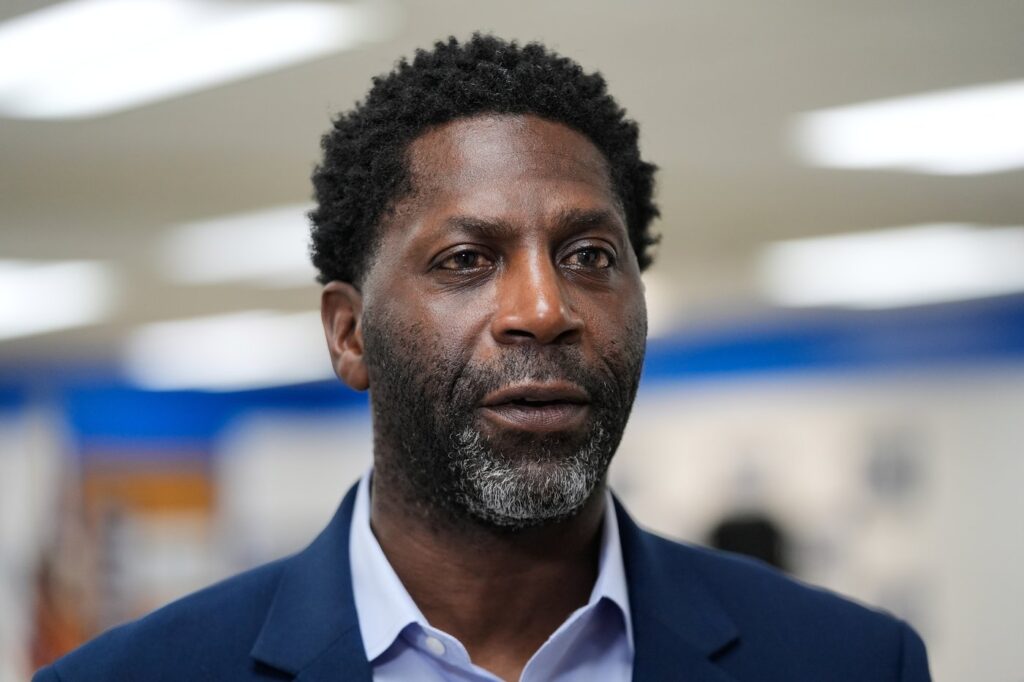
In a critical special election on Tuesday, a small swing district in Michigan is playing a pivotal role in determining whether Democrats can maintain their narrow majority in the state Senate ahead of Governor Gretchen Whitmer's exit from office in January 2025. The election features Democrat Chedrick Greene, a fire captain and former Marine, who is campaigning on a platform focused on lowering costs and receiving strong support from labor unions. He is opposed by Republican Jason Tunney, a former prosecutor, who emphasizes his local roots in Saginaw and runs on conservative principles. Additionally, Libertarian candidate Ali Sledz is also in the race.
The 35th state Senate district, which encapsulates Saginaw, Bay City, and Midland—approximately 100 miles north of Detroit—has a significant influence on Michigan's legislative agenda. With the Democrats holding a slim 19-18 majority, the outcome of this election is crucial, particularly as it influences the legislative landscape during the final months of Whitmer's term. The stakes are heightened as the district’s political dynamics offer insights into broader trends heading into the November midterm elections.
Political analysts consider this race a microcosm of the Midwest, reflecting national voter sentiment. Democratic U.S. Representative Kristen McDonald Rivet noted that the district's voting patterns could serve as an indicator of how the midterm elections will unfold, particularly as Saginaw County is unique in having supported the winning presidential candidate in the last five national elections.
The Republicans have taken the opportunity to critique the timing of the special election, accusing Whitmer of prolonged inactivity that left the district unrepresented in the state Senate for nearly 500 days. A victory for Greene would ensure the Democrats retain their slim majority, while a win for Tunney would result in a tie, complicating Democratic efforts to push their legislative agenda. In the event of a tie, Democratic Lt. Gov. Garlin Gilchrist II would act as the tiebreaker; yet, Republican members could hinder progress by abstaining from votes. It is also noteworthy that the Michigan House is under Republican control, further complicating the political landscape for Democrats.
This special election is for a term that concludes at the end of the year, meaning that the seat will be contested again in November. However, it holds significance as a barometer of voter sentiment ahead of the midterms, where Democrats are keen on regaining power in Congress. Some strategists advise caution in analyzing the results, pointing out that substantial Democratic spending and visits from notable figures, such as former Transportation Secretary Pete Buttigieg and Michigan Senator Elissa Slotkin, could skew perceptions of the electoral landscape. The Democratic Legislative Campaign Committee has invested $250,000 in Greene's campaign in February, framing the election's outcome as a determinant for future midterm strategies.
Despite Donald Trump winning all three counties in the 2024 presidential election, portions of the counties within District 35 are characterized by more competitive dynamics. Historical voting illustrates a significant shift; McDonald Rivet secured the seat with 53% of the vote in 2022, while Democrat Kamala Harris narrowly defeated Trump in the district in 2024, garnering 49.7% to 48.9%. Harris' success can largely be attributed to her 17-point lead in Saginaw, which showcases the district’s diverse voting base.
The region has a longstanding association with the auto industry, leading to a significant population of union-affiliated voters alongside a notable Black community, all of which is surrounded by more conservative rural areas. Cory Smidt from Michigan State University's Institute of Public Policy and Social Research highlighted that the district's demographics and political makeup closely mirror those of the state as a whole. However, he cautioned against interpreting the election results as a definitive measure of midterm outcomes; instead, he suggested that turnout and voting patterns could provide meaningful insights into the electorate’s mood.








