

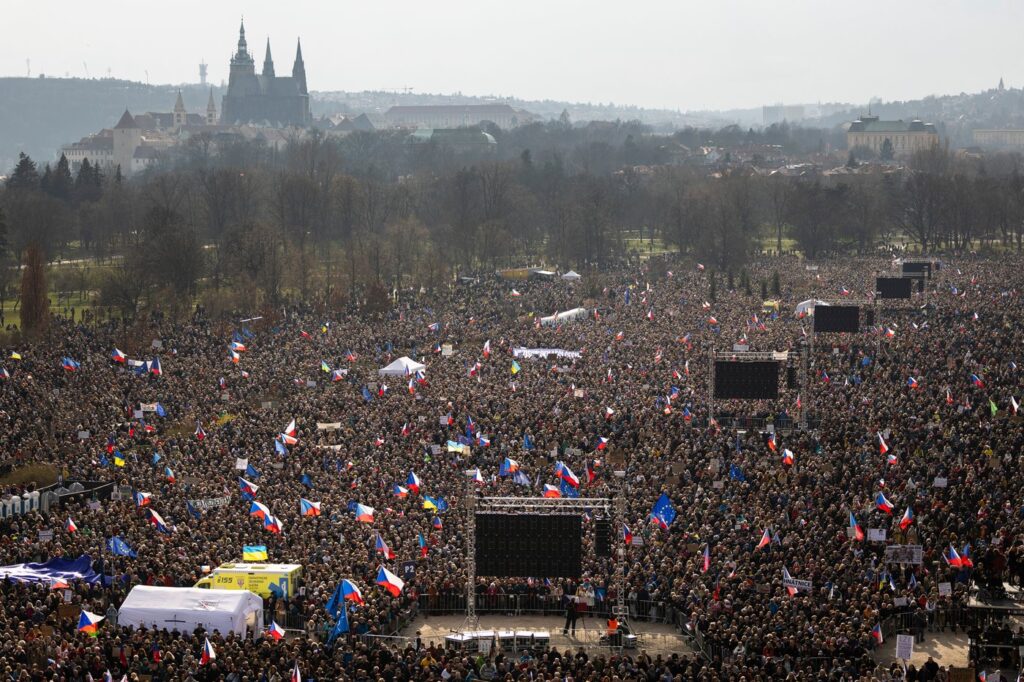
On Saturday, tens of thousands of protesters gathered in Prague to voice their dissent against the policies of the new Czech government led by populist Prime Minister Andrej Babiš. The demonstration took place at Letná Park, a historical site known for its pivotal role in the 1989 protests that contributed to the fall of communism in Czechoslovakia. Organizers estimated that around 200,000 people were present, many waving Czech national flags and carrying banners that called for the defense of democracy.
The protesters raised concerns that Babiš, a billionaire, along with his coalition government, poses a threat to democratic principles. They fear that the government is steering the Czech Republic away from supporting Ukraine and towards adopting authoritarian governance, similar to the political climates in Slovakia and Hungary. "We're here to clearly stand against dragging our country onto the path of Slovakia and Hungary," stated Mikuláš Minář, the event's head organizer from the Million Moments for Democracy group.
Babiš returned to power after his political movement, ANO (YES), achieved significant success in the October elections, forming a coalition with two smaller parties: the Freedom and Direct Democracy party, known for its anti-migrant stance, and the right-wing Motorists for Themselves. This coalition is pushing to redefine Czech domestic and foreign policies significantly.
Recently, Babiš has shown opposition to several key European Union initiatives, particularly concerning environmental regulations and migration. He has also rejected financial support for Ukraine during its ongoing conflict with Russia. This stance aligns him with other leaders in the region, such as Hungary’s Viktor Orbán and Slovakia’s Robert Fico, who share similar pro-Russian sentiments.
A new bill drafted by the government has also raised alarm among critics, as it resembles a Russian law concerning foreign agents. It would require non-governmental organizations (NGOs) and individuals engaged in vaguely defined political activities to register if they receive foreign funding, imposing significant fines for non-compliance. Václav Pavlík, former head of the Academy of Sciences, warned at the demonstration that "this law can easily be used to restrict personal freedom."
Further complicating the political landscape is the government’s proposal to alter how public radio and television are funded, a move perceived by many as an attempt to gain control over state broadcasters. The Million Moments group organized this protest following a critical decision by the lower house of parliament not to lift Babiš’s parliamentary immunity in a $2 million fraud case involving EU subsidies. This decision means that he will only face trial after his term in the house ends in 2029. The lawmakers also declined to allow for prosecution against Tomio Okamura, the lower house Speaker and head of the Freedom party, who has been accused of inciting hatred.
The Million Moments for Democracy group has accused the government of creating a divide between "ordinary people" and "the untouchables," highlighting concerns over social inequality and justice. Young protesters like Michael Šernohlávek, a 19-year-old student, shared their motivations for attending, emphasizing the importance of safeguarding the existing democratic freedoms. He stated, “I know that the system we have, our freedom, can’t be taken for granted, and it is important for me to protect it.”
As the tension between the government and citizens continues to escalate, organizers have announced plans for further protests in the future.








