

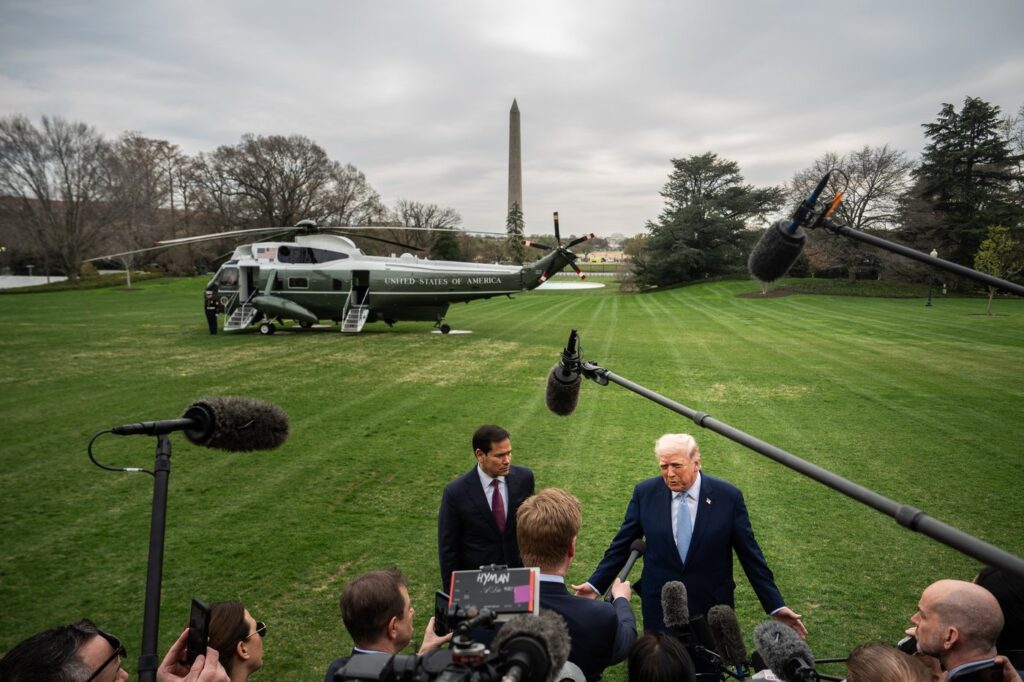
President Donald Trump has generated confusion through a series of contradictory statements regarding the ongoing Iran war. In just a few hours on Friday, he indicated that he was considering winding down U.S. military efforts in the Middle East while simultaneously confirming the deployment of additional troops to the region. Furthermore, the administration lifted sanctions on some Iranian oil, a move that relieved some economic pressure but also raised doubts about the clarity and effectiveness of U.S. strategy.
On Friday afternoon, Trump's remarks on his social media platform suggested that the United States was nearing its objectives in the war. He claimed that the U.S. had sufficiently degraded Iran's military capabilities and halted its pursuit of nuclear weapons. However, he controversially suggested that American forces could withdraw from the conflict without ensuring stability in the Strait of Hormuz, a vital channel for global oil transport now under threat from Iranian attacks.
The Hormuz Strait, through which around one-fifth of the world’s oil supply flows, has been heavily targeted during the conflict. While Trump asserted that the U.S. does not need to police the region, he also stated that America would assist if requested. His contradictory remarks highlighted an unclear stance on vital security issues, exacerbating concerns among critics regarding a lack of coherent long-term strategy.
The market response to Trump’s announcement was significant, with the S&P 500 index dropping by 1.5% amid surging oil prices. Increased chaos in the Middle East, including Israeli strikes on Iranian facilities and retaliatory Iranian actions, added to market volatility. U.S. fuel prices also spiked, demonstrating that global oil prices are intrinsically linked, regardless of the specific region involved.
In tandem with Trump’s comments about winding down military operations, his administration announced the deployment of three more warships and approximately 2,500 Marines to the Middle East. This marked the second surge of military personnel within a week and raised the total U.S. forces supporting the conflict to around 50,000. Although Trump dismissed the idea of sending ground troops, there were hints from his administration that special operations forces could be deployed if necessary. Analysts have expressed that a ground presence may ultimately be essential for securing strategic interests in the region.
On the sanctions front, the administration decided to lift restrictions on Iranian oil sales but only for oil that was already at sea as of Friday. This controversial move aimed to alleviate escalating energy prices by allowing a freer flow of Iranian oil, providing a temporary economic lifeline to the Iranian government that the U.S. has targeted. Although the administration had employed various mechanisms to bring down oil prices, such as tapping into the strategic petroleum reserve and relaxing restrictions on Russian oil, Brent crude still soared to $112 per barrel. Analysts predict that high oil prices will persist in the near future regardless of ongoing military developments.
Following the decision to lift sanctions, Treasury Secretary Scott Bessent noted that Iran’s sanctioned oil was predominantly being stored by China at reduced prices. By permitting the release of this oil into the market, Bessent suggested that around 140 million barrels could become available globally, albeit only representing a few days' worth of the entire market's consumption. Expert Patrick De Haan from GasBuddy cautioned that the temporary sanction lift is unlikely to significantly affect gas prices, as the instability surrounding the Strait remains a more pressing issue.
The contradictions inherent in the administration's decisions have not gone unnoticed, even among Republican representatives, with South Carolina Rep. Nancy Mace criticizing the dual approach of simultaneously bombarding Iran while attempting to purchase its oil. These inconsistencies continue to fuel skepticism regarding the overarching strategy for the war, leaving many U.S. policymakers and citizens alike questioning the effectiveness of the current U.S. foreign policy regarding Iran.








