

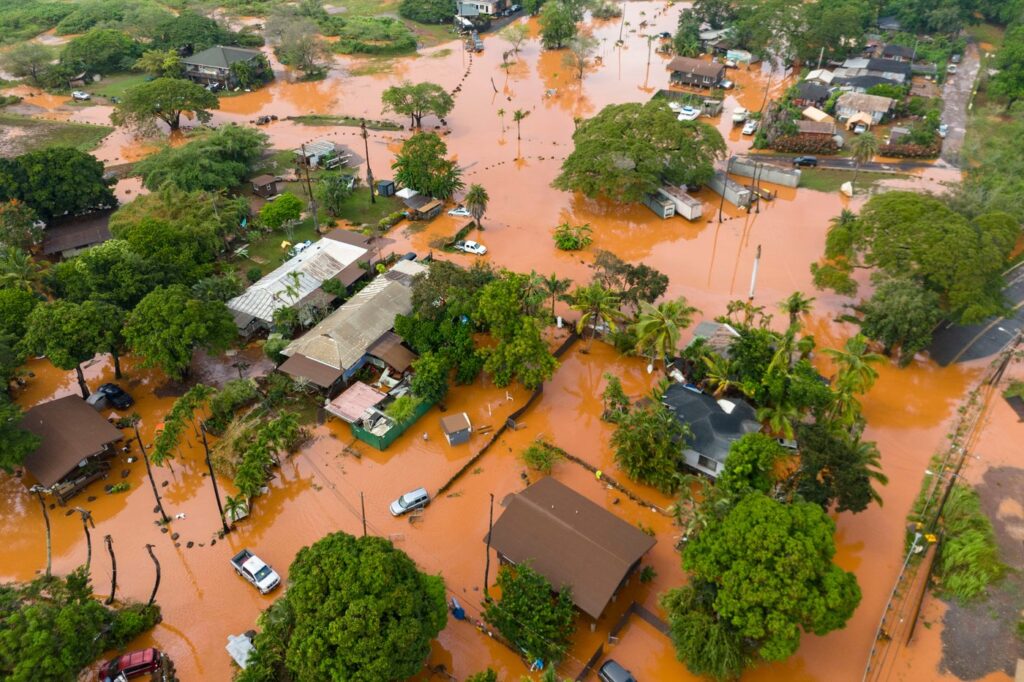
HONOLULU (AP) — Hawaii is currently facing its most severe flooding in over two decades as officials have issued urgent evacuation warnings for impacted areas, particularly urging residents in Waialua to "LEAVE NOW." This emergency response on Saturday followed heavy rainfall that worsened conditions on soil already saturated from a prior winter storm a week earlier. Additional rain was anticipated throughout the weekend, which has heightened concerns over ongoing threats.
Oahu’s North Shore, known internationally for its big-wave surfing, has been inundated with muddy floodwaters, causing substantial damage as raging currents lifted homes and vehicles. Approximately 5,500 individuals north of Honolulu are currently under evacuation orders as officials expressed fears of potential failure of a century-old dam. The National Weather Service had issued a flash flood warning early Saturday amid expectations of transitioning from light to moderate showers to more intense downpours.
Governor Josh Green warned that the economic toll from the disaster could exceed $1 billion, impacting infrastructure across airports, schools, roads, and a hospital in Kula, Maui. Green conveyed the seriousness of the situation at a press conference, highlighting the impending catastrophe for the state.
The entirety of Hawaii remained under flood watch, particularly Haleiwa and Waialua, the areas most heavily affected by the rainfall. Emergency alerts reinforced the necessity of evacuating Waialua, citing that the access road out of the area was at high risk of failure if the rainfall continued.
Direct communications have taken place between state officials and the White House, ensuring that federal support would be available in response to the crisis. Fortunately, no fatalities have been reported thus far, and authorities confirmed that no individuals remain unaccounted for. Over 200 rescues have been conducted, though around 10 people have experienced hypothermia due to the extreme conditions.
Emergency crews have utilized both aerial and aquatic resources in rescue efforts, yet challenges arose as personal drones were flown by individuals seeking to capture images of the flooding, complicating these operations. In a notable incident, 72 children and adults from a spring break youth camp on Oahu’s west coast were airlifted for safety, with officials preferring not to leave them in place despite the camp's high-ground location.
Governor Green noted that the scale of flooding is reminiscent of the 2004 disaster in Manoa, which caused significant damage, including to residences and the University of Hawaii library. Initial estimations suggest that dozens, if not hundreds, of homes were adversely affected, but comprehensive assessments of the destruction remain pending as evacuation orders remain in place.
Records show that areas of Oahu experienced rainfall amounts ranging from 8 to 12 inches (20 to 30 cm) overnight, with the island's highest peak, Kaala, receiving nearly 16 inches (40 cm) in just one day. Forecasts predict an additional 6 to 8 inches (15 to 20 cm) of rain over the next two to three days, escalating concerns over further flooding.
The recent deluges have been attributed to winter storm systems termed "Kona lows," characterized by moist air masses driven by southerly winds. Experts have also noted that the frequency and intensity of such rainfall events have amplified due to climate change attributed to human activity.
Particular attention remains on the aging Wahiawa dam, which has been flagged for its high hazard potential over the years, with officials expressing grave concerns about the imminent risk of failure. Water levels at the dam had receded, but forecasters warned that conditions could rapidly change with further rain accumulation.
As of recent reports, the dam’s water level peaked at over 85 feet (26 meters) before dropping slightly, although authorities remain vigilant about the potential for dangerous levels following additional rain. Waialua resident Kathleen Pahinui shared her concerns regarding the aging infrastructure while preparing to evacuate, expressing the community's hope for safety amidst the dire circumstances.
Currently, the state regulates 132 dams across Hawaii, most of which were originally constructed as part of irrigation projects for the sugar cane industry. The Wahiawa dam was constructed in 1906, initially to support agricultural production, and has been subject to scrutiny over safety compliance in recent years.








