

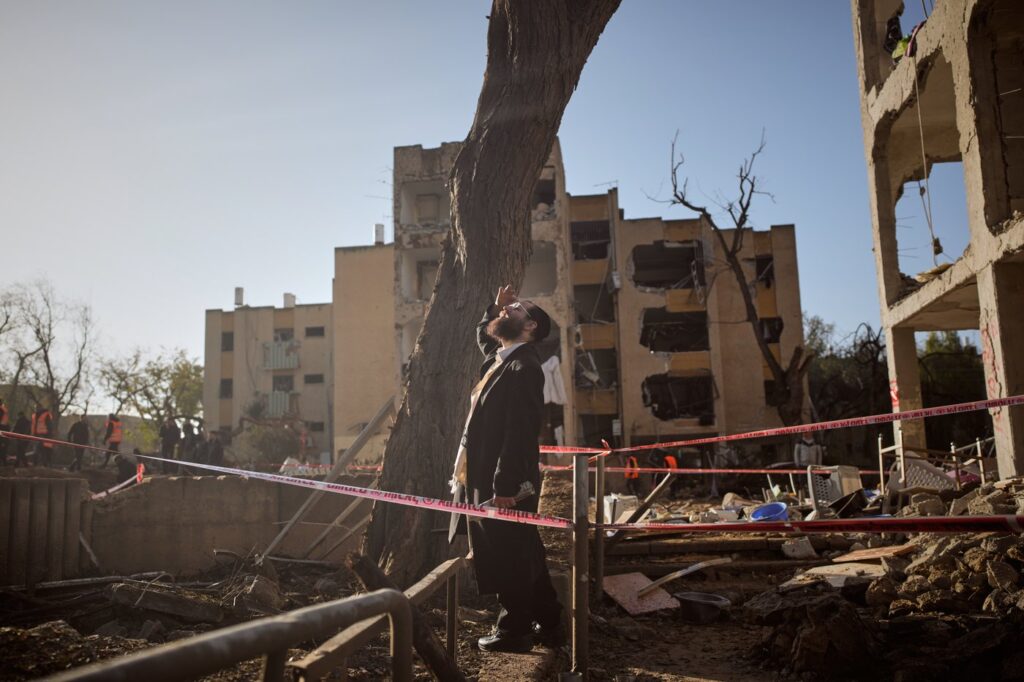
CAIRO (AP) – U.S. President Donald Trump issued a stark warning, stating that the United States would “obliterate” power plants in Iran if the country does not fully open the strategic Strait of Hormuz within 48 hours. This escalation follows a wave of Iranian missile strikes that targeted two cities in southern Israel, particularly near Israel's main nuclear research center, resulting in dozens of injuries and extensive damage to residential buildings.
These developments indicate a potentially perilous new phase in the ongoing conflict in the Middle East, now in its fourth week. On Sunday morning, air raid sirens sounded across Israel as residents in the cities of Dimona and Arad were met with the aftermath of the attacks. The missile strikes on Arad led to injuries for at least 64 individuals. Additionally, in northern Israel, a civilian was killed by fire from the Lebanese militant group Hezbollah.
In Qatar, authorities reported a tragic accident where six individuals were confirmed dead in a helicopter crash in the Persian Gulf, with one person still missing. The casualties included three Qatari forces and three Turkish nationals, comprising a military officer and two civilians. The incident was attributed to a “technical malfunction.”
In his ultimatum issued on Saturday, Trump elaborated on the consequences if Iran does not comply, stating that the U.S. would target various power plants, beginning with the largest. This likely refers to either the Bushehr nuclear power plant or the Damavand natural gas facility located near Tehran.
In response, Iran cautioned on Sunday that any assault on its energy infrastructure would result in retaliatory strikes against U.S. and Israeli energy and military assets within the region. This warning was conveyed through statements made by Iranian military officials disseminated via state media outlets.
The Strait of Hormuz, a vital maritime route connecting the Persian Gulf to the world’s oceans, has seen severe disruptions due to attacks on commercial vessels, which have effectively halted oil and gas shipments, leading to significant output reductions from several major oil producers.
Seyed Ali Mousavi, Iran's Permanent Representative to the International Maritime Organization, indicated that navigation through the strait would be permitted for “everyone except enemies,” signaling that Tehran would selectively allow vessel passage. Notably, Iran has already authorized the passage of ships bound for China and other parts of Asia.
In a significant development, Israel’s military reported that it was unable to intercept the missiles that struck Dimona and Arad, marking the first successful penetration of Iranian missiles through Israel's air defense systems in that area. Iranian Parliament Speaker Mohammad Bagher Ghalibaf noted that Israel's failure to intercept missiles aimed at the heavily guarded Dimona facility represented a shift in the operational dynamics of the conflict.
Israel's hard-line national security minister, Itamar Ben-Gvir, emphasized the urgency of the situation during a visit to Arad, describing Israel's current struggle against Iran as a “historic battle” that must continue until victory is achieved. Reportedly, Israel is considered the only nuclear-armed nation in the Middle East, though it has neither confirmed nor denied such claims. The U.N. nuclear watchdog stated that it had not detected any damage or abnormal radiation levels at the Israeli center following these attacks.
The Iranian missile strikes followed an assault on its primary nuclear enrichment site at Natanz, which Israel has denied responsibility for. The International Atomic Energy Agency noted that most of Iran's enriched uranium stockpile was situated at its Isfahan facility, prompting investigations into the strike at Natanz.
The ongoing conflict has resulted in a mounting death toll, claiming over 1,500 lives within Iran and causing significant casualties among Israeli civilians and U.S. military personnel. The violence has also spurred extensive humanitarian crises in Lebanon, where Israeli strikes against Hezbollah have reportedly resulted in over 1,000 deaths and displaced more than 1 million individuals. The broader impacts of this war extend beyond the immediate region, contributing to rising food and fuel prices globally.








