

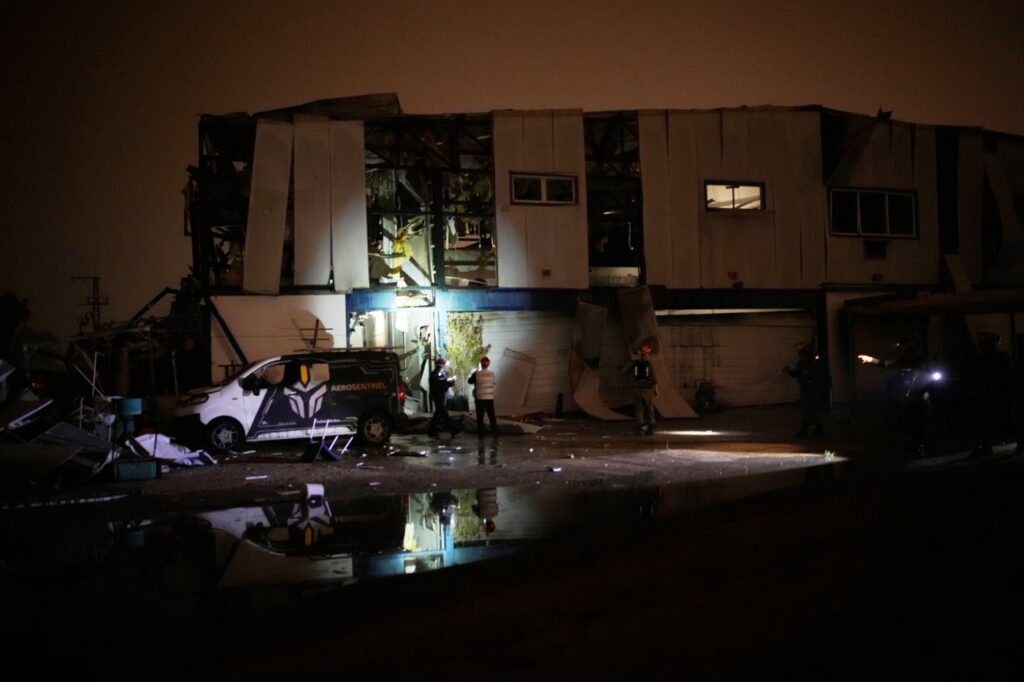
DUBAI, United Arab Emirates (AP) - Iran has launched attacks on targets throughout the Middle East, while American and Israeli airstrikes have been directed at the Islamic Republic as the war approaches its fifth week without a resolution. Tensions are escalating, particularly around the strategic Strait of Hormuz, prompting a meeting of the U.N. Security Council to address Iran's influence over this critical maritime passage.
Despite assertions from U.S. and Israeli officials that Iran's military capabilities have been significantly degraded, the nation has persisted in applying pressure on both Israel and its Gulf Arab neighbors. Reports from Bahrain and Kuwait indicate early morning missile barrages originating from Iran, with Israel also announcing the interception of incoming threats. Activists have documented strikes in and around Tehran and the central city of Isfahan, though the precise targets remain unclear.
Iran's operations targeting Gulf region energy infrastructure and its firm control over the Strait of Hormuz—which sees a fifth of the world’s oil and natural gas traffic in peacetime—have led to soaring oil prices and disruptions in global economies. The spot price of Brent crude, the international benchmark for oil, surged to around $109 early Friday, marking a 50% increase since February 28, when Israel and the United States began their military campaigns against Iran.
The ongoing conflict has severely impacted shipping routes through the Strait of Hormuz, which had previously been open to navigation. U.S. President Donald Trump has publicly stated that it is no longer Washington's responsibility to secure the waterway, urging the nations that rely on fuel shipments to "build some delayed courage" and take action themselves.
The U.N. Security Council is expected to vote on a proposal from Bahrain on Saturday, aiming to authorize defensive measures to ensure the safe transit of vessels through the strait. The initial draft from Bahrain sought to enable countries to use “all necessary means” to secure this vital shipping lane; however, opposition has emerged from Russia, China, and France—countries with veto power on the Council—against the use of force.
French President Emmanuel Macron, speaking during a visit in South Korea, described the expectation that the Strait of Hormuz could be forcibly reopened as unrealistic. He cautioned that any military operation would require substantial time and could expose vessels to threats from Iran's Revolutionary Guard. Macron emphasized that the reopening of the strait could only be achieved through negotiations with Iran following a potential ceasefire.
Discussions led by Britain and involving more than 40 countries are focusing on political solutions rather than military options to secure the strait. These discussions, which notably excluded the U.S., encouraged heightened diplomatic efforts and potential sanctions against Iran.
As the conflict escalates, the humanitarian impact is substantial. More than 1,900 individuals have died in Iran since the beginning of the war, with 19 fatalities reported in Israel. The casualty count includes over two dozen in Gulf states and the occupied West Bank, alongside 13 U.S. service members. The war has also devastated Lebanon, with over 1,300 deaths and more than 1 million displaced due to intensified Israeli military operations against the pro-Iranian Hezbollah militant group, resulting in the deaths of 10 Israeli soldiers.
In conclusion, the situation remains dire as military actions continue to claim lives and jeopardize the region's stability, while international diplomatic efforts to address the crisis are ongoing.








