

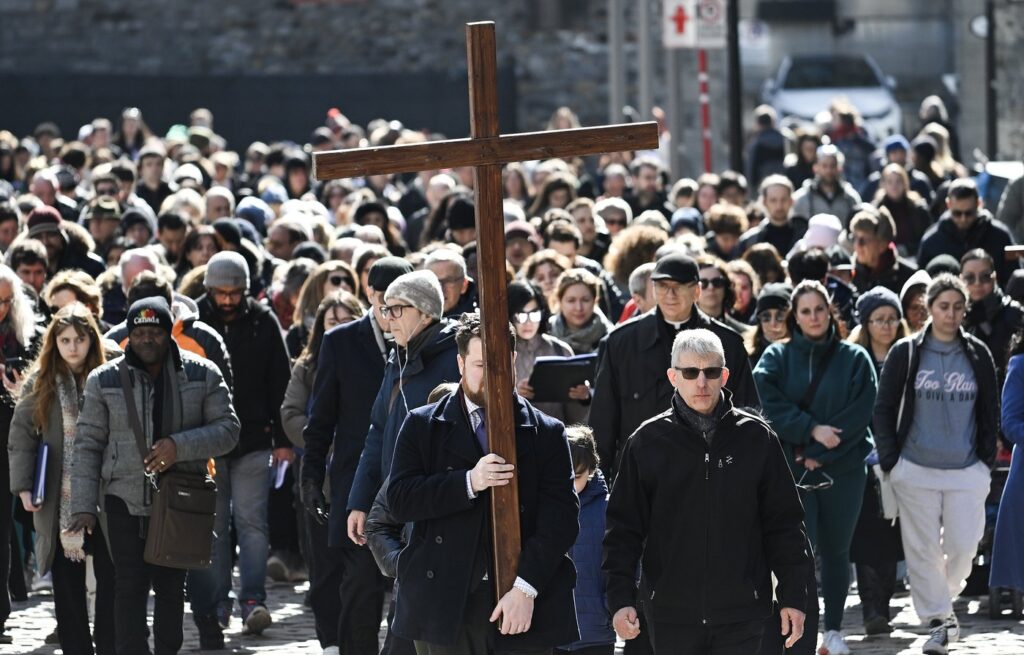
MONTREAL – Christians throughout Quebec are grappling with a new legal framework on Good Friday, following the provincial legislature's adoption of a law that impacts their annual Way of the Cross processions. A significant gathering is planned in Montreal, where several hundred participants are expected to join Archbishop Christian Lépine for a march characterized by “prayer, reflection, and silence.” This procession will proceed through the streets, culminating in stops at various historic churches to commemorate Jesus's journey to the cross.
However, the new legislation poses challenges for the future organization of such events, as it introduces a ban on public prayer. On Thursday, the Quebec government passed a law extending restrictions on wearing religious symbols in public workplaces to include daycare workers, and it prohibits prayer rooms in public institutions. Moreover, public prayer now requires explicit consent from municipalities.
The law stipulates, “No public road … or public park may be used for the purposes of collective religious practice unless a municipality authorizes, exceptionally and on a case-by-case basis, such a use in its public domain by resolution of the municipal council.” This regulation has raised concerns among religious leaders about their ability to exercise their faith openly.
Martin Laliberté, head of the Assembly of Quebec Catholic Bishops, expressed his fear that the legislation effectively relegates religious practitioners to second-class citizenship. He pointed out that street closures and public demonstrations occur frequently for various secular events, yet religious gatherings are now subject to stricter scrutiny. “If we do it for religious reasons, we don’t have the right,” he said, highlighting the inequity faced by believers.
In the past, organizers of the Way of the Cross and other processions have coordinated with local authorities while adhering to municipal regulations, but they have never been required to seek explicit permission until now. Laliberté emphasized that what was previously a right has become a privilege contingent on municipal approval, creating uncertainty for church leaders who now depend on the goodwill of local councils for event permits.
Moreover, he noted that the law's implications extend beyond ceremonial practices, as it invokes powers enabling the province to override certain sections of the Charter, potentially shielding the secularism law from judicial review. “We have rights, according to the Charter,” he asserted, “which say you have a right to express your faith publicly. But with the new law, people don’t have this right anymore. That’s a big shift for us.”
The Quebec Catholic bishops participated in consultations regarding the legislation, voicing their concerns specifically about the public prayer ban and the expansion of restrictions on religious symbols. Despite their feedback, the government remained unwilling to modify the proposed changes.
John Zucchi, the national director of Communion and Liberation Canada, which organizes the Montreal Way of the Cross procession, reported that they typically communicate with police regarding the event but have previously been informed that it is not obligatory to notify the city. Last year's event drew nearly 1,000 participants who walked silently behind a person carrying a crucifix, visiting various churches for singing, gospel readings, and poetry recitations. Zucchi noted that attendance has increased in recent years, nearly doubling since the COVID-19 pandemic.
Commenting on the significance of the procession, Zucchi described it as a meditation characterized by “soberness” and “quiet dignity.” He shared the apprehensions of religious leaders about the new law, though he remains hopeful about its immediate effects on their annual march in Montreal, citing a history of goodwill from local authorities and police.
Zucchi also raised a question regarding the nature of “public prayer,” pondering the categorization of a silent procession within the law's parameters. “With the case of a procession done in silence, what constitutes prayer?” he queried, reflecting the uncertainty surrounding the application of the new restrictions.
This complex legal and social landscape poses significant questions about the rights of religious citizens in Quebec as they navigate the implications of this recent legislation.








