

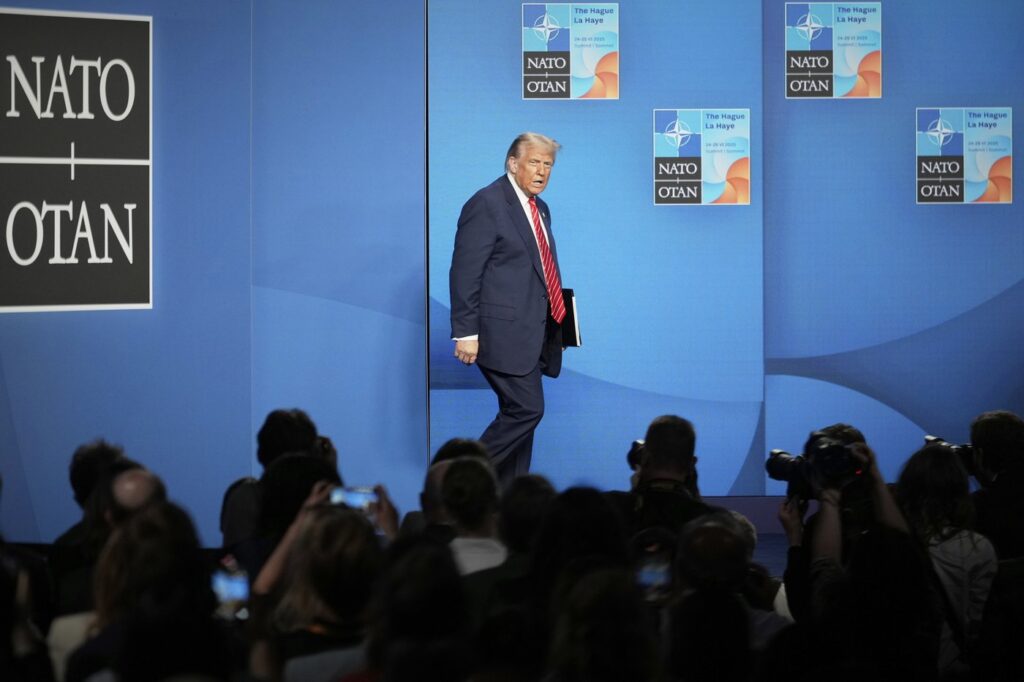
OTTAWA — President Donald Trump's recent comments to a British newspaper have reignited speculation surrounding the potential withdrawal of the United States from NATO, a defensive alliance that includes Canada. In an interview with the Daily Telegraph, Trump expressed his frustration with NATO allies, asserting that they have failed to support America in its conflicts, particularly in the ongoing tensions with Iran. He labeled NATO as a "paper tiger" and suggested that the idea of the U.S. leaving the alliance is "beyond reconsideration," prompting serious concerns among experts regarding Western security.
Aaron Ettinger, an associate professor of political science at Carleton University, emphasized the gravity of the situation, stating that the threat of U.S. withdrawal from NATO must not be taken lightly. He warned against dismissing Trump's threats as mere bluster, referring to the acronym "TACO" (Trump Always Chickens Out), which scrutinizes the president's tendency to issue aggressive declarations before backing down. He highlighted that NATO's strength heavily relies on U.S. participation, making the prospect of abandonment a realistic concern.
According to the latest NATO annual report released recently, the United States accounted for 60 percent of the total defense expenditures among NATO allies. While the seriousness of Trump's withdrawal intentions remains uncertain, experts suggest several methods he could employ to exit the alliance or disrupt it from within.
Ettinger noted that although it is legally possible for Trump to withdraw from NATO, the process is not simple. The NATO Charter allows any member to leave the alliance with one year’s notice; however, U.S. domestic law complicates the situation. A law enacted in 2023 stipulates that the president must consult Congress and obtain two-thirds Senate approval to withdraw from NATO. Ettinger remarked that any attempt to exit would likely involve legal battles, potentially reaching the Supreme Court, and constitutional law would favor the legislative restrictions put in place by Congress.
Trump's potential legal hurdles are compounded by the fact that the 2023 law limiting presidential withdrawal from NATO was introduced by Marco Rubio, a former Florida senator who argued that any U.S. president should require senate approval to leave the alliance. Consequently, any attempt by Trump to unilaterally withdraw risk significant legal challenges and prolonged litigation.
Experts believe that withdrawing from NATO is not the only avenue available to Trump. Wendy Gilmour from the Conference of Defence Associations think-tank pointed out that Trump has demonstrated the capacity to create chaos without formally exiting the treaty. She suggested that he might utilize executive orders—even if they lack a clear legal foundation—to reduce U.S. support for NATO operations. This option, while sidestepping a formal withdrawal, could severely impact the alliance's functionality.
Roland Paris, an international affairs professor at the University of Ottawa, echoed similar concerns. He proposed that Trump could effectively undermine NATO's operations by cutting funding and withdrawing military participation while still remaining a formal member. For instance, removing the U.S. military’s participation or the American position of supreme allied commander could lead to significant operational paralysis within NATO.
When questioned about Canada’s contingency plans in the event of U.S. withdrawal from NATO, Foreign Affairs Minister Anita Anand reiterated Canada's unwavering commitment to the alliance. She stated that Canada remains steadfast in its decision-making regarding collective defense in the NATO framework, recently meeting its commitment to allocate two percent of its GDP towards defense spending.
This week’s discussions on NATO were not limited to Trump alone. U.S. Secretary of Defense Pete Hegseth also failed to reaffirm the U.S. commitment to the alliance during a press conference. He indicated that an alliance loses its value if member nations are unwilling to support each other when needed. Hegseth's sentiments reflected concerns raised by Rubio, who suggested a necessary reevaluation of NATO's purpose and its implications for U.S. support.
The backdrop to these discussions includes international conflicts, particularly the ongoing war with Iran, where nations like Spain and Italy have curtailed the use of their airbases by U.S. military forces. This resistance raises questions about the future dynamics of NATO, especially as concerns arise regarding violations of international law amidst military actions.
Despite Trump’s earlier threats to exit NATO, he refrained from criticizing the alliance during his prime-time address on the war, instead urging allies to bolster military efforts in pivotal regions like the Strait of Hormuz, reflecting a complex relationship between U.S. foreign policy and NATO obligations.








