

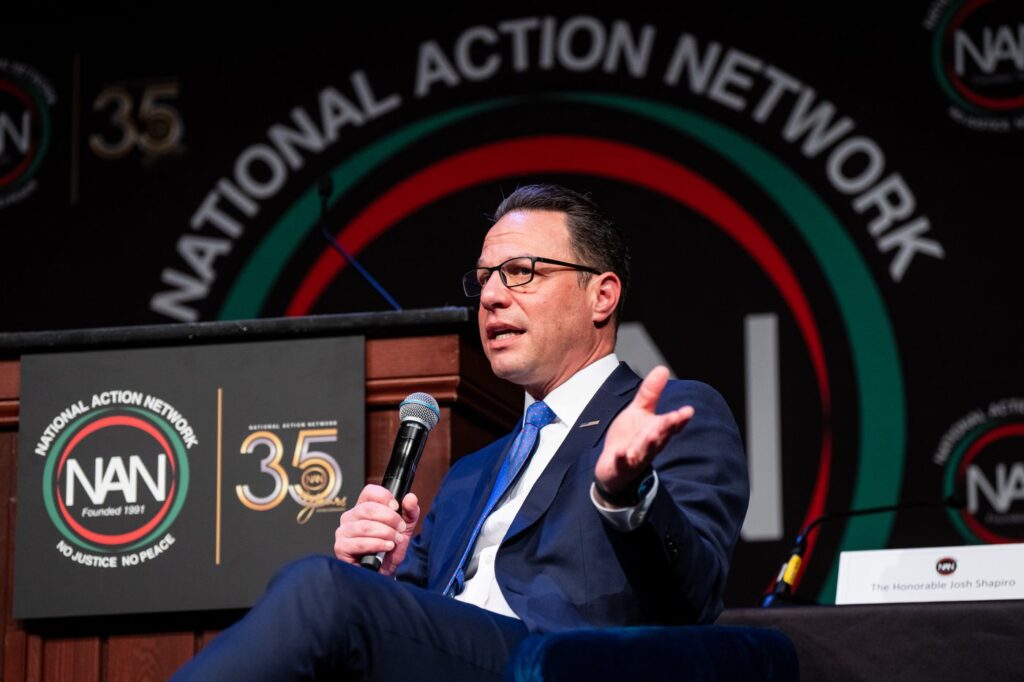
NEW YORK – The Democratic Party is actively engaging with African American activists in New York this week as the unofficial contest for the 2028 presidential nomination begins to take shape at an annual conference organized by Rev. Al Sharpton. Notable figures among the Democratic hopefuls, like Pennsylvania Governor Josh Shapiro, have taken to the stage to articulate their visions and strategies aimed at garnering support from this critical voting demographic.
Governor Josh Shapiro opened the conference by denouncing President Donald Trump's leadership, attributing it to a nationwide increase in antisemitism, Islamophobia, racism, and general bigotry. He emphasized the growing chaos and cruelty in society, asserting that even amidst disagreements on policies like health care or taxation, the baseline expectation should be an honorable president, which he believes Trump does not represent. Shapiro, already considered a frontrunner for the 2028 nomination, used the platform to further his message about accountability and social justice while criticizing Trump as a key issue for upcoming elections.
The National Action Network's four-day conference is drawing more than half a dozen potential candidates who are eager to connect with Black leaders—an indispensable group within the Democratic Party's voter base. While the primary election season is set to commence in earnest after the November midterm elections, this week’s event highlights the candidates positioning themselves for a competitive race. Rev. Sharpton, the founder and president of the National Action Network, emphasized the importance of understanding candidates' visions and actions in the present as they prepare for the future.
In addition to Shapiro, the conference includes a diverse lineup of speakers such as Maryland Governor Wes Moore, Illinois Governor JB Pritzker, former Transportation Secretary Pete Buttigieg, Kentucky Governor Andy Beshear, Representative Ro Khanna from California, and Arizona Senators Mark Kelly and Ruben Gallego. Former Vice President Kamala Harris is also scheduled to give remarks. Notably, California Governor Gavin Newsom, another likely contender for the nomination, is absent due to family commitments, although he did meet with Sharpton earlier this year.
The influence of Black voters in Democratic primaries cannot be overstated. Historical context shows that enthusiasm within this community can drastically sway the outcome of nomination contests. In the 2020 primaries, despite Buttigieg’s strong performances in predominantly white states like Iowa and New Hampshire, Joe Biden harnessed the substantial support of Black voters in South Carolina to secure his position as the nominee. This dynamic demonstrates the critical role Black voters play in shaping Democratic contests.
All prospective candidates seem to settle on criticizing Trump while acknowledging the necessity for Democrats to differentiate themselves by showcasing their values and policies. Khanna, known for his ties to Bernie Sanders, stressed the importance of engaging Black voters through a narrative that connects to the Civil Rights tradition and historical figures like Frederick Douglass and Martin Luther King Jr. He articulated the need for a new moral vision that embraces racial justice, economic equity, and global peace while opposing militarism and wealth inequality.
During his speech, Shapiro also aimed to project himself as a candidate in alignment with the priorities of African Americans. He positioned Pennsylvania as a pivotal swing state and reiterated the importance of diversity, equity, and inclusion initiatives, while emphasizing accountability for law enforcement. Further attacking Trump, he framed the upcoming midterm elections as a referendum on the current state of affairs in Washington, D.C.
Ashley Sharpton, Rev. Sharpton’s daughter, expressed enthusiasm about the responses garnered by speakers such as Shapiro and Khanna, noting the palpable engagement from the audience. She remarked on the collective craving for the energy and consistency that speakers bring to the event, highlighting the significance of this gathering for Democratic aspirants seeking to resonate with Black voters.








