

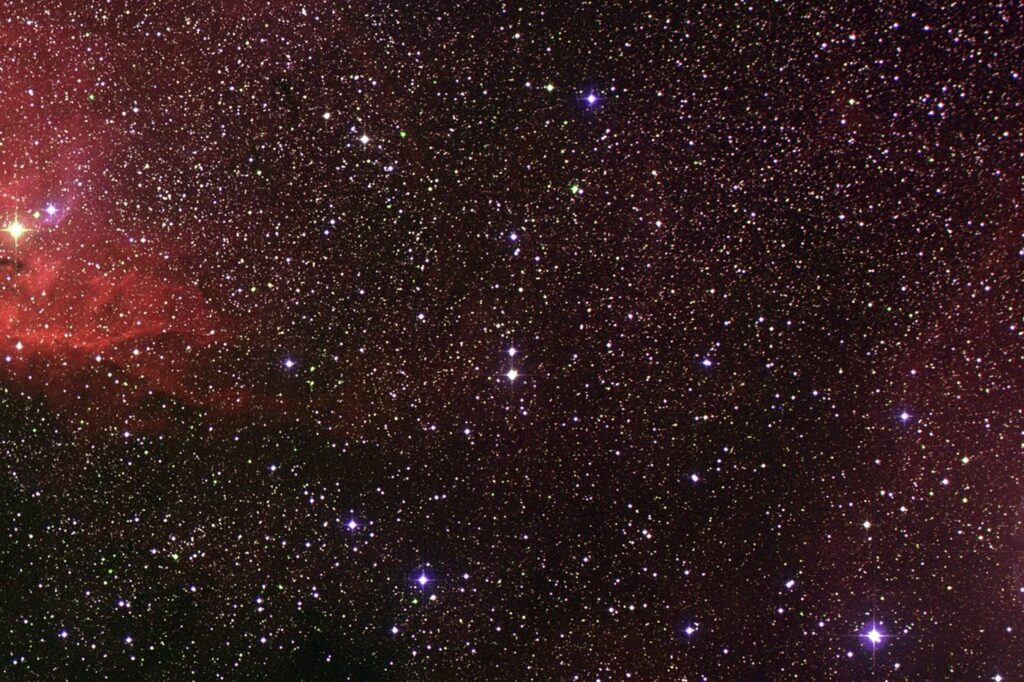
CAPE CANAVERAL, Fla. (AP) — In a groundbreaking study, scientists have successfully measured the instantaneous power of jets emitted from a black hole for the first time. An international research team reported that the jets from the relatively nearby black hole-star system known as Cygnus X-1 possess a power equivalent to 10,000 suns. Additionally, they measured the speed of these jets to be approximately 355 million mph (540 million kph), which is about half the speed of light.
Located 7,200 light-years away from Earth, Cygnus X-1 consists not only of a black hole but also a blue supergiant star that has been its companion for many years. This binary system was first identified over half a century ago and resides within the Milky Way's Cygnus constellation. A light-year, the distance that light travels in one year, is nearly 6 trillion miles (9.7 trillion kilometers).
The research was conducted by Steve Prabu from the University of Oxford and his team, who based their findings on 18 years’ worth of high-resolution radio imaging data obtained from a global network of telescopes. Although Prabu conducted this research while affiliated with Australia's Curtin University, the study was published in the journal Nature Astronomy. Through their analysis, Prabu and colleagues were able to measure what he referred to as the “dancing jets,” which are propelled in opposite directions due to the stellar wind emanating from the companion star.
Previously, the measurement of a black hole’s jet power had to be averaged over tens of thousands of years. This new capability of real-time measurement is a significant advancement. Prabu highlighted a key finding from their research: approximately 10% of the energy produced as matter is drawn towards the black hole is carried away by these powerful jets.
The black hole in Cygnus X-1 is considered relatively small for black holes. It continuously pulls gases from its stellar companion as they orbit around one another. Discovered in the 1960s, this binary system provides the black hole with material to “consume” and subsequently eject as jets. Prabu remarked that these jets could offer valuable insight into how black holes interact with and influence galaxies and other cosmic structures by inducing large-scale shocks and turbulence in their vicinity.
Looking ahead, Prabu expressed interest in applying similar measurement techniques to other black holes in the universe. “It would be exciting to measure jet power in many more systems,” he noted. This research not only enhances our understanding of Cygnus X-1 but also opens new avenues for studying black holes and their role in the cosmos.
___
The Associated Press Health and Science Department receives support from the Howard Hughes Medical Institute’s Department of Science Education and the Robert Wood Johnson Foundation. The AP is solely responsible for all content.
Marcia Dunn, The Associated Press








