

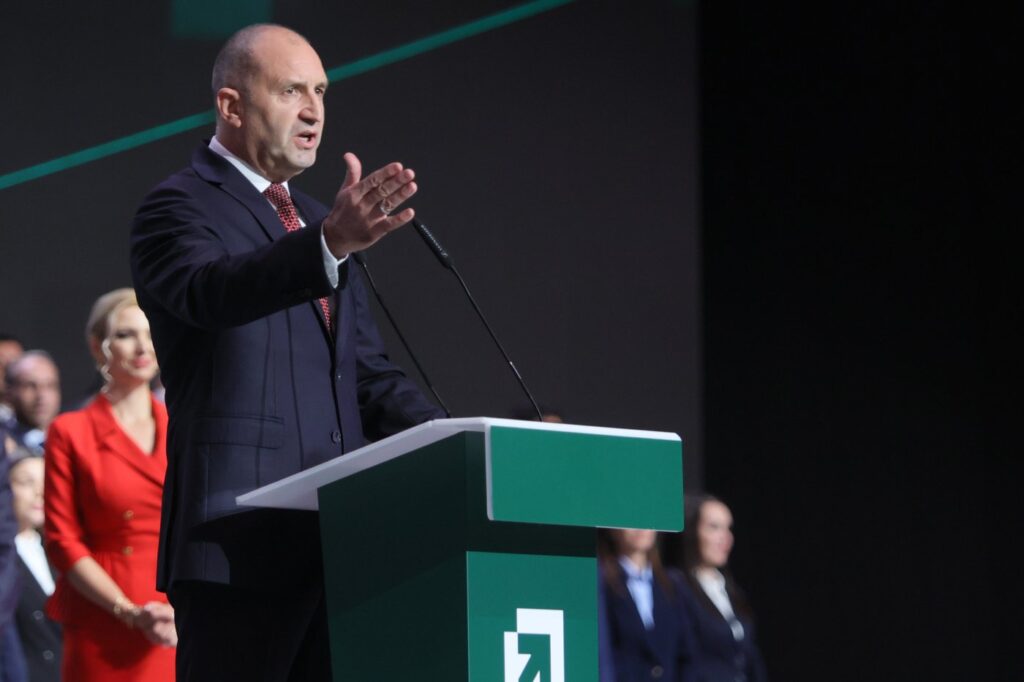
Bulgarians are set to participate in an early election on April 19 that could see the left-leaning former president Rumen Radev return to power. This election comes shortly after voters in Hungary opposed the authoritarian policies and far-right movement led by Viktor Orbán.
Rumen Radev’s newly formed coalition, known as Progressive Bulgaria, is anticipated to secure the majority of votes in the upcoming poll. Many voters are hopeful that a Radev victory will contribute to ending the ongoing issues of oligarchic corruption, while others support his Eurosceptic and pro-Russian stance. Radev resigned from the presidency—a largely ceremonial position—in January, just months before his second term concluded, to pursue the role of prime minister.
The 62-year-old ex-fighter pilot and air force commander is regarded as Bulgaria’s most popular politician and has promised a fresh start for the nation if his coalition wins the election. This snap vote follows the recent resignation of a conservative-led government, which was compelled to step down amid widespread anti-corruption protests that sparked nationwide demonstrations in December 2025.
Bulgaria, a member of the European Union and NATO with a population of approximately 6.5 million, joined the eurozone on January 1 this year, just as the country also entered the Schengen Area. However, the nation has experienced ongoing political instability since 2021, when three-time conservative Prime Minister Boyko Borissov resigned in the wake of significant protests against corruption. Since then, no government has successfully lasted more than a year, with protests and parliamentary compromises leading to seven inconclusive early elections in five years, causing growing distrust in state institutions, voter apathy, and decreasing election turnout.
In a bid to address these issues, Bulgaria recently requested help from the EU diplomatic service to counter Russian influence in public opinion via social media and propaganda outlets. This request was a response to expert warnings about active networks of Russian accounts that aim to create division among the populace.
Early opinion polls suggest that the turnout for the upcoming election could exceed 50%, significantly up from the average turnout of 35% in previous elections. This increase is attributed to the emergence of new political players and efforts by the interim government to boost public confidence ahead of the vote, which included nationwide police raids, arrests, and pretrial proceedings targeting vote-buying.
Polling indicates that Radev's coalition might secure over 30% of the vote, placing him nearly 10% ahead of Boyko Borissov, the leader of the center-right GERB party, whose government was ousted following the December protests. Most polls report a margin of error between 3% and 3.5%.
Radev has positioned himself as an adversary to the country’s entrenched mafia and its connections to high-ranking political figures. At his recent pre-election rally, he vowed to dismantle the corrupt, oligarchic model of governance. Although polls indicate Radev is likely to emerge victorious, he will require a coalition partner for a stable government. He has ruled out alliances with Borissov’s GERB party or the Movement for Rights and Freedoms, led by Delyan Peevski, who has faced corruption sanctions from both the United States and the United Kingdom.
A potential coalition partner could be the pro-Western bloc "We Continue the Change," which is projected to receive 12%-14% of the votes. However, significant foreign policy issues may hinder such cooperation. The ongoing controversy surrounding the Russian invasion of Ukraine complicates matters, as Radev has expressed opposition to military aid for Kyiv and advocated for reopening diplomatic discussions with Russia as a means to resolve the conflict.
Evelina Slavkova from the research center Trend has suggested that Radev is unlikely to seriously pivot Bulgaria towards Russia, citing the country’s successful navigation of its NATO and EU memberships amidst existing political challenges. While Radev has maintained a delicate balance between varying positions during the campaign, Slavkova emphasized that definitive stances will be essential once in power to guide the nation effectively.








