

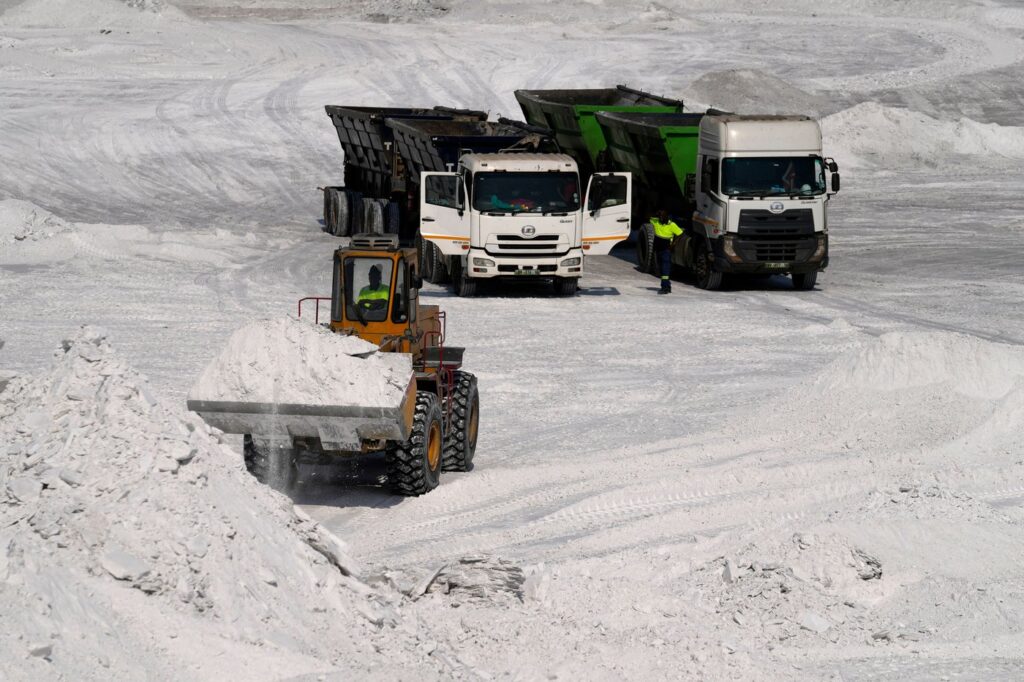
PHALABORWA, South Africa (AP) — An ambitious U.S.-backed initiative is under development at the Phalaborwa Rare Earths Project, centering on two significant sand-like dunes situated at an old chemical processing plant in South Africa. This exploratory project aims to extract rare earth elements (REEs) from industrial mining waste, tapping into an increasingly vital resource for modern technology.
With a substantial investment of $50 million from the U.S. government's International Development Finance Corporation (DFC), the project exemplifies heightened U.S. efforts to lessen dependence on China for critical minerals. These minerals are crucial for the manufacturing of electronic devices, robotics, defense systems, and electric vehicles. The emphasis on rare earth elements emerges from the growing acknowledgment of their importance in advanced technological applications.
Rare earth elements, numbering 17 in total, are categorized alongside other essential minerals such as copper, lithium, cobalt, and nickel, given their criticality in developing new technologies. Former President Donald Trump prioritized expanding U.S. access to these minerals to counter China's economic influence. In 2023, during the Trump administration, the U.S. committed nearly $12 billion to establish a strategic reserve of these critical minerals.
Despite the current diplomatic rift between the U.S. and South Africa—exacerbated by Trump's executive order in February 2023 to halt financial assistance—the DFC pressed ahead with the Phalaborwa project for strategic economic interests. The involvement of the DFC underscores the importance of unlocking Africa's mineral potential while aligning with U.S. priorities.
The project, developed by Rainbow Rare Earths, has no direct stake from the South African government. The DFC’s investment is facilitated through a partnership with TechMet, emphasizing the goal of securing critical mineral supplies for the West. Rainbow Rare Earths CEO George Bennett stated the company aims to predominantly supply the U.S., particularly for defense applications.
This venture seeks to extract several rare earth elements, including neodymium, praseodymium, dysprosium, and terbium, which are essential components in high-performance magnets used in various industries including wind energy, electric vehicles, and robotics. Operations are projected to commence in 2028, focusing on 35 million tons of phosphogypsum—an industrial byproduct from phosphate rock processing to produce fertilizers.
The operational lifespan of the project is estimated to be 16 years, with the DFC's financial input contingent upon the initiation of construction for the processing facility in early 2027. Although rare earths are relatively abundant, they are typically found in low concentrations, complicating the extraction process and making it economically challenging.
Neha Mukherjee, research manager at Benchmark Mineral Intelligence, indicated that while the Phalaborwa project employs an experimental above-ground extraction method, its success remains uncertain. She noted that the project appears to have a favorable cost structure compared to conventional mining operations, which is encouraging given the current demand for rare earth elements outside of China.
Rainbow Rare Earths promises that the mineral extraction process will utilize up to 90% renewable energy, marking a potential reduction in operational costs compared to traditional extraction methods. Alberto Bruttomesso, project director at Rainbow Rare Earths, highlighted that previous processes resulting in phosphogypsum involved significant energy consumption, particularly in heating, which adds to production costs.
The U.S. has been actively seeking to boost its domestic critical mineral mining while forging international partnerships to access resources abroad, including in Ukraine and Greenland. The Phalaborwa project stands as a key initiative among several DFC-backed mineral extraction projects across Africa. Mining analyst Patience Mususa emphasized the U.S. is aiming to close the investment gap in African mining, where China currently holds a dominant position.
In summary, the success of the Phalaborwa Rare Earths Project will be pivotal in addressing the global demand for rare earth elements, providing the U.S. with a strategic advantage while invigorating the mining sector in South Africa.








