

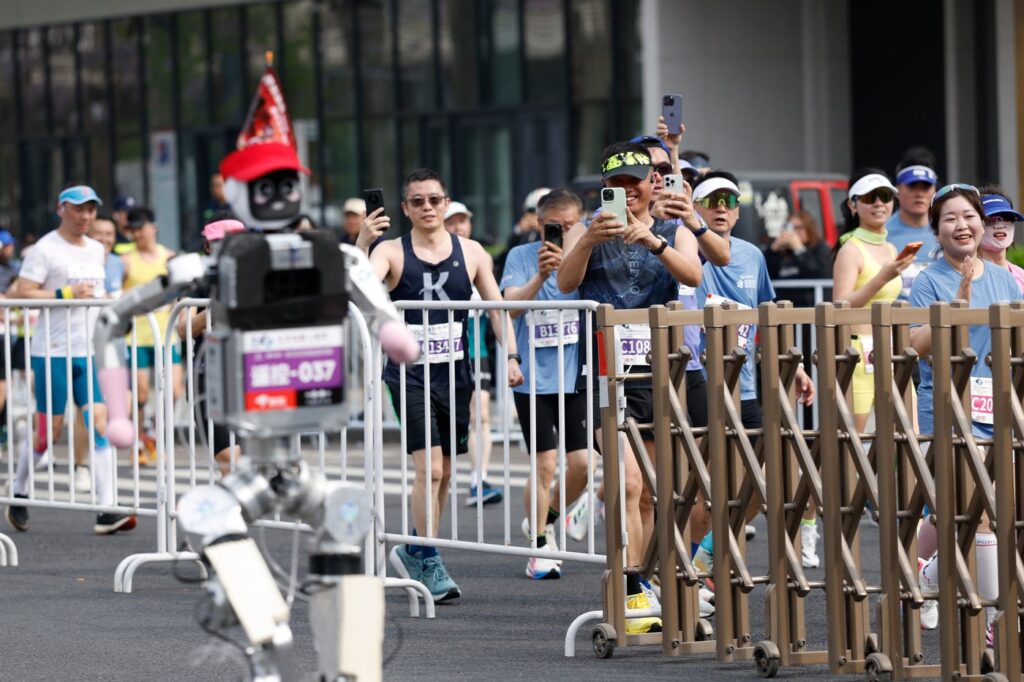
BEIJING (AP) — A humanoid robot from Honor, a Chinese smartphone manufacturer, made headlines by winning a half-marathon race for robots in Beijing on Sunday, April 19, 2026. The robot completed the 21-kilometer (13-mile) course in an impressive time of 50 minutes and 26 seconds, outperforming the human world record set by Uganda's Jacob Kiplimo, who finished a similar distance in approximately 57 minutes during the Lisbon road race in March.
This achievement highlights significant advancements in technology, particularly in robotics, in China. Last year's inaugural robot half-marathon saw the winning robot finish the race in a staggering 2 hours, 40 minutes, and 42 seconds, showcasing the rapid developments within the field over the past year.
However, the race was not without its challenges. Some robots faced technical difficulties, with one robot falling at the start line and another colliding with a barrier. According to the Beijing Economic-Technological Development Area (Beijing E-Town), around 40% of the robots were able to navigate the course autonomously, while the remainder was operated remotely.
State media outlet Global Times reported that a separate, remotely-controlled robot from Honor crossed the finish line first in a time of 48 minutes and 19 seconds. Nevertheless, it was the autonomous robot that was declared champion according to the event's weighted scoring rules. State broadcaster CCTV added that the runners-up, also from Honor and utilizing autonomous navigation, completed the course in roughly 51 and 53 minutes.
As the competition between technology sectors escalates, especially between the U.S. and China, advancements like these carry national security implications. The Chinese government's latest five-year plan emphasizes a strong focus on the frontiers of science and technology, with the development and application of humanoid robots being a key aspect of its 2026-2030 strategy in the world's second-largest economy.
Research and advisory group Omdia ranked three Chinese firms—AGIBOT, Unitree Robotics, and UBTech Robotics Corp.—as leading vendors in the global market for general-purpose embodied intelligent robots. Each of these companies shipped more than 1,000 units last year, with the first two surpassing 5,000 units, highlighting the rapid proliferation of robotics technology in China.
In conclusion, the successful performance of the humanoid robot in the half-marathon not only demonstrates China's growing capabilities in robotic technology but also exemplifies the implications of such advancements in the global technological landscape. The event showcased innovation, competition, and the potential for autonomous systems to perform complex tasks at high efficiency, paving the way for a future where robots are increasingly integrated into various aspects of life.








